
7 HockeyStack Alternatives Compared for 2026
Seven HockeyStack alternatives compared on trials, setup time, models and pricing, so you can check your own data before you sign anything.
Table of contents
HockeyStack's demo is one of the best in the category. The problem is that the demo isn't your data.
Several 2026 reviews describe the same arc: a strong sales process, a long onboarding, and reports that never matched Salesforce. If that worries you, the safest move is a tool you can test against your own CRM before you commit.
In this guide, I'll compare seven HockeyStack alternatives with that lens: how fast you can see real numbers, what it costs, and where each one falls short.
The test we ran
The question for every tool was simple: how quickly does it show numbers I can check against the CRM? I connected the ones with a trial or free plan, which included Dreamdata, Factors.ai, Cometly and Attribution App, to the same HubSpot portal. CaliberMind and Usermaven are sold through demos, so I relied on their product tours, documentation and teams I know who run them.
Plenty of the brands and agencies we work with have evaluated HockeyStack, and their questions set the criteria, along with reviews on G2 and Capterra. I compared:
- Whether you can try it on your own data first
- Time from signup to a first trustworthy report
- Attribution models and account features
- Pricing and contract terms
We make SourceLoop, and we held it to the same questions. Its section says plainly where HockeyStack does more.
Last checked November 2026. Confirm current pricing with each vendor.
What HockeyStack does well, and where buyers get stuck
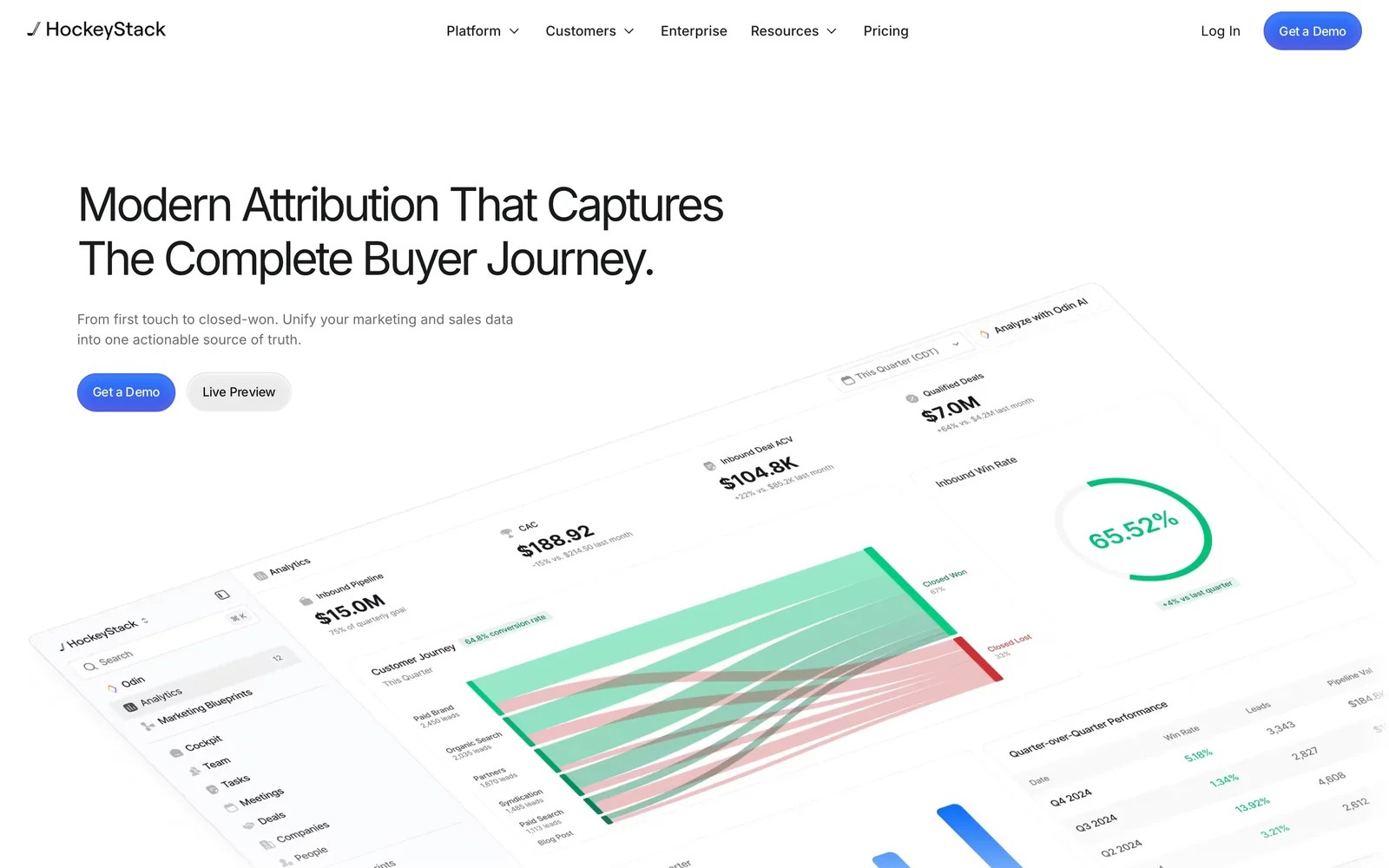
HockeyStack unifies CRM, ad, website and product data, then adds AI agents for analysis and sales. Its journey views and instant model switching are genuinely good, and teams with clean data love them.
"HockeyStack allows us to follow journeys in a more complex way than our previous method, which is especially valuable with paid ads to see how they influence our funnel." (Source)
The risk sits in implementation. With quoted, annual pricing and no trial, you find out whether your data connects after you've signed:
"The onboarding process became a sunk cost." (Source)
"Data was constantly incorrect in HockeyStack compared to our Salesforce instance and the sync/load times were incredibly slow." (Source)
HockeyStack alternatives compared
Here's how the 7 HockeyStack alternatives compare on how you can start, setup and pricing, as of November 2026.
| Tool | Best for | Try before buying | Typical setup | Account features | Pricing |
|---|---|---|---|---|---|
 SourceLoop | Lead-gen businesses, agencies, SaaS | 7-day trial | Same day | Company journeys | From $49/mo |
 Dreamdata | B2B SaaS running ABM | Free plan | Days, guided on paid | Yes | Free, paid quoted |
 Factors.ai | ABM on LinkedIn and Google | Trial | Days | Yes | From $199/mo |
 Cometly | Paid-heavy B2B SaaS | Self-serve start | Days | Account journeys | Usage-based |
 CaliberMind | Enterprises with RevOps | No | Weeks | Yes | Quote |
 Attribution App | Auditable SaaS attribution | 14-day trial | Days to weeks | Partly | From $399/mo |
 Usermaven | SaaS wanting product analytics too | Demo | Days | No | Quote |
The 7 best HockeyStack alternatives
Each section starts with who it's for, then what it's actually like to use.
1. SourceLoop
Best for: lead generation businesses, agencies and SaaS teams that want attribution to pipeline and revenue, checked against their own CRM before paying for a year.
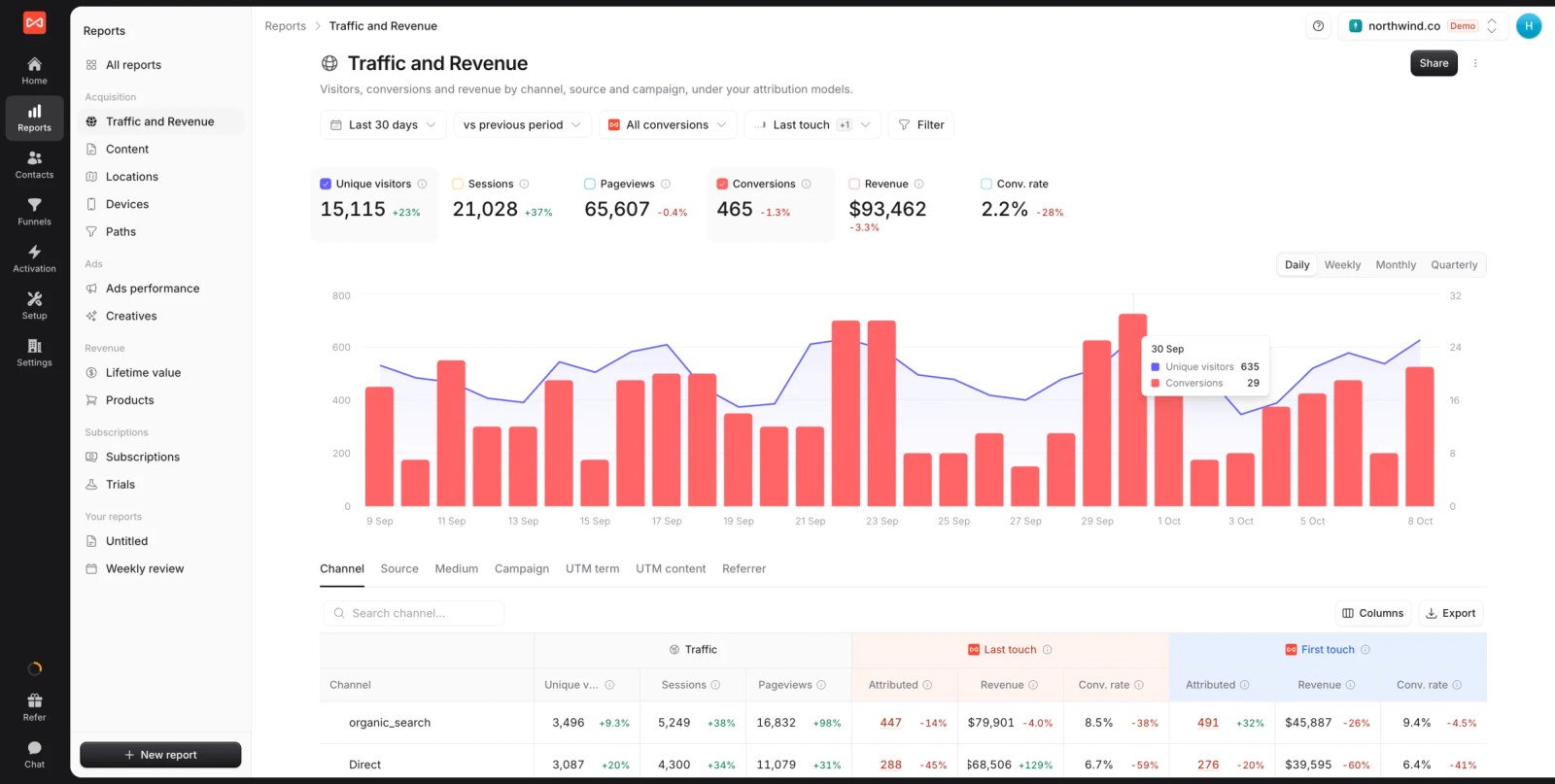
SourceLoop is a first-party marketing attribution and measurement tool. One script records every visit and its source, then each lead from a form, call, chat or booking is followed into HubSpot, Salesforce, Pipedrive or Jobber, and stages, deals and revenue are credited back to campaigns.
It's built to be checked. Every number drills down to the people behind it, and the seven models are published rules, so if a report doesn't match your CRM you can see exactly why.
Key features
- Seven published models: first and last touch, first and last non-direct, linear, U-shaped and time decay, switchable on any report.
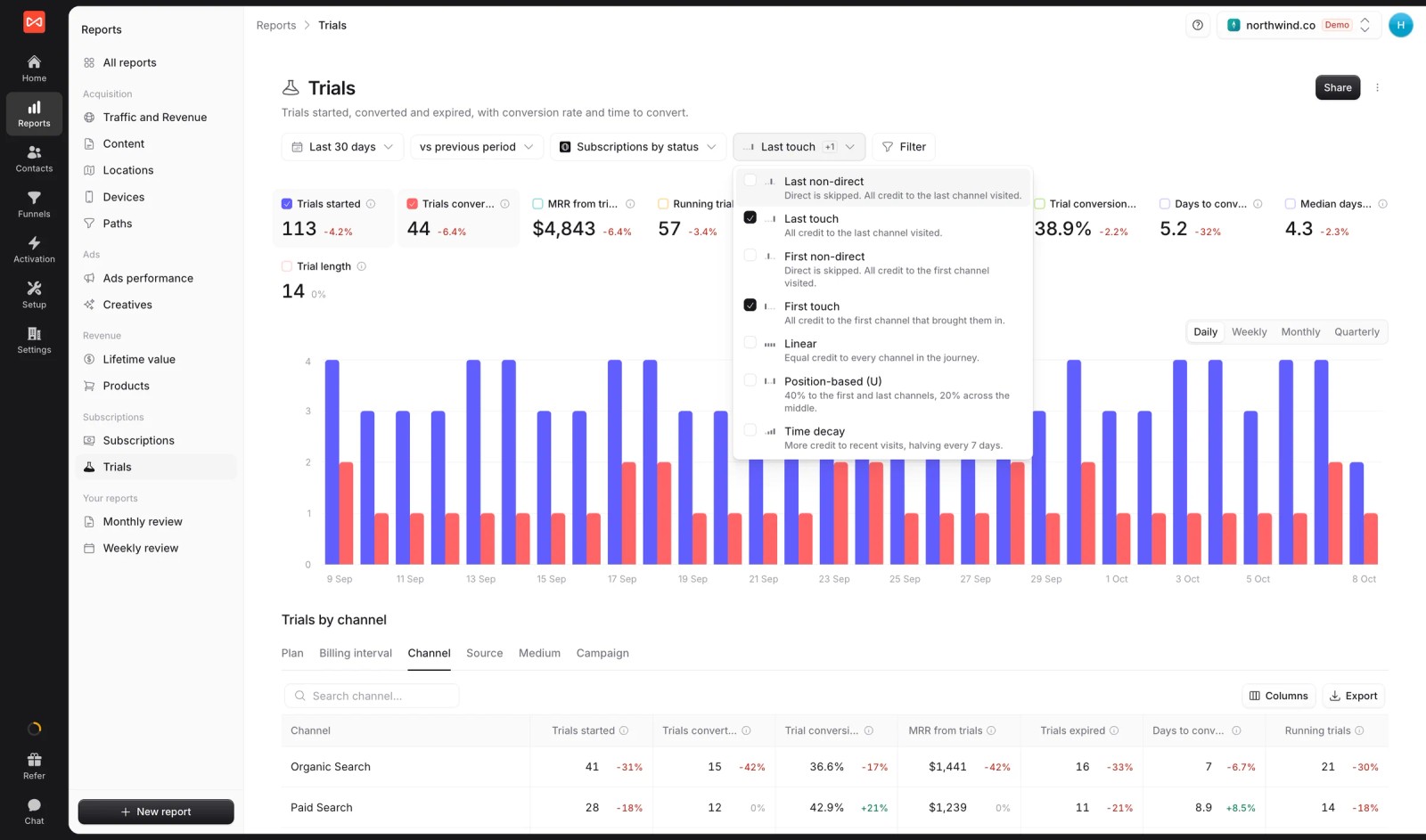
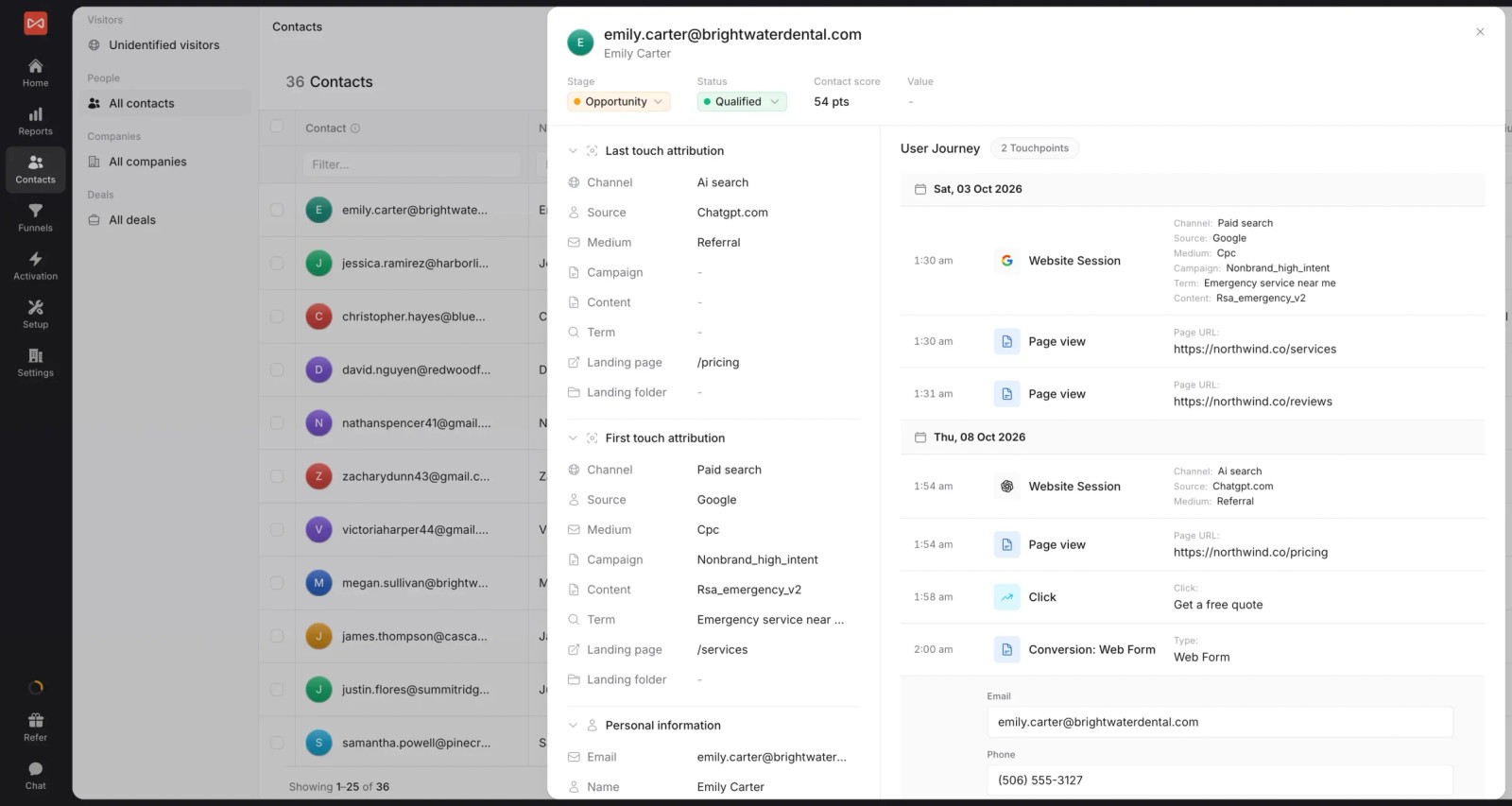
- Journey on every lead: each visit, ad click and landing page before the conversion, plus company journeys that group colleagues by email domain and CRM company.
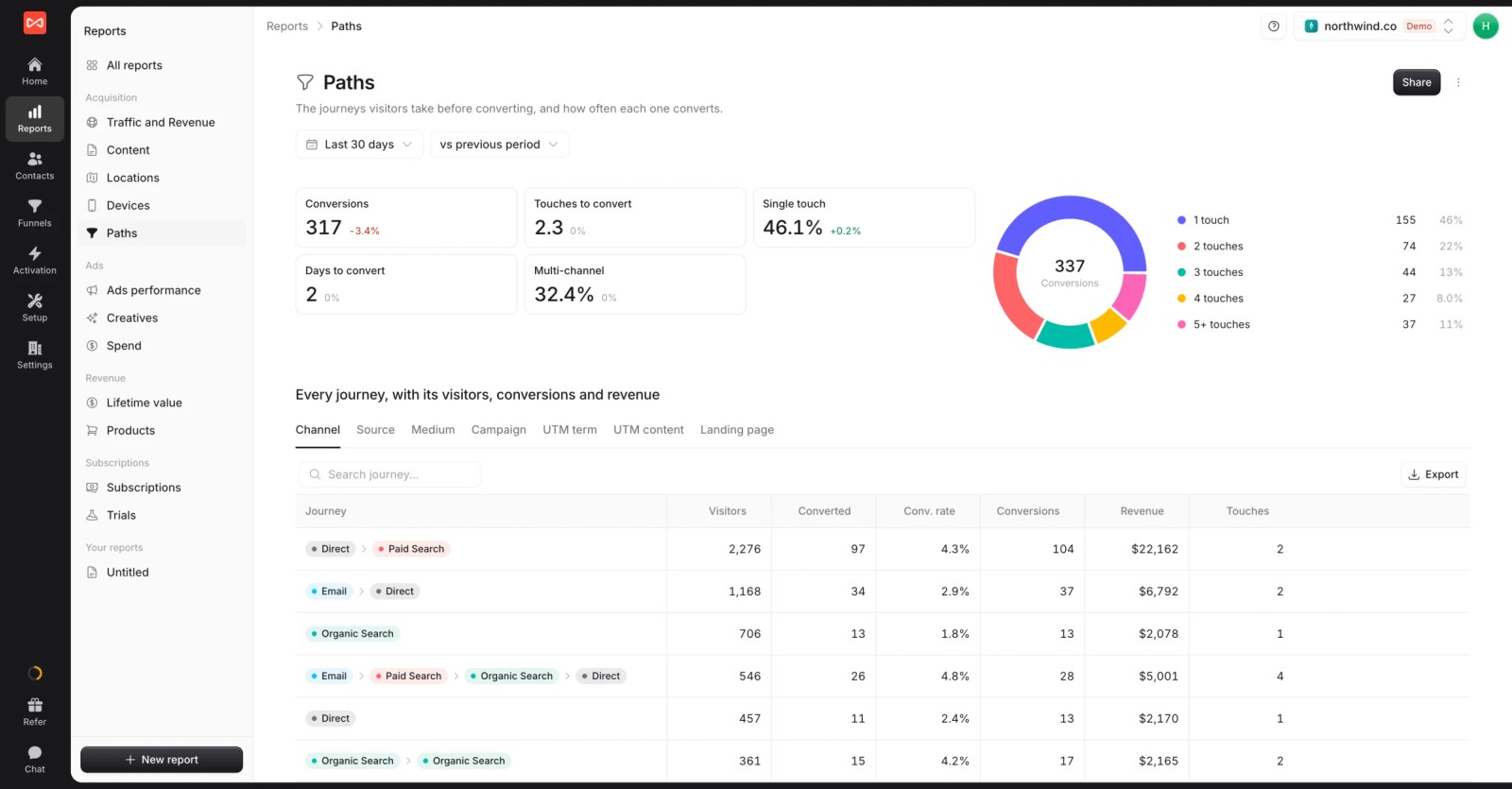
- Conversion paths: the channel sequences behind conversions, with touches and days to convert.
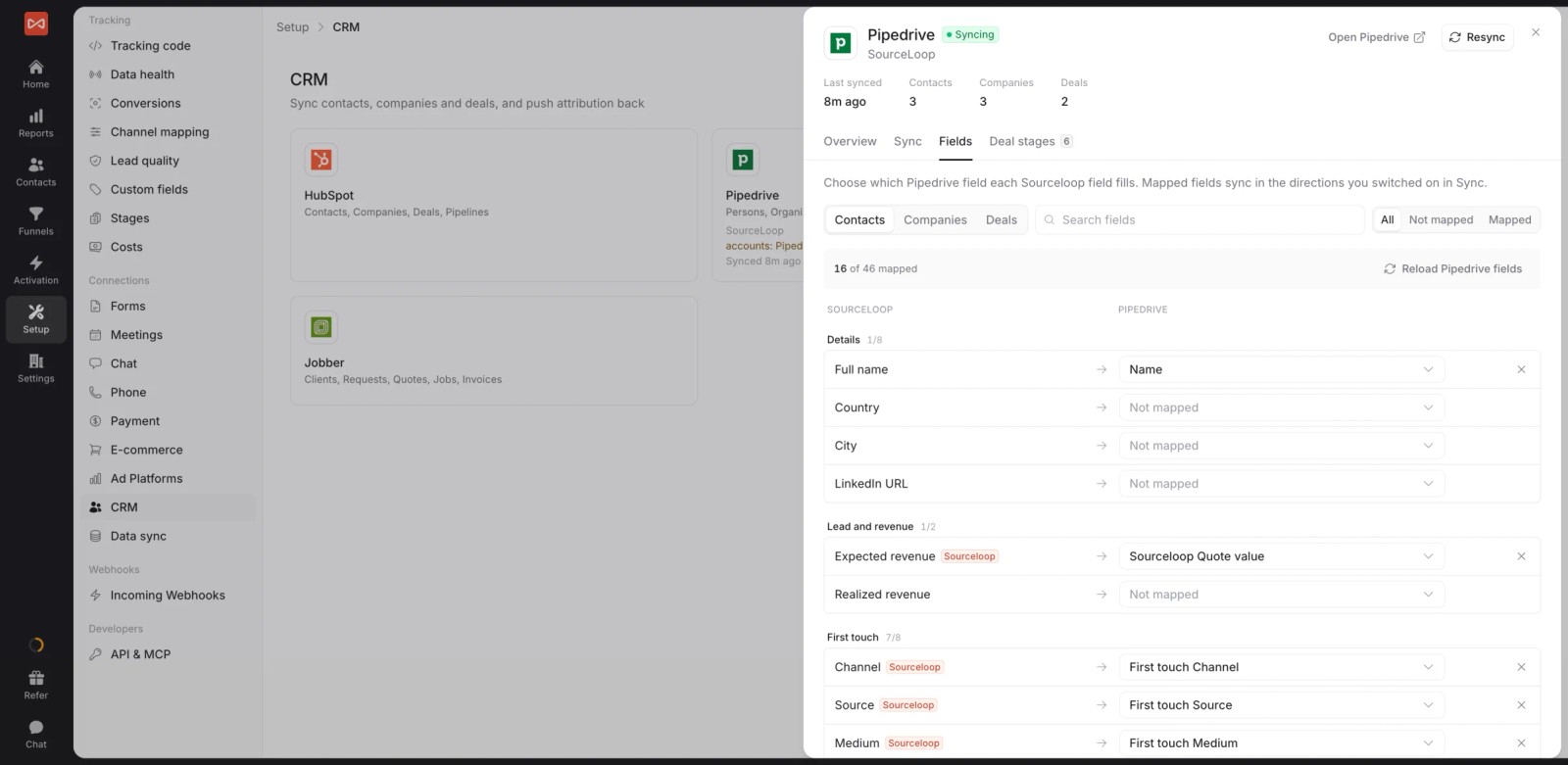
- Two-way CRM sync: attribution fields written to each record, stages and won deals read back.
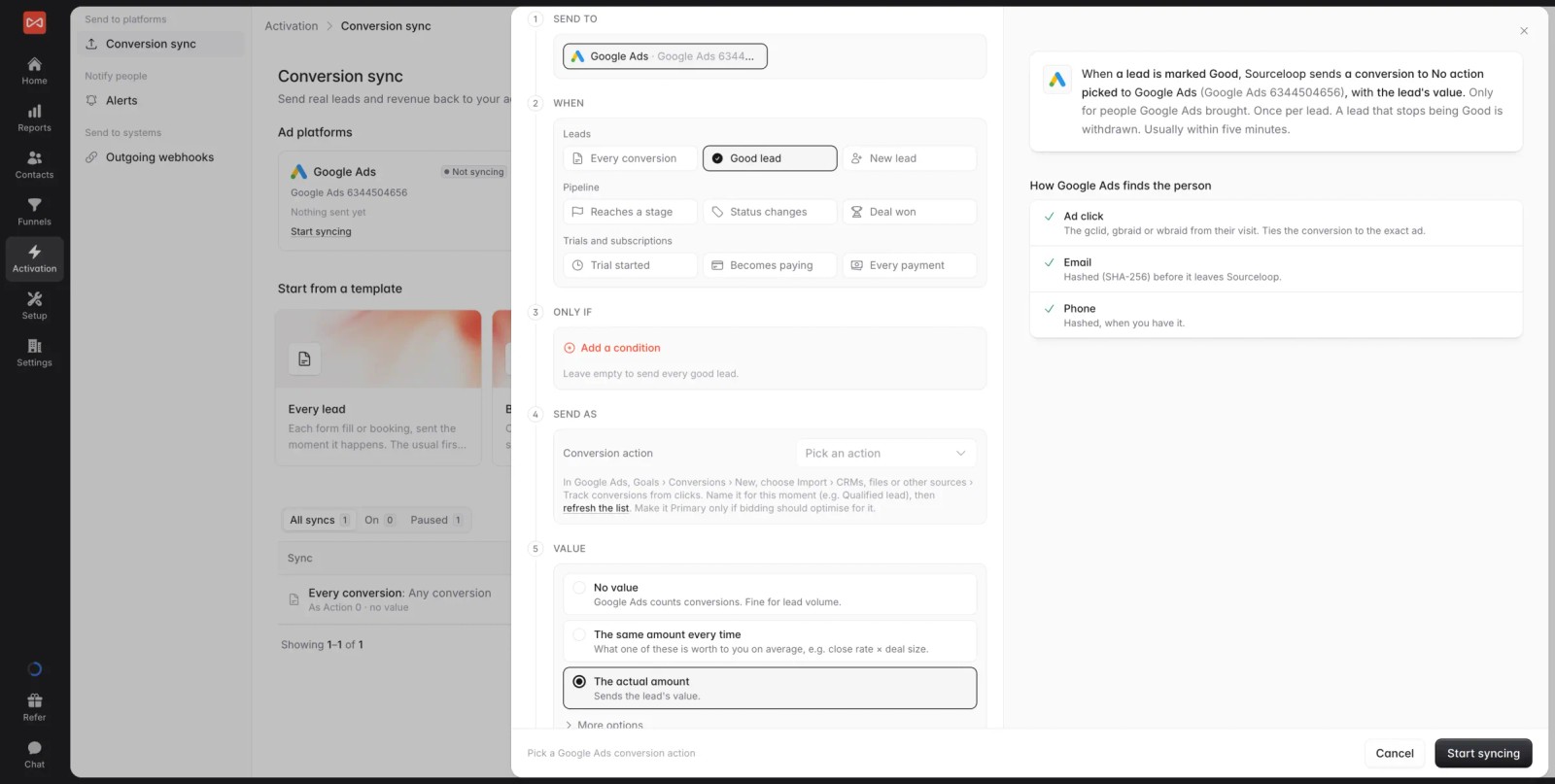
- Conversion sync: good leads and won deals go to Google Ads, Meta, Microsoft Ads and ChatGPT Ads with their value.
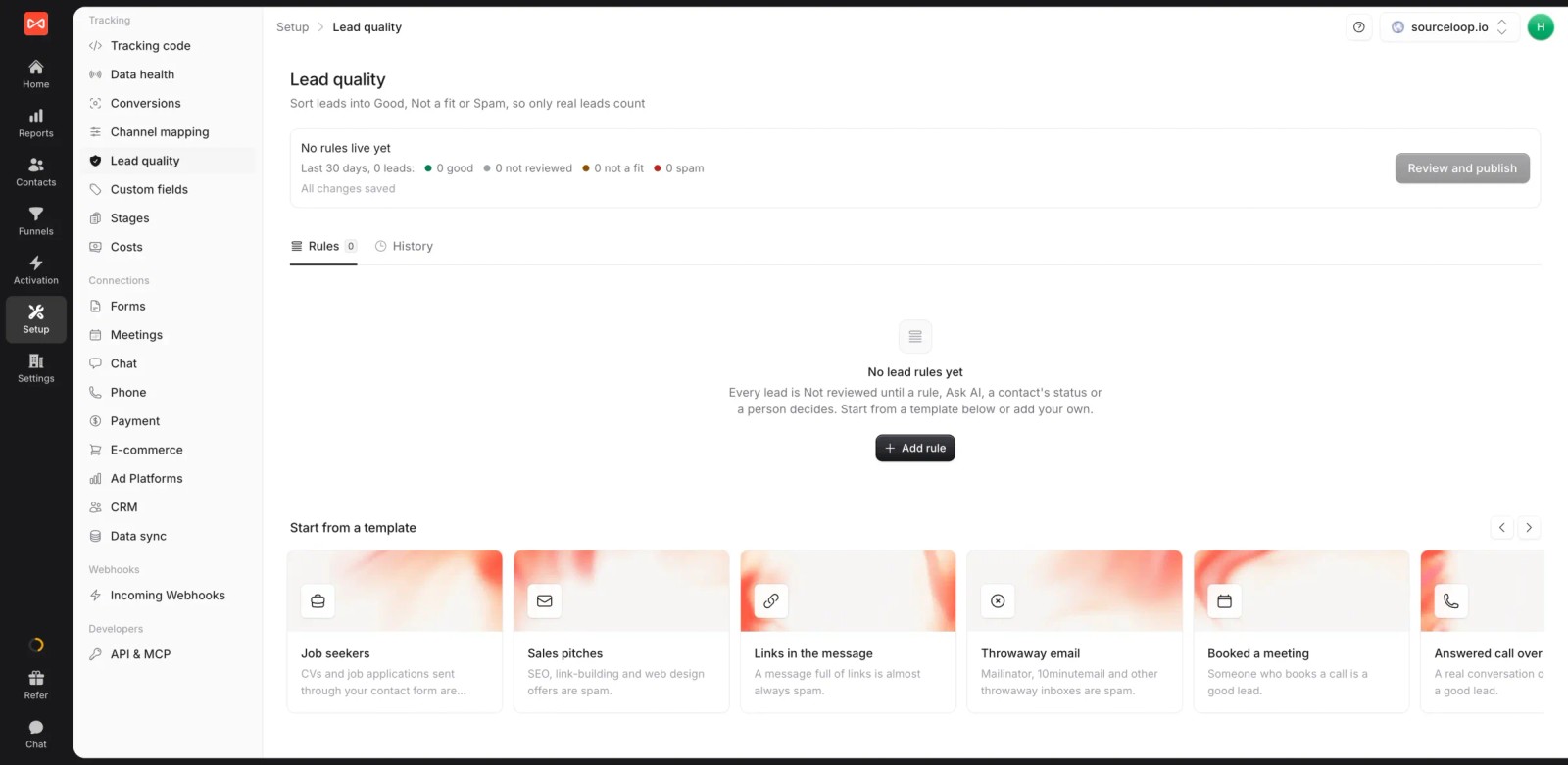
- Lead quality rules: filter out junk with templates for job seekers, throwaway emails and booked meetings, so pipeline numbers hold up in a review.
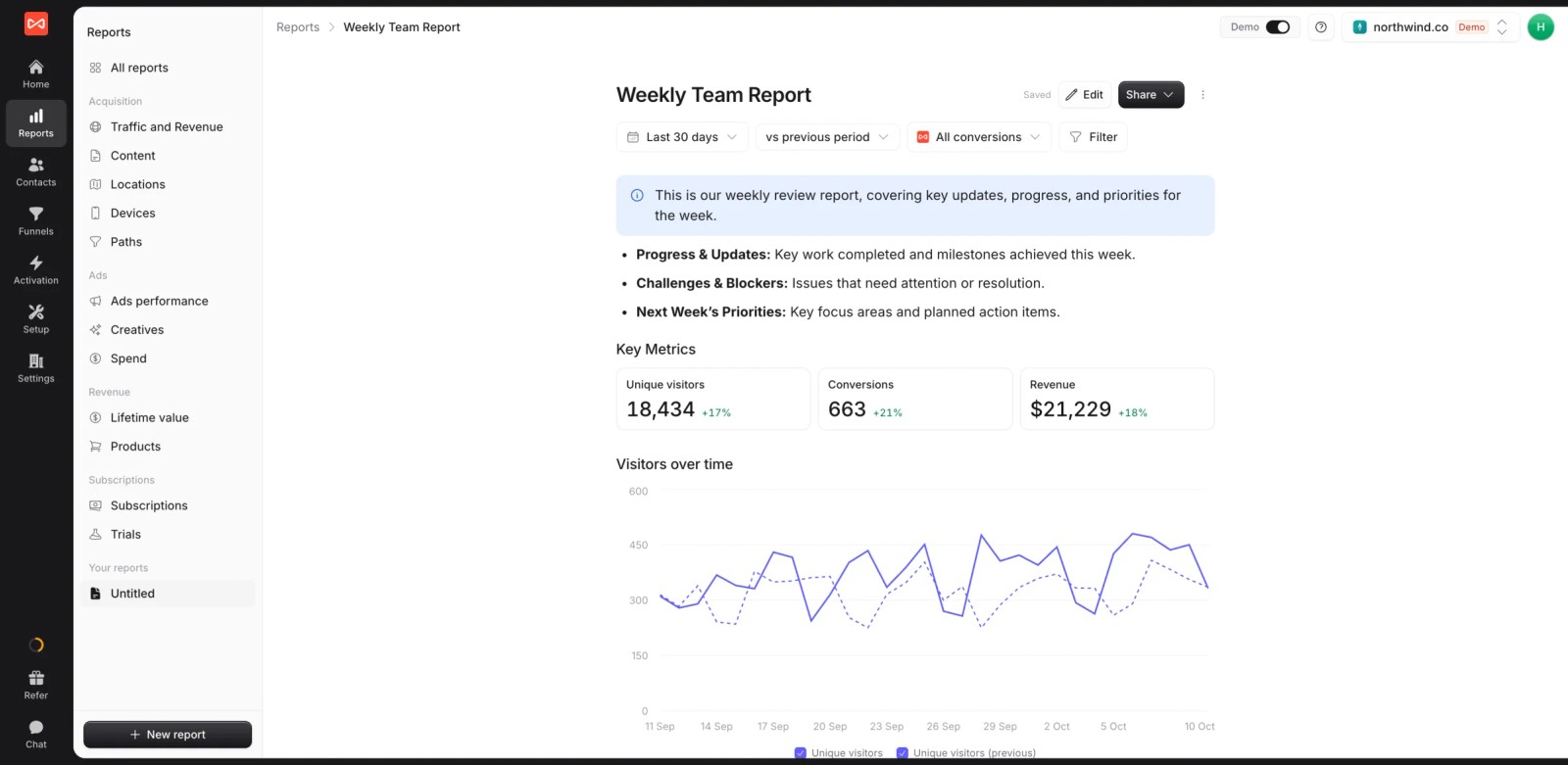
- Alerts and custom reports: post new opportunities to Slack, and share live reports that leadership can open any time.
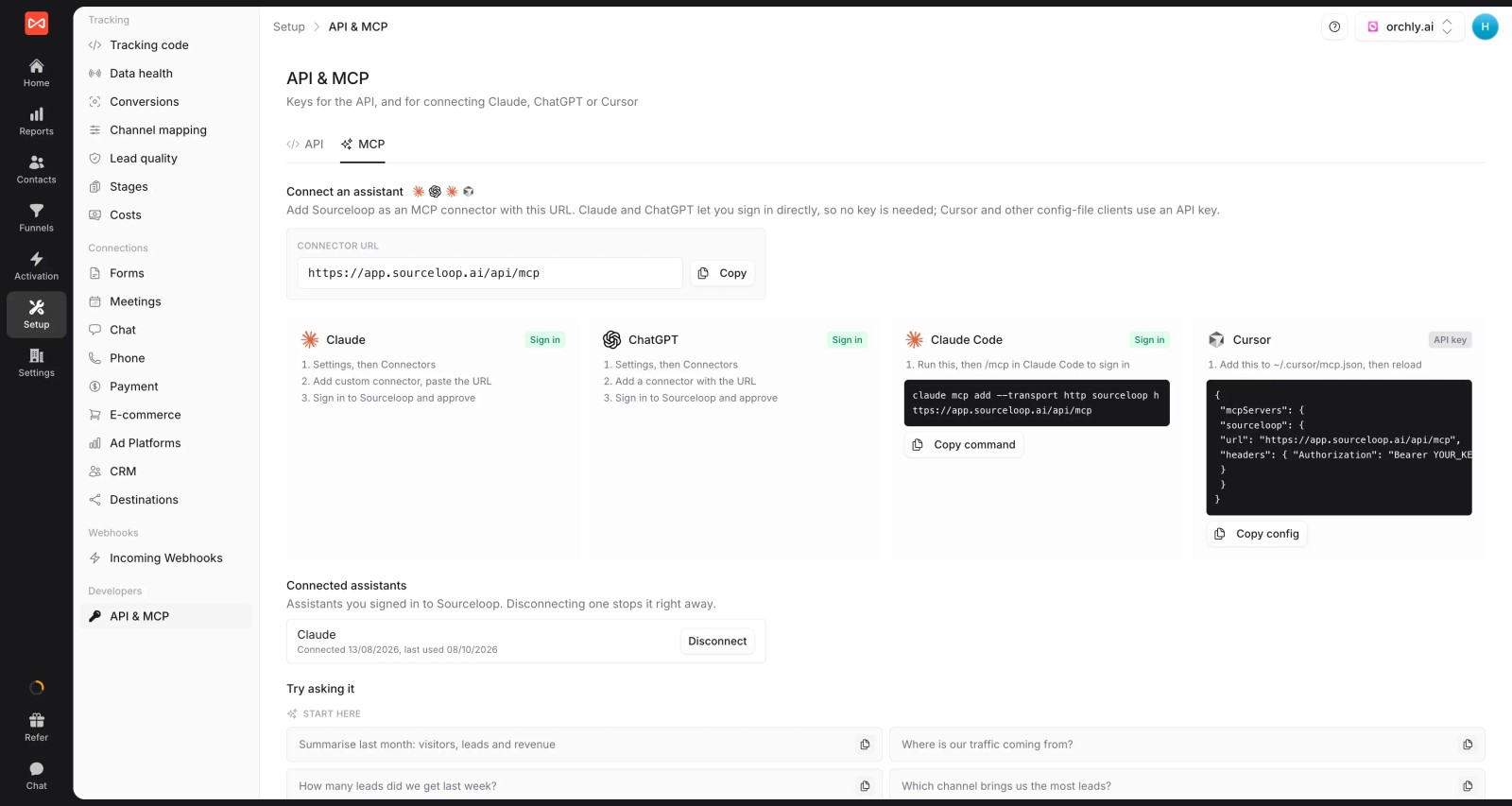
- API and MCP server (Professional and up): ask an AI assistant about attribution and deals, or have it build a report.
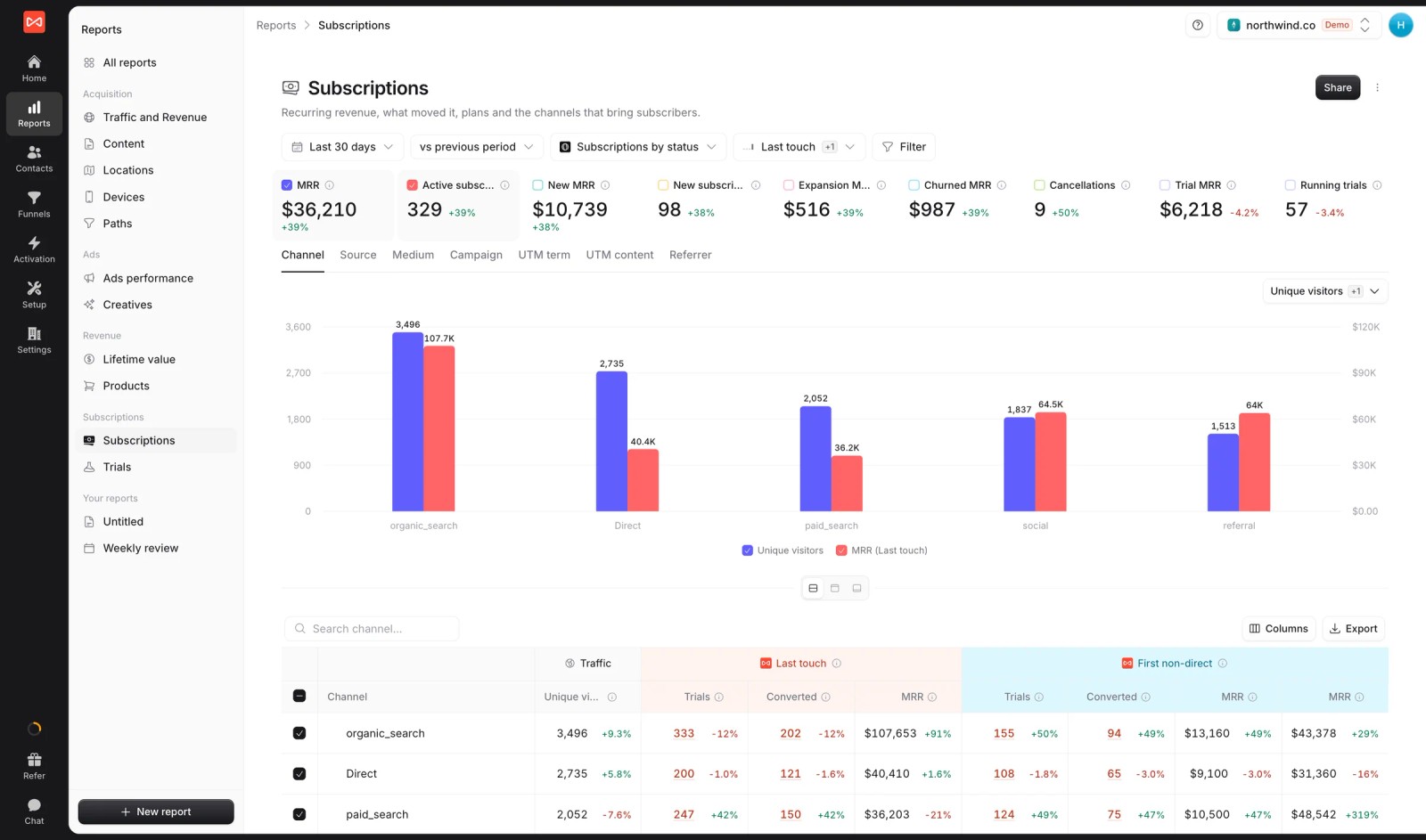
- Payments and subscriptions: Stripe, Paddle and other billing tools for SaaS revenue, MRR and LTV by channel.
Where it falls short
- No IP-based company identification, intent data or product usage analytics, all of which HockeyStack offers.
- No custom or W-shaped models. If your board wants a bespoke model, look at CaliberMind.
Pricing
- Essential: $49/mo for one site and 30,000 page views, with tracking, attribution reports, lead quality rules and alerts
- Professional: $99/mo for 100,000 page views and unlimited users, adding CRM sync, conversion sync to the ad platforms, the API and MCP
- Agency: $249/mo for three sites and 1.5 million page views, adding white label reporting
- Unlimited conversions, 7-day trial, monthly billing available.
Verdict: the lowest-risk way to get lead and deal attribution you can verify yourself. Pick an account platform if anonymous company research is central to your reporting.
2. Dreamdata
Best for: B2B SaaS companies with long, multi-person sales cycles that want to start free.
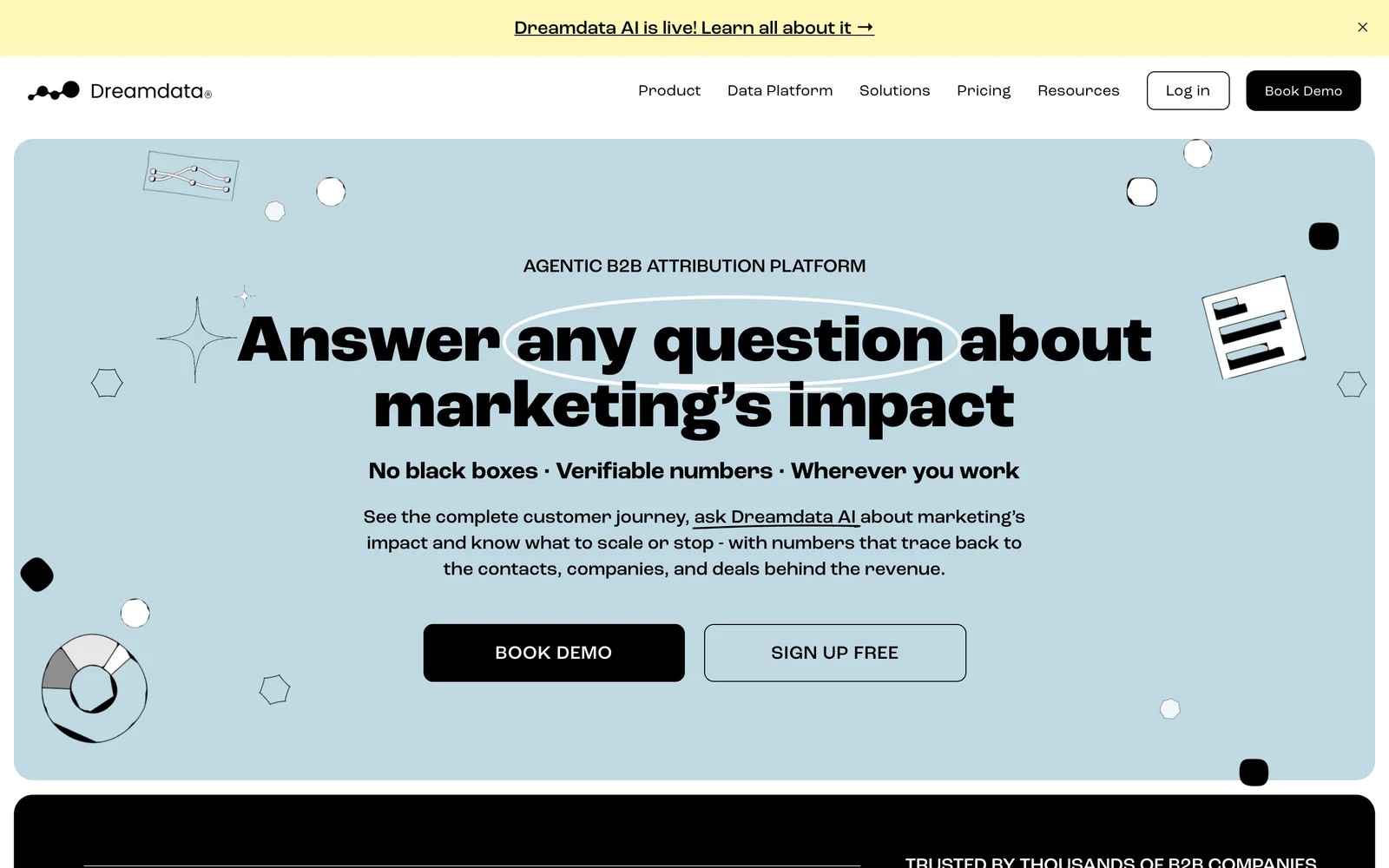
Dreamdata builds a company timeline from every contact's activity and credits CRM stages to the channels and accounts that moved a deal. It identifies visiting companies and has an AI agent and an MCP server.
I've used Dreamdata on the free plan, and of everything here it's the closest to HockeyStack in spirit. The difference is that you can connect HubSpot or Salesforce and see your own company journeys before anyone sends a contract.
The first week felt good. Seeing five people from one account, their ad views and their meetings in a single timeline made a long deal easy to explain to sales.
The harder part came later. There are many ways to slice the same data, and it took a while before I trusted which report answered which question. Full attribution also lives on custom-priced plans, so the free tier is a preview, not the whole product.
Key features
- Every contact at a company is joined into one timeline, showing ads, pages, meetings and CRM activity in order.
- Revenue is credited across CRM stages, from MQL through opportunity to closed-won, by channel and account.
- Anonymous visits are matched to companies, so early research is visible before anyone fills in a form.
- An AI agent and an MCP server let you query the data from your own assistant or workflow.
Where it falls short
- Full attribution sits on custom-priced plans, so the real cost only appears after a sales conversation.
- Reports update live with no way to freeze a dataset, which complicates month-end and board reporting.
- It doesn't attribute phone calls, so deals that start on a sales call are harder to credit.
What users say
"Easy integrations, self-service settings you can modify to fit the company's needs, easy-to-set-up custom reports, attribution modeling, and journey reports are amazing if you want to deep-dive into specific accounts, a great tool to share with the sales team." (Source)
"the reporting can sometimes be confusing because it’s real-time, and there isn’t a way to lock in or “stamp” a specific dataset at a given point in time." (Source)
Pricing
- Free: $0/mo with 2 months of history and 5 seats
- Attribution and Activation: custom pricing
3. Factors.ai
Best for: account-based teams that want company identification and LinkedIn activation alongside attribution.
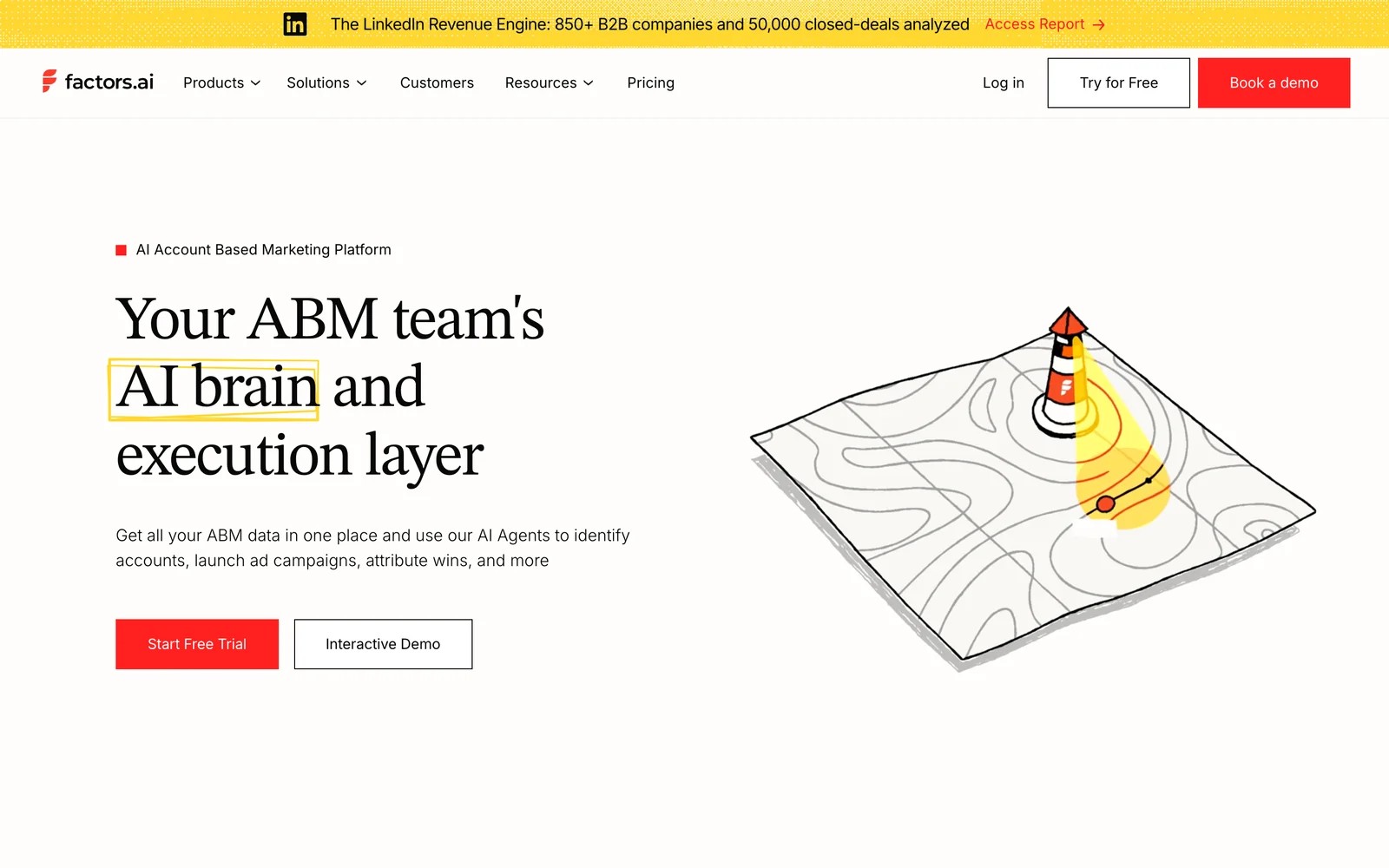
Factors.ai matches visitors to companies, scores their engagement, and ties account activity to CRM deals. It also builds LinkedIn and Google audiences from engaged accounts.
During the trial, the speed of the first insight stood out. Within a day of adding the script, I had a list of named companies browsing pricing and case study pages, which is a very different feeling from waiting weeks for HockeyStack's onboarding.
Account timelines are well done, with every person and touch laid out in order. Where I slowed down was the interface beyond the defaults, which takes some learning, and the share of traffic from smaller companies that never matched.
Key features
- Visiting companies are identified from IP data, so account research appears before any form is submitted.
- Account timelines show every person and touch in sequence, which helps sales see how an account warmed up.
- Account-level attribution ties engagement to HubSpot and Salesforce deals for pipeline reporting by channel.
- LinkedIn and Google Ads audiences can be built from engaged accounts, with spend tracked against them.
Where it falls short
- Smaller companies often go unmatched, which leaves gaps for teams selling to small and mid-sized businesses.
- Pricing climbs with usage and identified accounts, so costs can grow faster than the marketing budget.
- There's no call tracking, so phone-led deals need a separate tool to be attributed.
See our Factors.ai alternatives if the account focus is more than you need.
What users say
"Factors shows us which companies are visiting our website and what they're looking at, before they ever fill out a form." (Source)
"We’re also experiencing some delays with the HubSpot-to-Factors sync" (Source)
"The UI takes longer to learn than it should." (Source)
Pricing
- Lite: $199/mo
- Basic and Growth: $6,000 and $20,000 a year
- Enterprise: from $30,000 a year. Free trial available.
4. Cometly
Best for: B2B SaaS teams spending heavily on Meta and Google that want ad-level revenue and conversion sync.
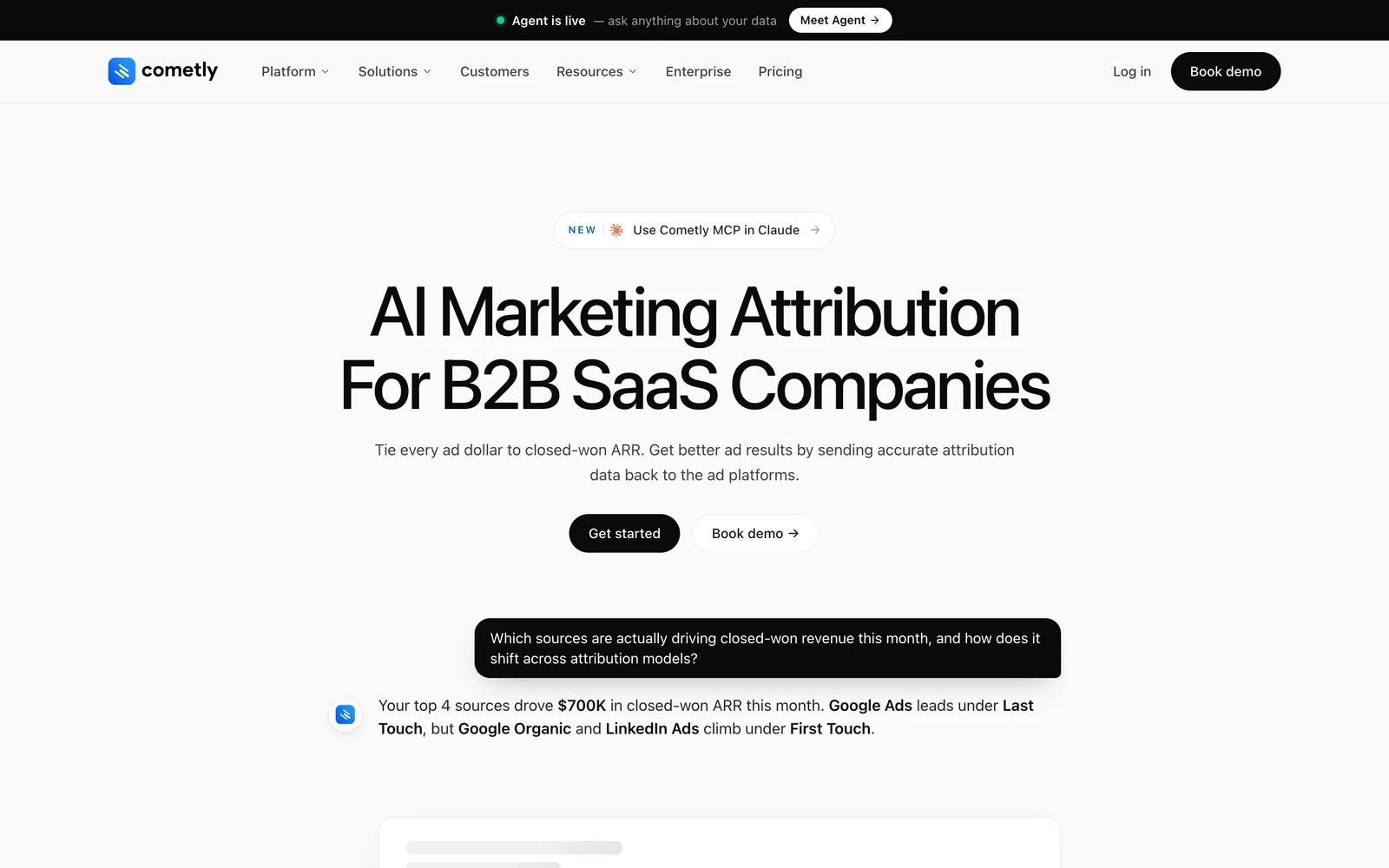
Cometly tracks ad clicks with a first-party pixel, follows leads to closed-won in the CRM, and sends conversions back through the ad platforms' conversion APIs. It now positions itself squarely for B2B SaaS.
I've tested Cometly myself. Connecting the pixel and the Meta and Google accounts was quick, and seeing revenue by ad next to what Ads Manager claimed was the most useful view in the first week.
It's narrower than HockeyStack. It's centered on paid acquisition, so organic, content and events get less attention, and getting pipeline data right took more configuration than the setup screens suggest.
Key features
- A first-party pixel and server-side tracking capture ad clicks that browser-only tracking tends to lose.
- Leads are followed through to pipeline and closed-won revenue in the CRM, credited to the ad that started them.
- Conversions, including offline sales, are sent back to Meta and Google through their conversion APIs.
- An AI agent and an MCP server answer questions about ad performance in plain language.
Where it falls short
- It's built around paid ads, so content, events and organic programs get thinner reporting than in HockeyStack.
- Prices aren't shown on the pricing page, which makes it hard to budget before a conversation.
- There's no call tracking for B2B teams whose demos are often booked by phone.
What users say
"Cometly marries sales and marketing data into one platform and feeds it back to your ad channels for optimization so you can make data driven decision right from your Ad Accounts." (Source)
"Documentation is out of sync with the actual application" (Source)
Pricing
- Usage-based Core plan and a quoted Enterprise plan. See our Cometly alternatives.
5. CaliberMind
Best for: enterprise B2B teams that want custom attribution models and mix modeling, with RevOps to run them.
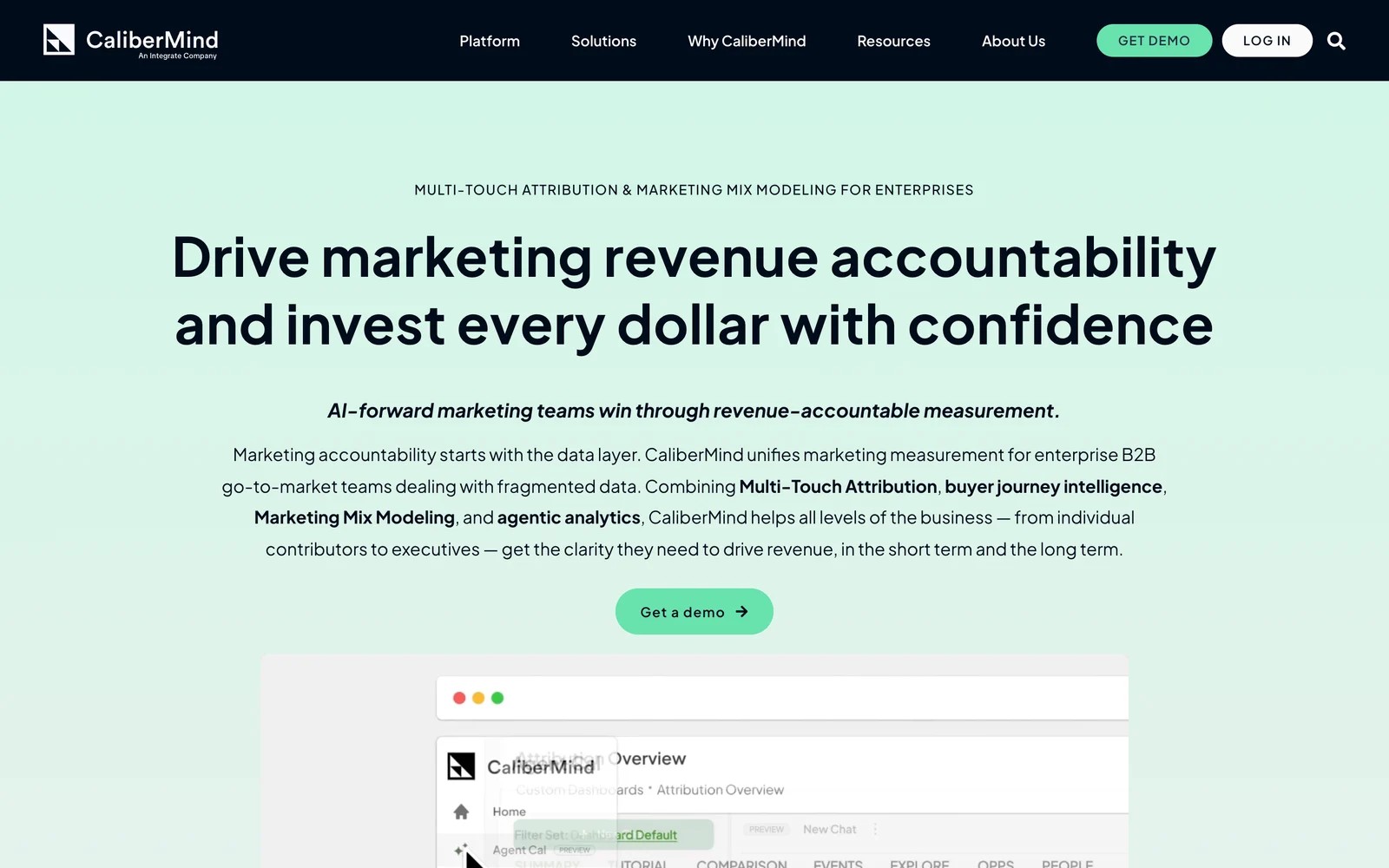
CaliberMind sits on its own data warehouse and combines multi-touch attribution, marketing mix modeling and AI analytics. It belongs to Integrate now.
If what you liked about HockeyStack was the ambition, CaliberMind matches it. The product tour shows custom models built around your funnel, account-level journeys and executive views, all priced by data volume.
The teams I know who run it say it rewards investment. The flip side is the same as HockeyStack's: it's only as good as the CRM data you give it, and it takes a dedicated owner to keep it accurate.
Key features
- Custom attribution models can be designed around your own sales motion, not just standard rule-based options.
- Marketing mix modeling runs alongside multi-touch attribution to cover offline and brand spend.
- Account funnels and journey summaries show how buying groups progress from engagement to revenue.
- Pricing by data volume means the whole revenue team can log in without per-seat charges.
Where it falls short
- It needs a RevOps owner and clean CRM data, which many mid-sized teams don't have in place.
- There's no trial, so like HockeyStack you learn whether your data fits after the contract starts.
- New users describe a steep learning curve and outdated help materials.
What users say
"We're able to quickly see performance by channel and see the direct impact to revenue." (Source)
"It's a steep learning curve, and outdated materials cause confusion for new users." (Source)
Pricing
- Quoted after a guided scoping process.
6. Attribution App
Best for: SaaS teams that want click-level attribution they can audit customer by customer.
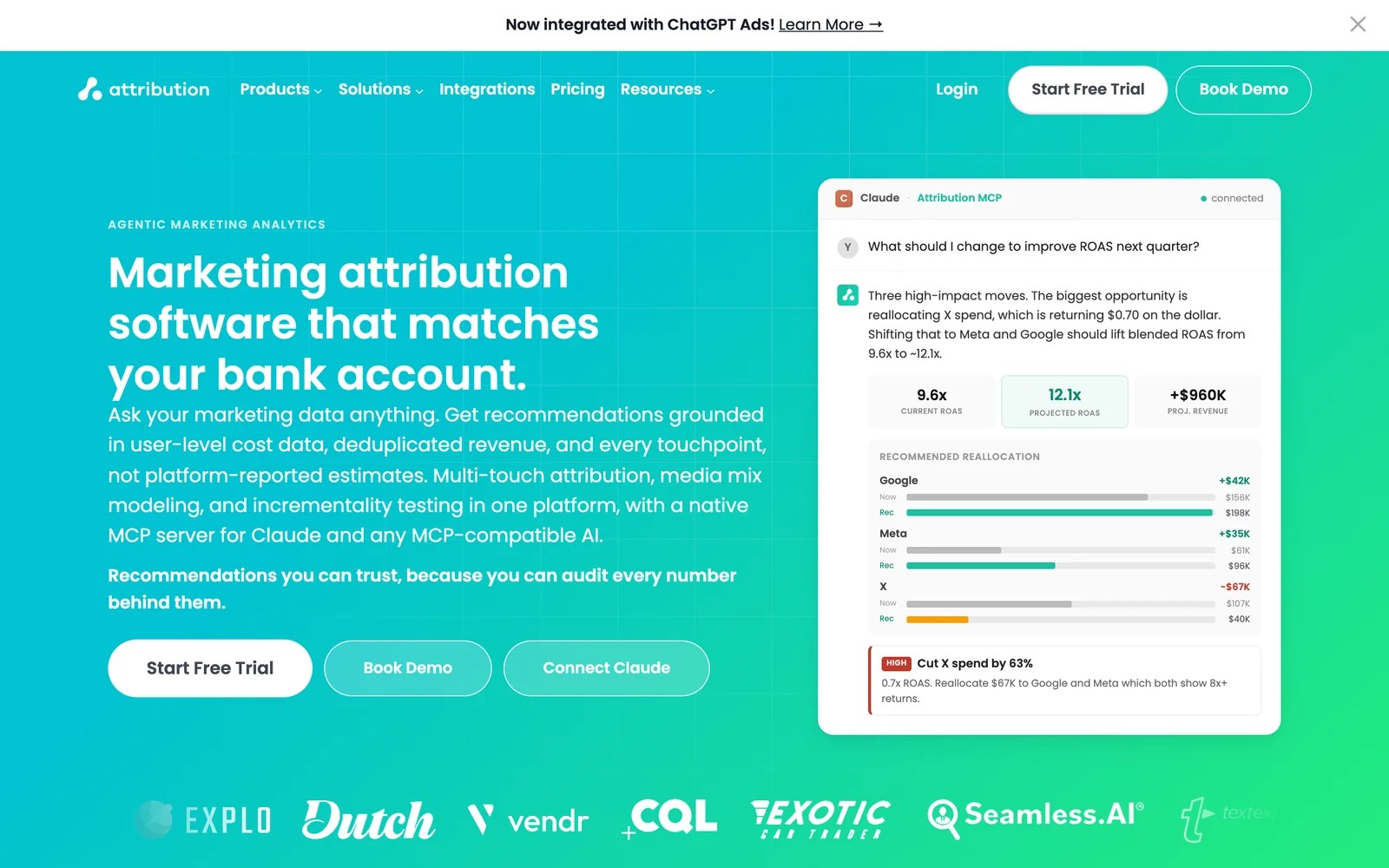
Attribution App is deterministic: every conversion traces to a documented click, and ad spend is imported to the ad. It reads revenue from Stripe and the main CRMs, and it now adds media mix modeling, incrementality testing and an MCP server.
What I liked on the trial was the honesty of the numbers. Click a channel, then a campaign, and you see the customers behind it. There's no modeled layer to argue about.
It asked more of me up front than I expected. Getting Segment, Stripe and the CRM talking took some coordination, and attribution only starts from install, so early reports were sparse.
Key features
- Every conversion is tied to a documented click, with configurable models and lookback windows.
- Revenue comes from Stripe, HubSpot or Salesforce, which fits subscription SaaS well.
- Ad costs are imported to the individual ad, so ROAS by campaign is calculated automatically.
- Media mix modeling, incrementality testing and an MCP server extend the core attribution.
Where it falls short
- It doesn't track calls, which leaves a gap for sales-led B2B teams.
- There's no historical backfill, so you start with an empty reporting window.
- Attribution stays inside the app, with nothing written back to CRM contacts for sales reps.
What users say
"Automated integration to pull cost data from ad partners." (Source)
"Their documentation is lacking and should be updated." (Source)
Pricing
- Pro: $399/mo ($335 billed yearly) for up to 10,000 monthly tracked users
- Custom: above that, with a 14-day trial
7. Usermaven
Best for: SaaS teams that want marketing attribution and product analytics without HockeyStack's price tag.
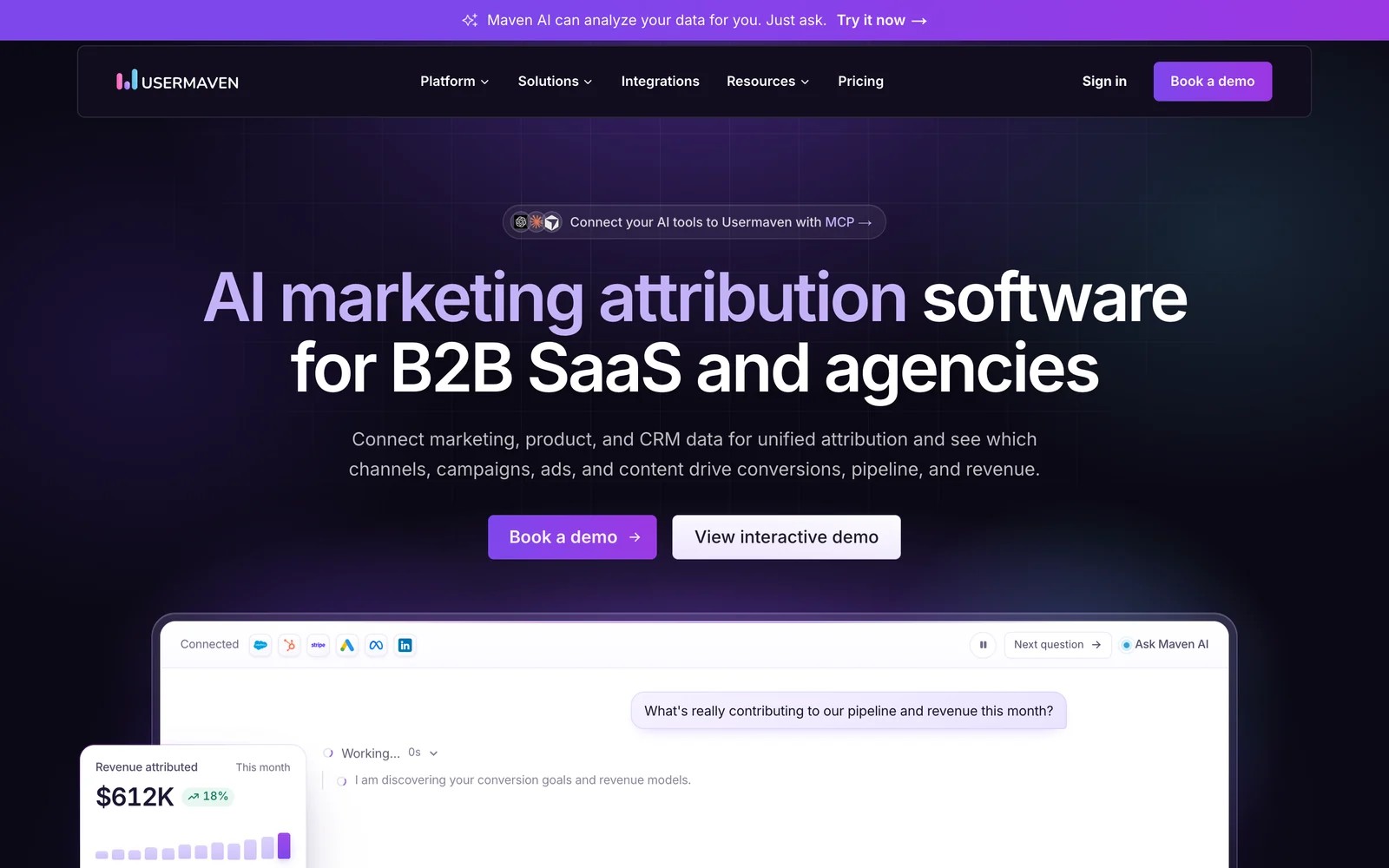
Usermaven auto-captures website and product events, runs multi-touch attribution with windows up to 365 days, and connects to HubSpot, Salesforce, Stripe and the main ad platforms. Maven AI and an MCP server sit on top.
It covers a slice of what HockeyStack does: marketing attribution plus product usage. For a product-led SaaS company, that pairing is often what matters most.
It's sold through demos now, so I went by its product tour and documentation. Reviewers say setup is easy and the data is trustworthy, and they want more tutorials for advanced use cases.
Key features
- Website and product events are captured automatically, so most clicks and page views need no tagging.
- Multi-touch attribution supports lookback windows of up to 365 days for slower B2B decisions.
- Product analytics covers engagement, retention and cohorts, linking acquisition to usage.
- Maven AI and an MCP server answer questions about your data in plain language.
Where it falls short
- There's no account-level view of buying groups, which B2B teams with long cycles may miss.
- Prices aren't published, and there's no free plan to test with.
- It doesn't write attribution back to CRM contacts, so sales won't see sources in their records.
What users say
"The installation was also insanely easy and the custom domain was a breeze to do." (Source)
"Not many tutorials on how to set it up for different use cases compared to the behemoth that is Google Analytics." (Source)
Pricing
- Business and Enterprise plans, both quoted after a demo.
How to choose
Decide how much risk you're willing to take before seeing your own data.
1. Want proof first?
- SourceLoop, Dreamdata, Factors.ai, Cometly and Attribution App can all be tested before a long contract. SourceLoop suits lead-gen businesses, agencies and SaaS teams that want lead and deal attribution with published pricing.
2. Need account-level depth?
- Dreamdata or Factors.ai for B2B accounts, CaliberMind for enterprise custom models.
3. Paid acquisition or product usage?
- Cometly for ad-level revenue in SaaS.
- Usermaven if product analytics matters as much as attribution.
For background on how these tools split credit, see our guide to multi-touch attribution tools.
Frequently asked questions
-
What is HockeyStack?
HockeyStack is a B2B go-to-market analytics platform. It unifies CRM, ad, website and product data for multi-touch attribution and journey reporting, with AI agents for analysis and sales.
-
How much does HockeyStack cost?
HockeyStack doesn't publish pricing. It's quoted after a demo, on annual contracts, with no free plan or trial as of November 2026.
-
Which HockeyStack alternatives have a free trial?
SourceLoop and Attribution App have trials, Dreamdata has a free plan, Factors.ai offers a trial, and Cometly has a self-serve Core plan.
-
What is the best HockeyStack alternative for B2B SaaS?
Dreamdata is the closest match for account-based B2B SaaS. SourceLoop suits SaaS teams that want lead, deal and subscription revenue attribution with fast setup. Cometly suits paid-heavy SaaS.
-
How do I avoid a failed attribution rollout?
Test the tool on your own CRM data before signing, check that a few known deals show the right sources, and get data-connection milestones in writing if the vendor is demo-only.

 Paid Social


