








Ad platforms
Server-side conversion tracking software
Server-side conversion tracking with Conversions API sync
Pixel-based tracking misses 30-50% of conversions thanks to iOS 14, Safari ITP, and ad blockers. SourceLoop sends complete first-party conversion data to Google Ads, Meta CAPI, and LinkedIn CAPI, with the attribution credit you decide is right.
Free 7-day trial. No credit card required.
Used by 750+ marketing teams, agencies, and SaaS companies
Why pixels miss conversions
Your ad platforms only bid on the conversions they can see
Pixels live in the browser, and the browser keeps getting locked down. By the time Google, Meta, or LinkedIn record a sale, 30-50% of conversions are gone, so Smart Bidding optimizes on a partial signal. Server-side conversion tracking syncs first-party conversions straight to each ad platform via the Conversions API (CAPI).
30-50%
Conversions hidden in the browser
iOS 14 App Tracking Transparency and Safari ITP drop the pixel events Google Ads, Meta CAPI, and LinkedIn rely on to learn.
~40%
Visitors blocking the pixel
Ad blockers and cookieless browsers stop the pixel from firing, so the conversion never reaches the platform. Server-side delivery does.
Cookieless
Third-party cookies deprecating
The identifiers pixels depend on are going away. First-party, server-side CAPI syncing is the durable way to keep measuring.
Conversion sync stack
Reclaim the conversions your ad pixel is missing
First-party, server-side conversions delivered to every ad platform past iOS 14, Safari ITP, and ad blockers, with the credit model you choose.


Recover lost data
First-party events survive iOS 14, ITP, and ad blockers.

Conversions sent
Track delivery and match rate by platform, in real time.
Score by value
Send deal value, not just a generic conversion event.
Click IDs preserved
GCLID, fbclid, and more, matched to every conversion.
Connected ad accounts · 6
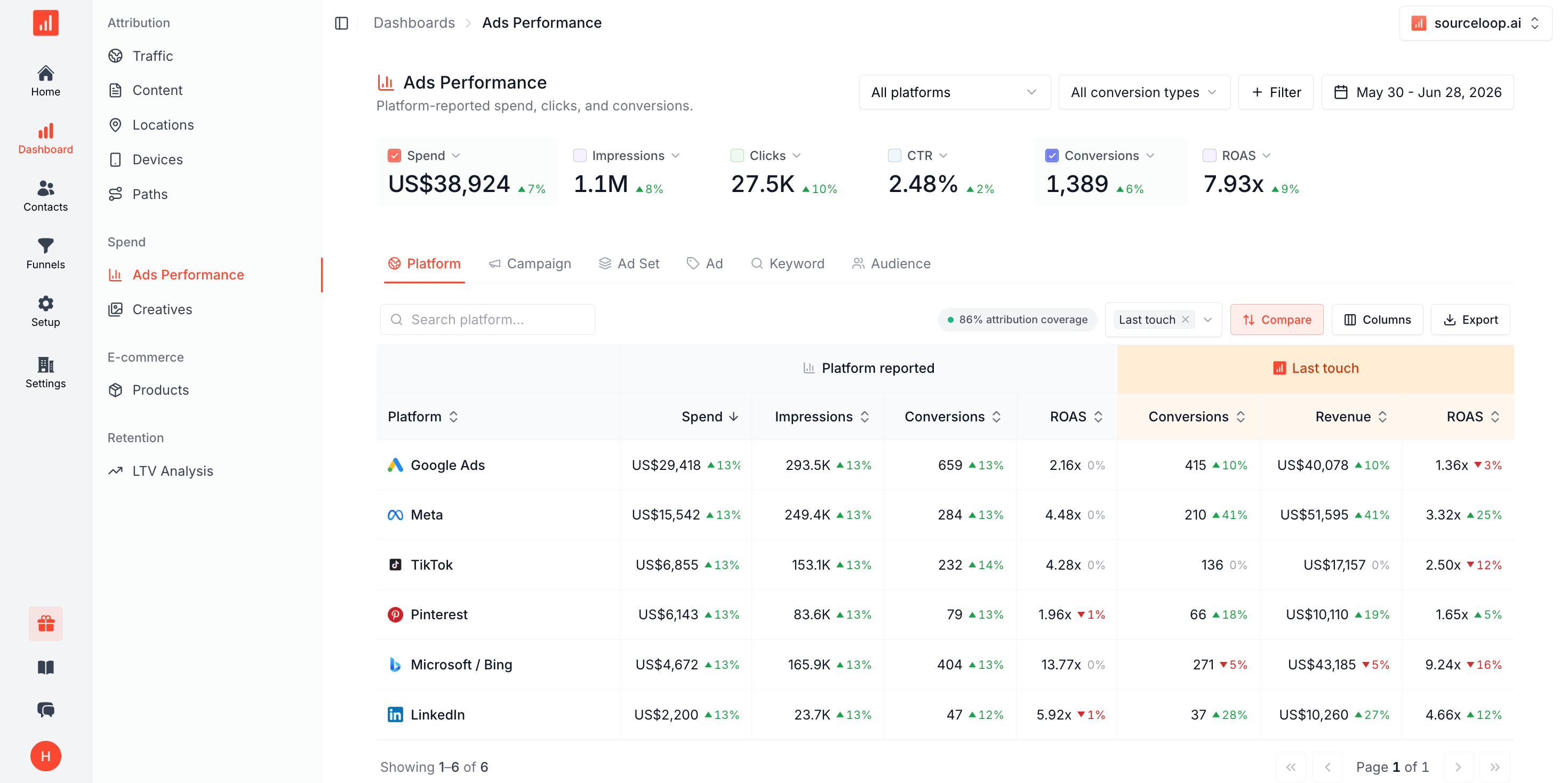
 Google Ads 2,140 Live
  Meta CAPI 1,820 Live
  LinkedIn CAPI 624 Live
  Microsoft Ads 418 Live
  TikTok Ads 312 Pending
 Server-side, every platform
Conversions API for every ad platform you spend on
Google Ads (Enhanced Conversions + the Ads API), Meta CAPI, LinkedIn CAPI, Microsoft, TikTok, Pinterest, and Reddit. OAuth in once and we handle delivery, retries, dedupe, and identifier hashing per platform spec.
- Real-time delivery, automatic retries
- Per-platform dedupe and identifier hashing
You pick the credit
Send first-touch, last-touch, or any model, per platform
Most CAPI tools only know last-click. SourceLoop already tracks every touch on the visitor's journey, so you choose what each platform learns from. Train Google Ads on first-touch credit, Meta on last-touch, LinkedIn on revenue-weighted multi-touch, all from the same dataset.
- First-touch, last-touch, linear, U-shaped, custom
- Revenue, MRR, and LTV-weighted values supported
paid_subscription
+ $1,188 gclid CjwKCAj…7-Aw
conversion_action paid_subscription
conversion_value 1188.00
currency_code USD
user_email_sha256 e3b0c44…b855
conversion_date_time 2026-04-27 14:32:08
How it works
Three steps from snippet to live conversion sync
No GTM, no server container, no DIY CAPI endpoint to maintain.
-
<script src="https://cdn.sourceloop.ai/sl.js" defer></script>
01Install the snippet
We capture GCLID, Wbraid, Gbraid, fbclid, and li_fat_id on the visitor's first landing.
- 02
Connect your ad accounts
OAuth into Google, Meta, LinkedIn, Microsoft, TikTok. Map conversion actions in five minutes.
-
Live conversion sync
- Google Ads 2,140 sent
- Meta CAPI 1,820 sent
- LinkedIn CAPI 624 sent
03Conversions sync in real time
Server-to-server delivery, automatic retries, identifier hashing where supported.
FAQ
Server-side conversion tracking FAQ
Why don't my Google Ads or Meta conversion numbers match my CRM?
Pixel-based conversion tracking sits in the browser, where iOS 14 App Tracking Transparency, Safari ITP, ad blockers, and cookieless visitors all cut into what gets reported. Most teams lose 30-50% of conversions before the ad platform ever sees them. SourceLoop captures every conversion first-party, then pushes it server-side to your ad accounts so the numbers actually reconcile with your CRM.
What is the Conversions API (CAPI) and why does it matter?
The Conversions API is a server-to-server channel for sending conversion events to ad platforms (Meta CAPI, LinkedIn CAPI, Google's Enhanced Conversions, etc.) instead of relying on the browser pixel. It's resistant to iOS 14, Safari ITP, and ad blockers, and the platforms reward CAPI events with higher event-match-quality scores, which makes Smart Bidding more accurate.
Can I choose which attribution touch gets sent to each ad platform?
Yes. Because SourceLoop already tracks first-touch, last-touch, and the full multi-touch journey, you decide what credit each platform learns from. Train Google Ads on first-touch, Meta on last-touch, and LinkedIn on a U-shaped multi-touch model on the same dataset, per-event if you want.
How does iOS 14, Safari ITP, and ad blockers affect tracking?
iOS 14's App Tracking Transparency, Safari's Intelligent Tracking Prevention, and consumer ad blockers all restrict third-party cookies and pixel calls in the browser. SourceLoop's snippet runs as first-party JavaScript on your own domain, then delivers conversions server-to-server via Conversions API, so none of these restrictions break attribution.
How is this different from setting up Meta CAPI or Google Enhanced Conversions manually?
DIY CAPI means writing a server endpoint, hashing identifiers (email, phone) per platform spec, deduping browser pixel and server events, retrying failures, and updating schemas every time a platform changes. SourceLoop ships all of that. Map a conversion action once, we handle delivery, retries, identifier hashing, and per-platform dedupe.
Will this work with Smart Bidding (tCPA, ROAS, Maximize Conversions)?
Yes. Smart Bidding strategies need a steady, complete conversion signal to learn from. Server-side first-party events are exactly that signal. Send revenue value alongside the conversion and Maximize Conversion Value / tROAS bidders learn what actually pays, not what the form-fill volume looks like.
Which ad platforms do you support?
Google Ads (with Enhanced Conversions and the Google Ads API), Meta (Conversions API), LinkedIn (Conversions API), Microsoft Ads, TikTok Ads, Pinterest Ads, and Reddit Ads. The same SourceLoop snippet captures the click identifier; we handle the per-platform schema, hashing, and delivery.
What is the difference between client-side and server-side conversion tracking?
Client-side tracking fires from the visitor's browser, so an ad blocker, a privacy browser, or a failed script means the conversion never leaves the page. Server-side tracking sends the event from a server you control, after the conversion is confirmed. The browser can no longer drop it, and you can attach information the browser never had, such as the deal value your CRM assigned it later.
What is the difference between the Conversions API and the Meta pixel?
The pixel is browser-side and reports the moment something happens on the page. The Conversions API is server-side and reports the same event from your infrastructure, including events that never touched a browser. Meta recommends running both and deduplicates them by event ID, which SourceLoop sends automatically so the same purchase is not counted twice.
How do I track offline conversions in Google Ads and Meta?
Offline conversions are the ones that happen after the click and away from your site: a deal marked closed-won in your CRM, a sale taken over the phone, a subscription that finally converted. SourceLoop keeps the original GCLID or fbclid attached to that person, so when the deal closes we upload it as an offline conversion with its real value, and the ad platform learns to bid for buyers rather than form fills.
Do I need a Conversions API Gateway or server-side Google Tag Manager?
No. Both exist to give you a server you control between the browser and the ad platforms, which means provisioning cloud infrastructure and maintaining it. SourceLoop already is that server, so the events, the identity matching, and the delivery to each platform are handled without a Gateway instance or a server-side GTM container to run.