
6 Best Funnel.io Alternatives for Marketing Data in 2026
Six Funnel.io alternatives compared: cheaper connectors, governed pipelines, client reporting and ready-made attribution, with real user reviews.
Table of contents
Funnel is good at the plumbing. It pulls data from hundreds of marketing platforms, cleans it up and sends it to Looker Studio, BigQuery or Power BI.
The questions start once the plumbing works. Someone still has to build the dashboards, decide how to credit channels, and keep it all running as sources change.
In this guide, I'll look at six alternatives, split by what you actually want at the end: a cheaper pipe, a governed one, finished reports, or the attribution answer itself.
How this list was built
Pipelines are easy to demo and hard to judge, so we connected the same Google Ads and Meta accounts to every tool we could start on our own: Supermetrics and Windsor.ai on their trials and free plan, Fivetran's free tier, and Funnel's own 30-day trial as the baseline. Adverity and Whatagraph sell through demos, so those sections draw on walkthroughs, documentation and agencies we know who use them.
The brands and agencies we work with tend to ask the same question in the end: which campaigns produced revenue? That's the yardstick here, alongside reviews from G2 and Capterra. We compared:
- How pricing grows as you add sources, accounts or rows
- Where the data lands, and who has to build the reports
- How much transformation and modeling is left to you
- Whether you get attribution, or just spend and clicks
SourceLoop is our product. It isn't a data pipeline at all, and we've scored it against the same questions and been direct about the gaps.
Last checked November 2026. Confirm current pricing with each vendor.
Why teams look past Funnel
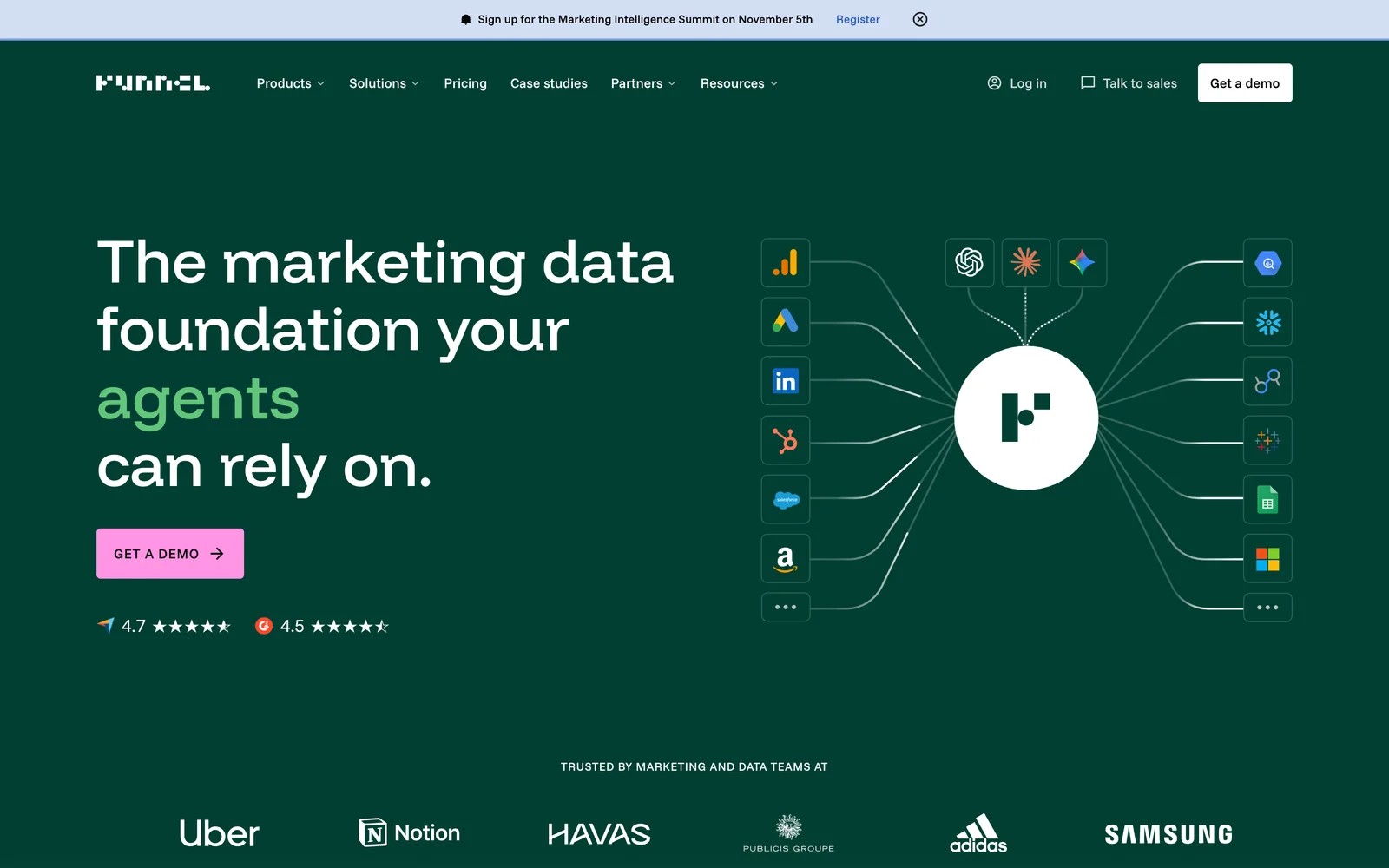
Funnel's pricing page starts at $300 a month for Starter and $600 for Business, both billed annually, with a 30-day free trial. Measurement features like MMM and multi-touch attribution are an add-on on Business and up.
Users rate it highly for ease of use and connector coverage:
"What I find most helpful about Funnel is having one tool that both the marketing and data teams can use." (Source)
The friction usually comes from three directions:
- Cost as you grow: more sources and more accounts push you up the tiers.
- Transformation limits: Funnel cleans and maps data, but heavier modeling still happens elsewhere.
- No answers by default: it delivers data. Turning that into channel credit and revenue is your job.
"As the number of data sources keeps increasing, the price is also rising significantly, especially when you start diversifying the marketing mix." (Source)
"As an ETL, the \"E\" and \"L\" parts are perfect, the \"T\" could be improved" (Source)
Funnel.io alternatives compared
Here's how the 6 Funnel.io alternatives compare on what you get, where data lands and price, as of November 2026.
| Tool | What you get | Where data lands | Who builds reports | Attribution to revenue | Pricing |
|---|---|---|---|---|---|
 SourceLoop | Tracking, spend sync and attribution | SourceLoop, plus warehouse export | Ready-made, plus custom | Yes | From $49/mo |
 Supermetrics | Connectors | Sheets, Looker Studio, BigQuery and more | You | No | From $49/mo |
 Windsor.ai | Connectors | Looker Studio, BigQuery, Power BI and more | You | No | Free plan, from $23/mo |
 Adverity | Governed data platform | Adverity or your warehouse | You, with built-in dashboards | No | Quote |
 Whatagraph | Client reporting | Whatagraph reports | Templates and AI | No | From €699/mo |
 Fivetran | General data pipeline | Your warehouse | Your data team | No | Free tier, usage-based |
The 6 best Funnel.io alternatives
SourceLoop comes first because it answers the question most Funnel setups are built to answer. The pipelines follow, from cheapest to most technical.
1. SourceLoop
Best for: lead generation businesses, agencies and SaaS teams that bought a pipeline mainly to see which campaigns produce leads and revenue.
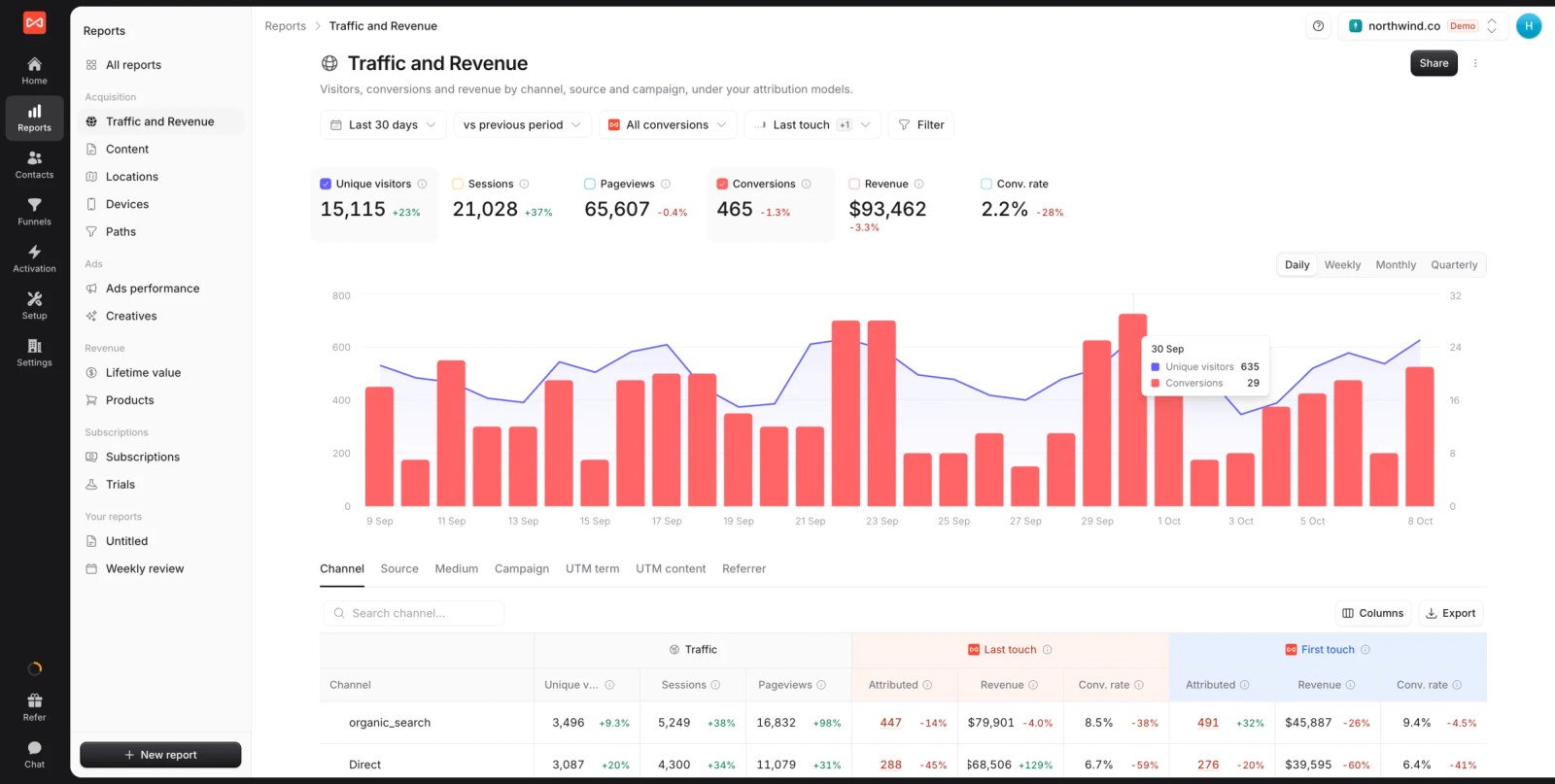
SourceLoop is a first-party marketing attribution and measurement tool. It's not a pipeline. It collects its own data: every visit and its source, every lead from forms, calls, chats and bookings, deals from the CRM, payments from billing, and spend from the ad platforms.
Because it owns the whole chain, the reports exist on day one. Channel and campaign results with revenue, cost per lead, and ROAS by platform are already there, under whichever of seven attribution models you pick.
Key features
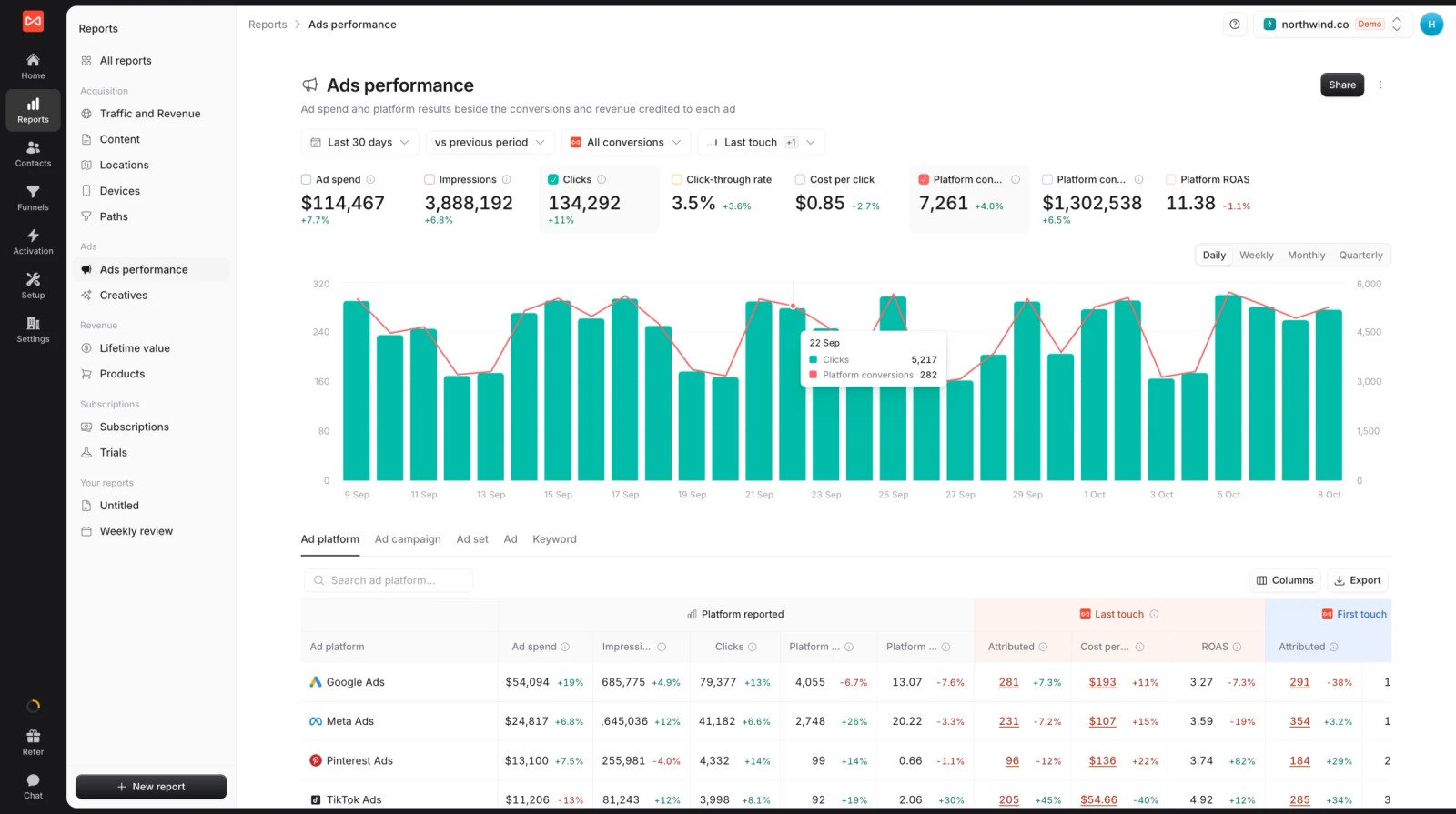
- Ad spend sync: spend, impressions and clicks from Google Ads, Meta, Microsoft Ads and ChatGPT Ads, shown beside the leads and revenue SourceLoop credits to each platform.
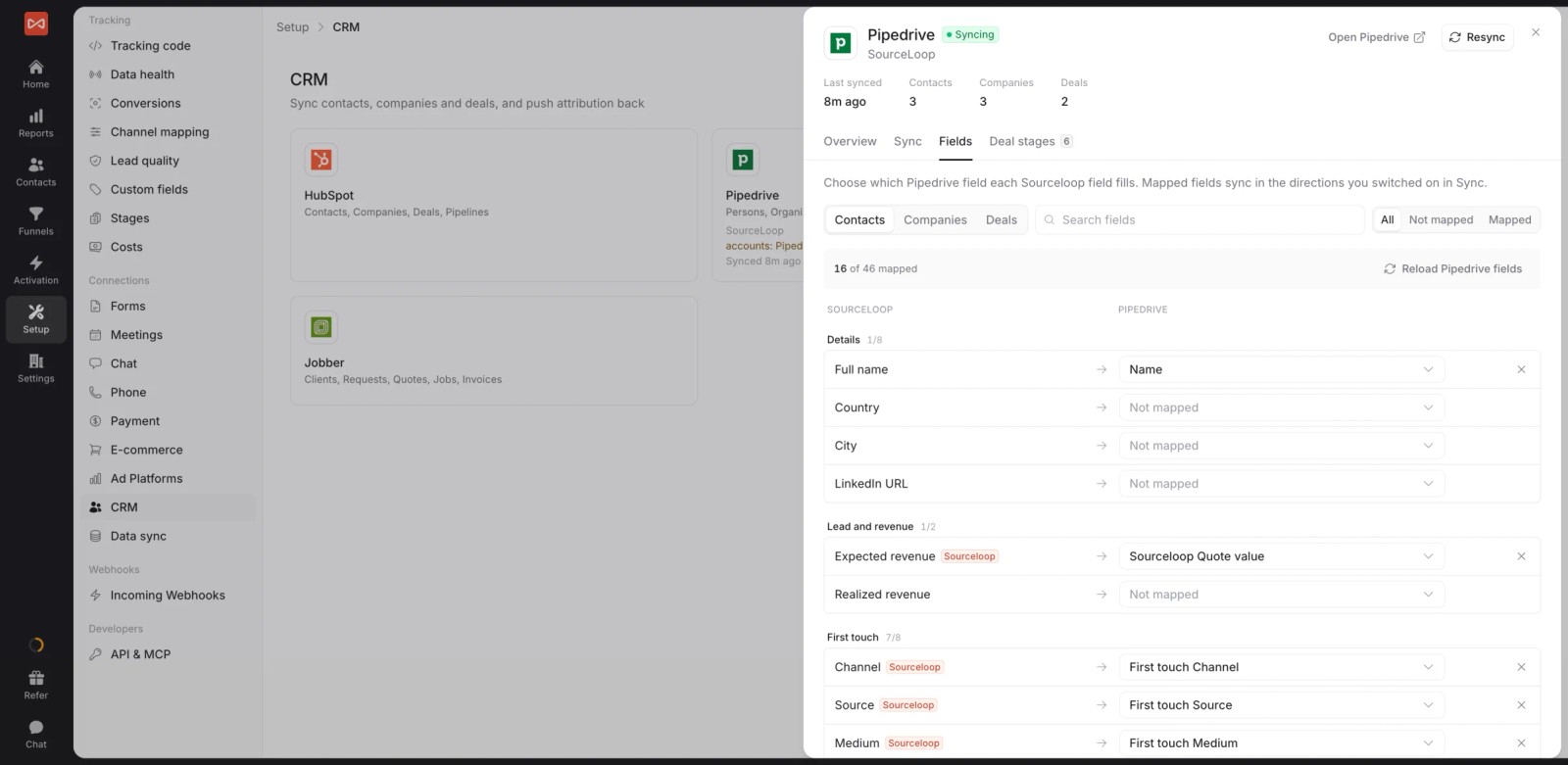
- Leads and revenue tied together: two-way CRM sync with HubSpot, Salesforce, Pipedrive and Jobber, plus Stripe, Paddle and other payment providers.
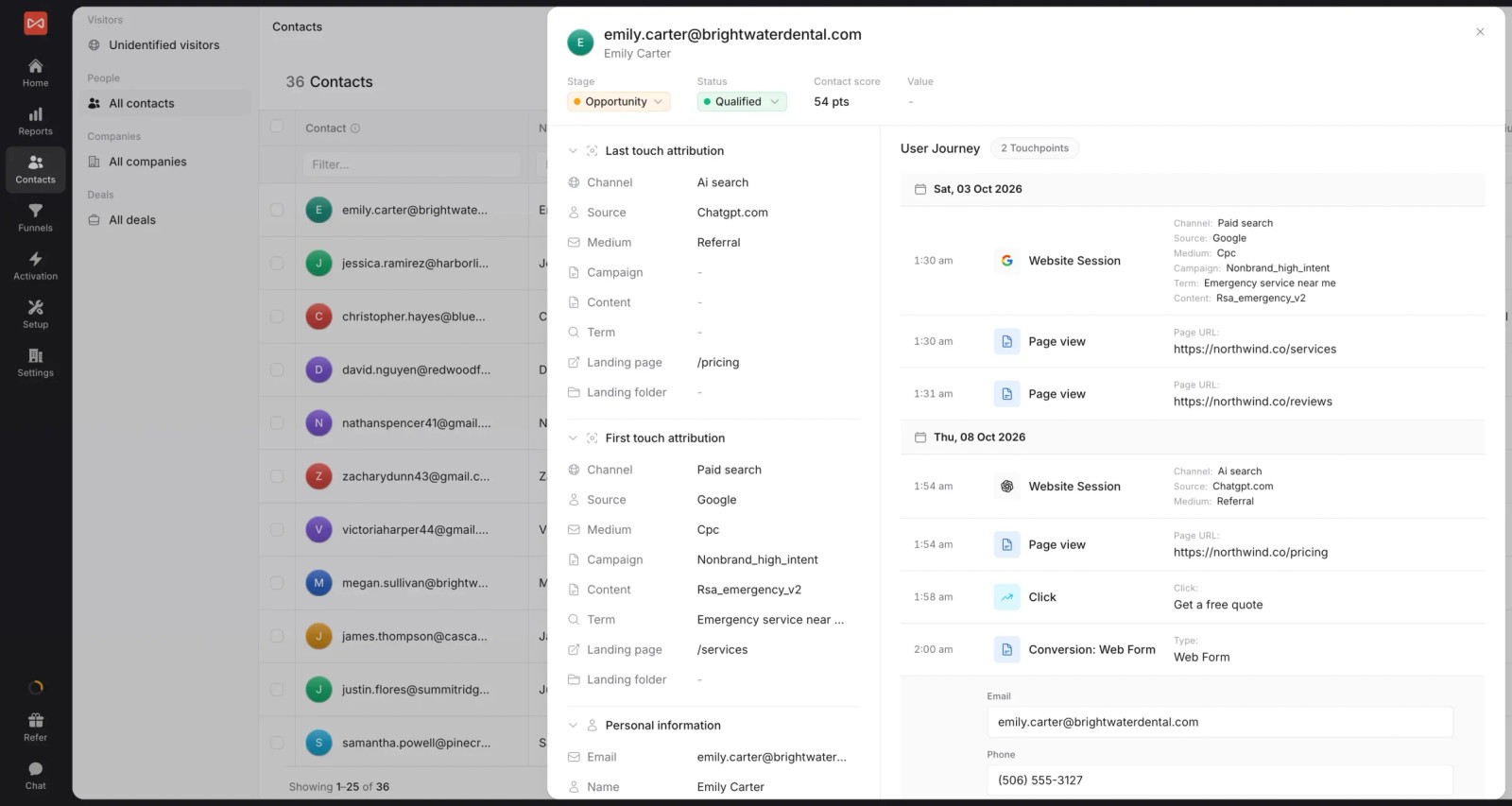
- Journeys on every lead: the full visit history, ad clicks and landing pages before each conversion.
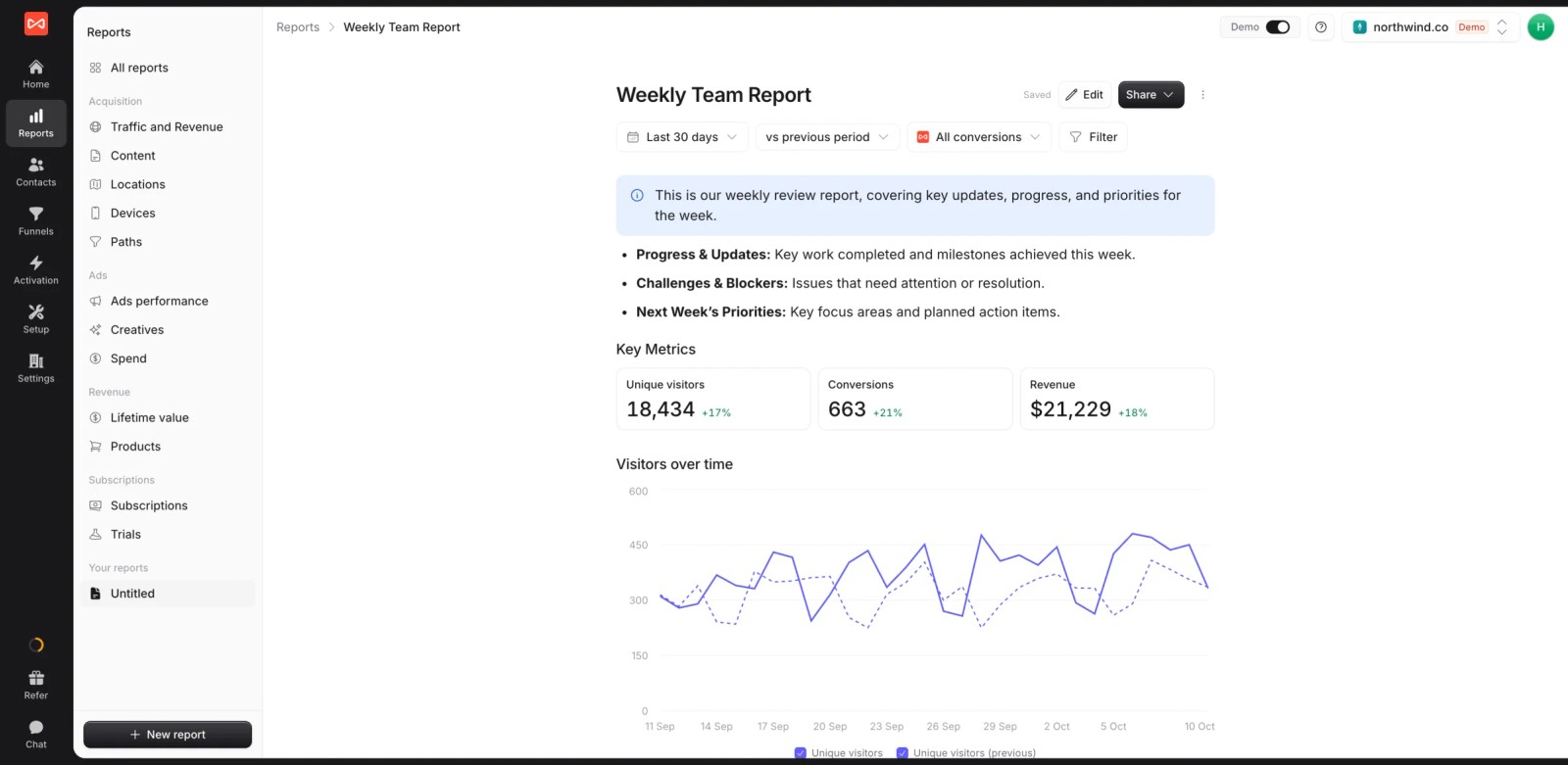
- Custom reports: build a live report from any metric, share it as a link, or export it to PDF or PowerPoint with your branding.
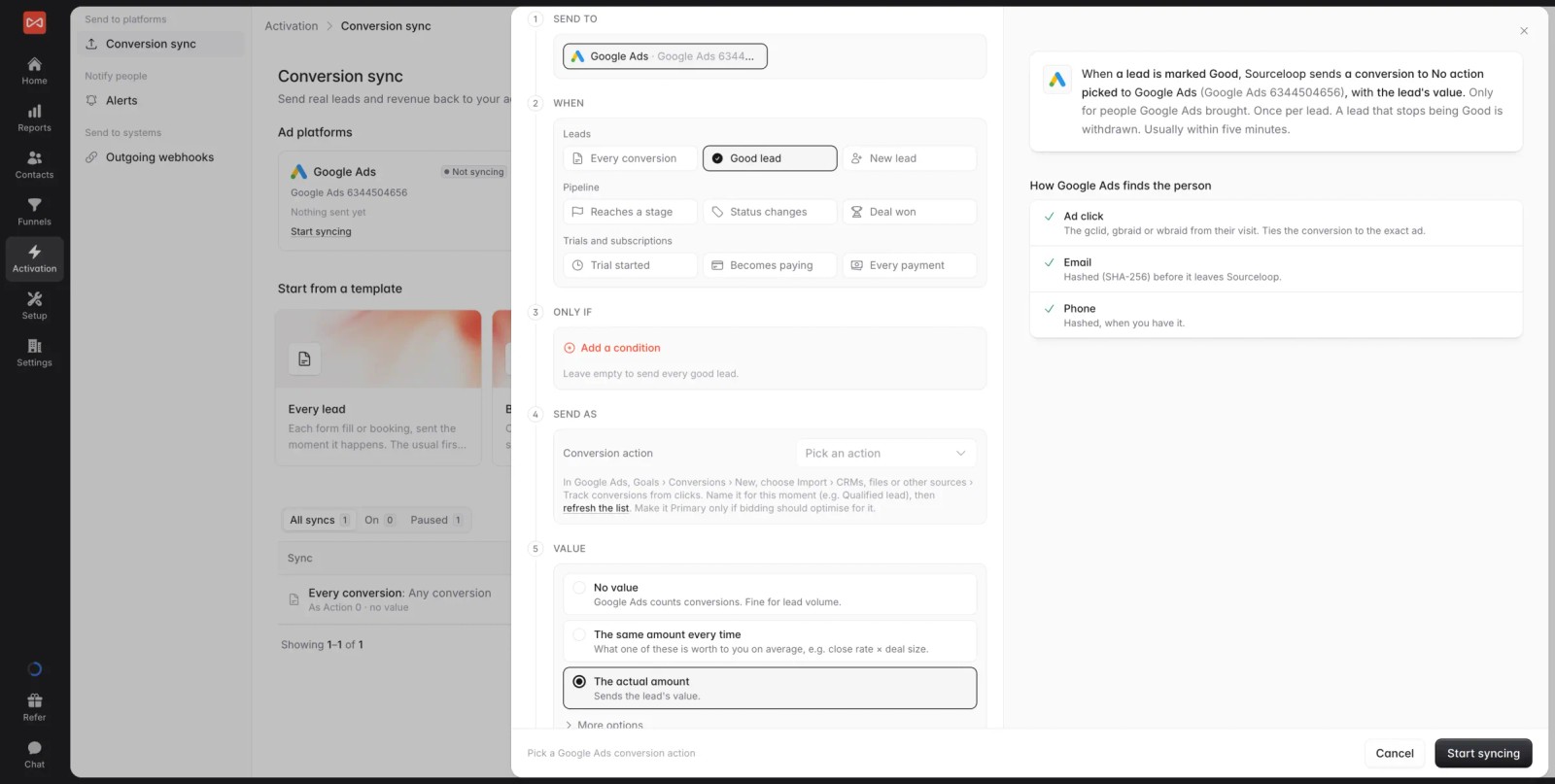
- Conversion sync: qualified leads and won deals go back to Google Ads, Meta, Microsoft Ads and ChatGPT Ads, which no pipeline on this list does for you.
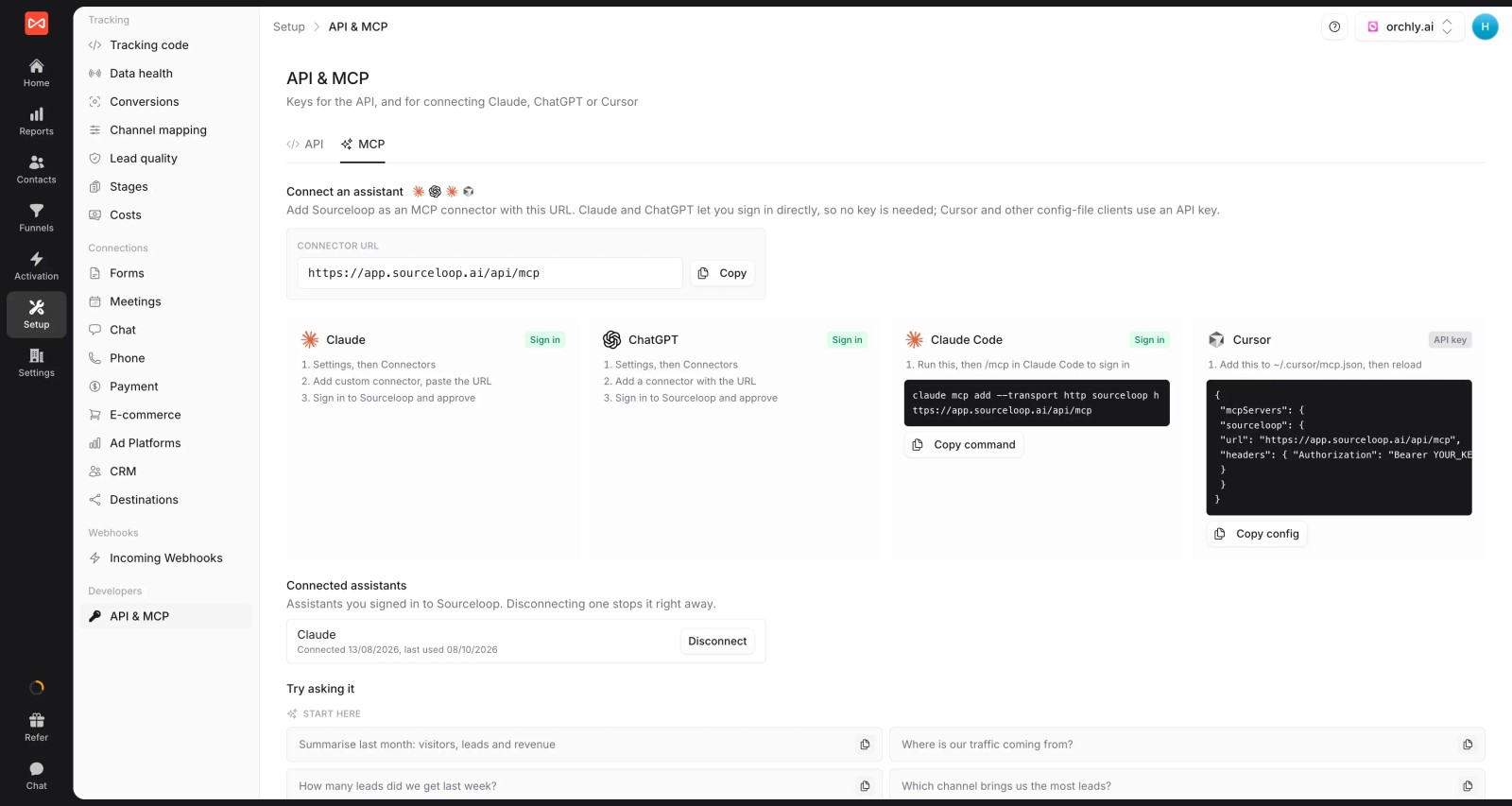
- Warehouse export, API and MCP: send data to Snowflake, BigQuery, S3 or GCS, query it through the API, or let an AI assistant read it over MCP (Professional and up).
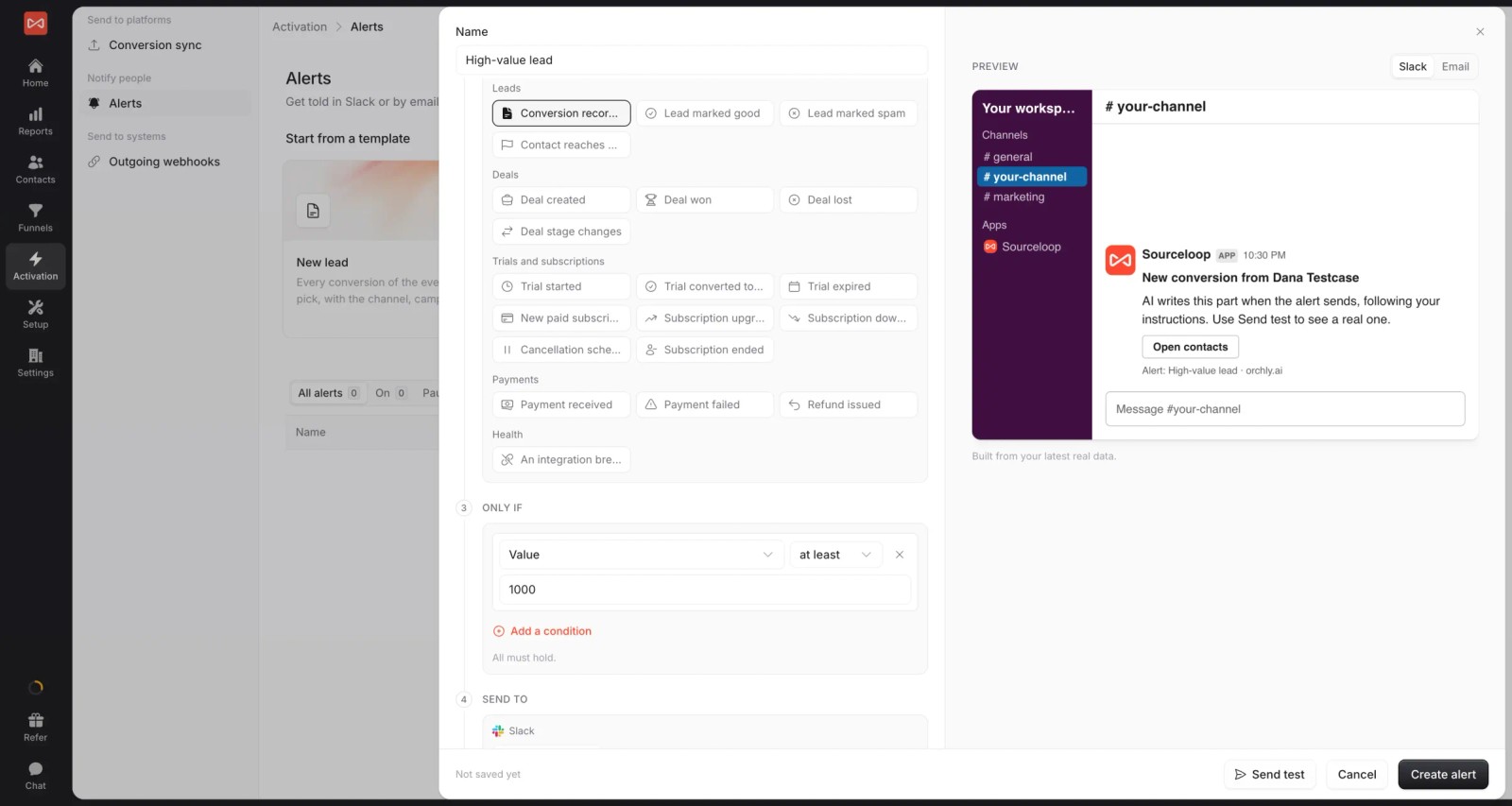
- Alerts: Slack or email messages on new leads, deals or weekly numbers, so nobody has to open a dashboard to know how the week went.
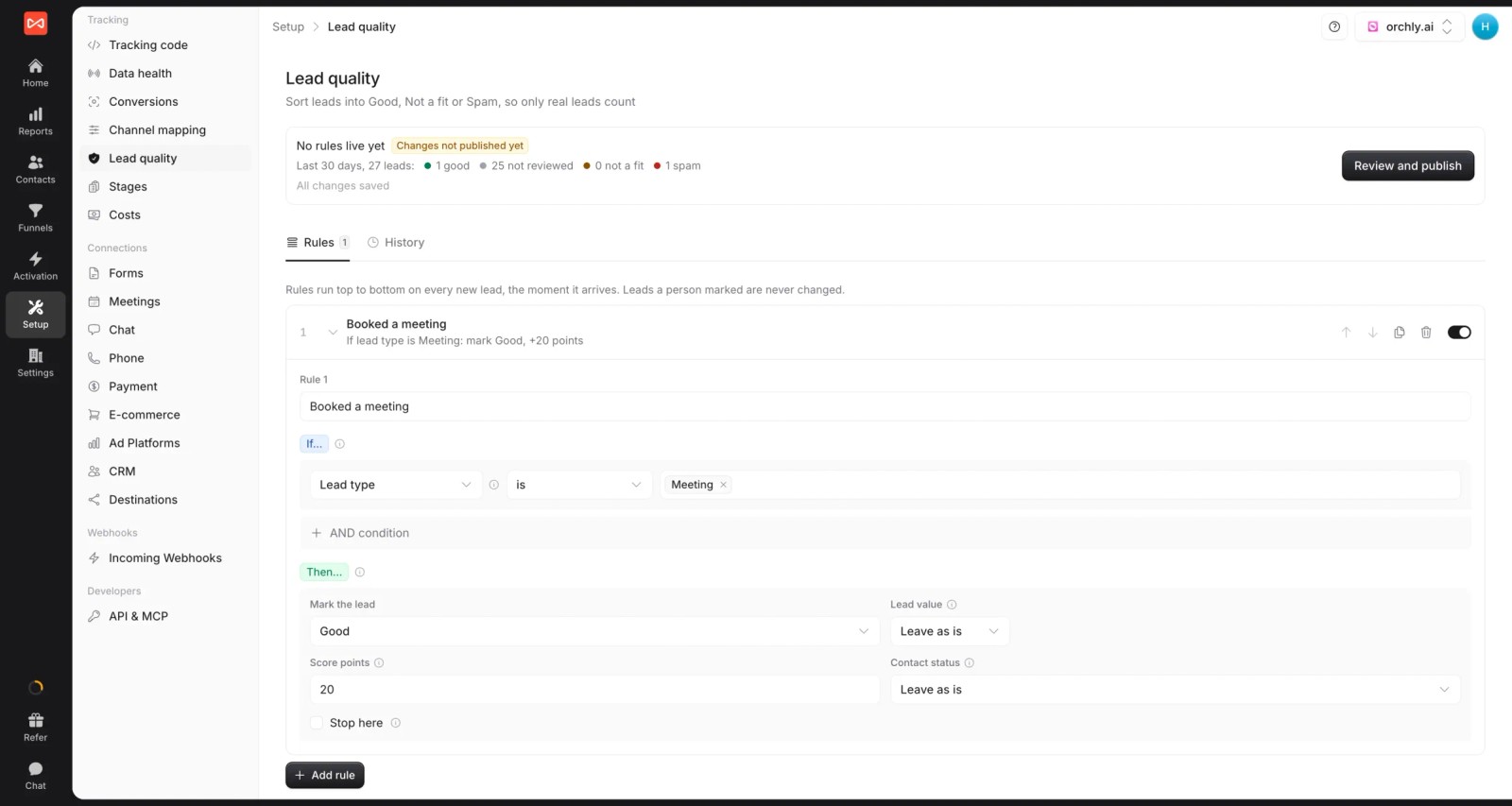
- Lead quality rules: mark leads Good, Not a fit or Spam, so cost per lead reflects leads worth having.
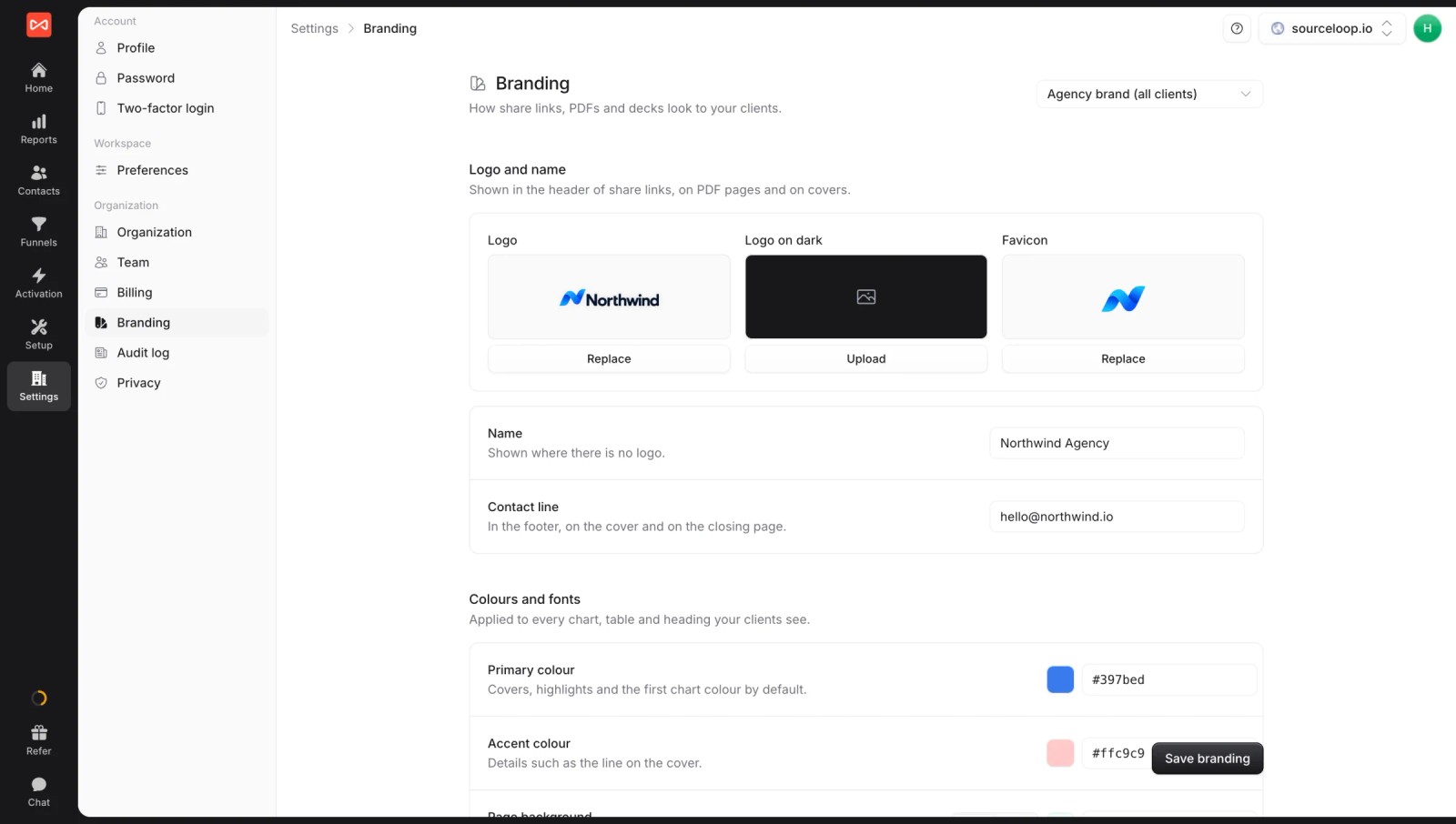
- White label: your logo, colors and share domain across every client report and export.
Where it falls short
- It only connects four ad platforms for spend today, so brands spending on TikTok, LinkedIn, Pinterest or programmatic will need manual cost entries or a pipeline alongside it.
- It doesn't pull organic social, SEO or email platform metrics, so a full cross-channel performance dashboard still needs a connector tool.
Pricing
- Essential: $49/mo for one site and 30,000 page views, with tracking, attribution reports, lead quality rules and alerts
- Professional: $99/mo for 100,000 page views and unlimited users, adding CRM sync, conversion sync to the ad platforms, the API and MCP
- Agency: $249/mo for three sites and 1.5 million page views, adding white label reporting
- Unlimited conversions on every plan, and a 7-day trial. Funnel starts at $300/mo before any dashboard is built.
Verdict: the better choice if your pipeline exists to answer "which campaigns make us money". Keep a connector tool if you also need every channel's raw metrics in one warehouse.
2. Supermetrics
Best for: marketers and agencies who live in Looker Studio or Google Sheets and want the cheapest reliable connectors.
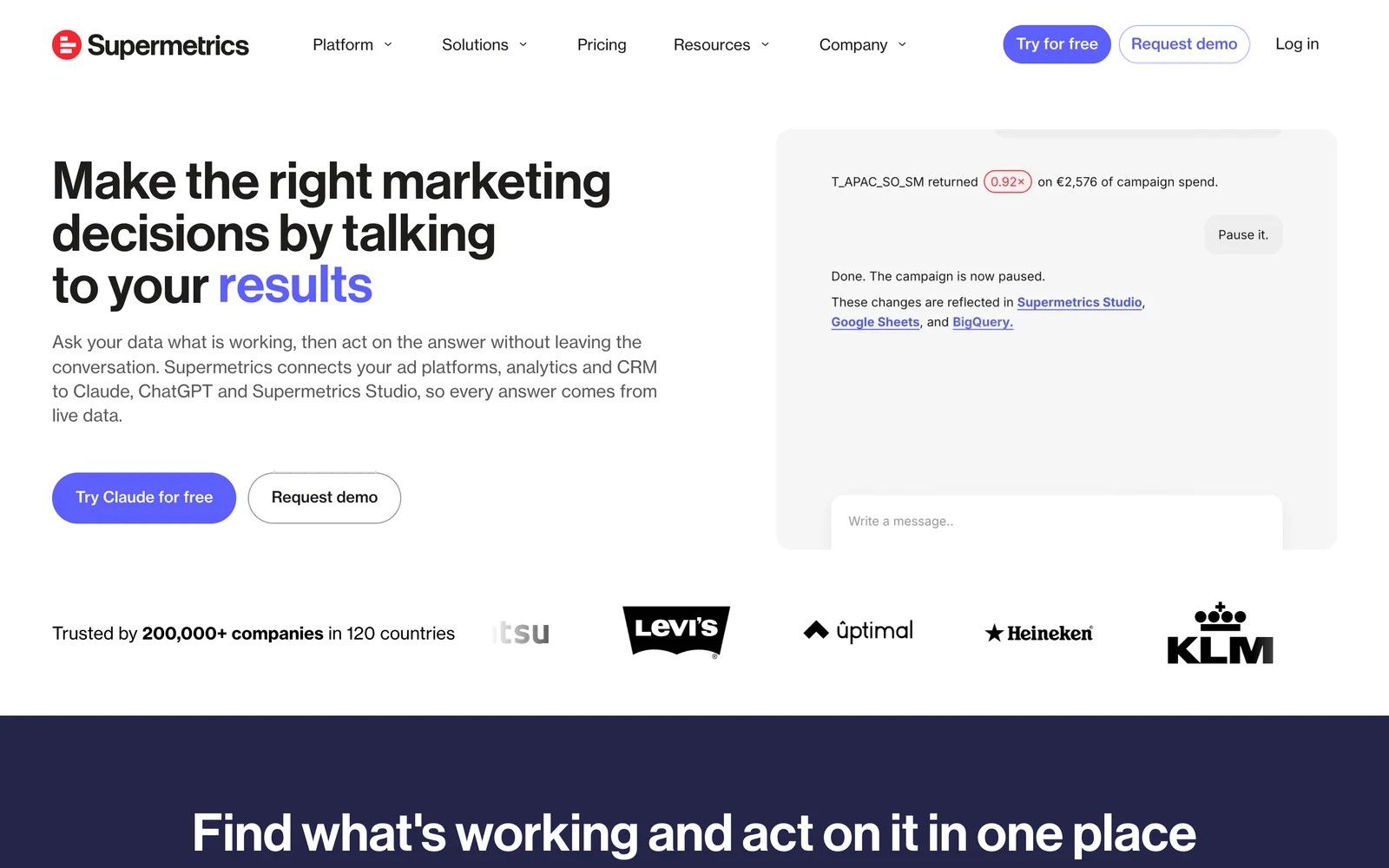
Supermetrics is the connector tool most marketers have already met. It pulls data from ad, analytics and social platforms into Sheets, Excel, Looker Studio, BigQuery and other destinations.
On the trial, I had Google Ads and Meta flowing into Looker Studio within minutes. The Google connectors in particular felt more complete than Looker Studio's native ones, which matches what reviewers say.
The pricing is where you need a calculator. It scales by destinations, data sources and accounts per source, so an agency with many clients can end up adding extras on top of the plan price.
It also leaves all the thinking to you. You get clean tables of spend and clicks; which channel deserves credit for revenue is a question for whoever builds the report.
Key features
- Connectors for the major ad, analytics and social platforms deliver data without writing or maintaining API code.
- Data lands in Sheets, Excel, Looker Studio, BigQuery and other destinations, so reports stay in tools the team already knows.
- Fixed-price plans scale by sources, accounts and destinations rather than data volume, which keeps bills predictable for smaller setups.
- Supermetrics Studio adds AI credits for building and analyzing reports on top of the connected data.
Where it falls short
- Extra sources, accounts and destinations are add-ons, so agencies with many clients can see costs climb well past the plan price.
- It delivers raw platform metrics with no attribution, so revenue by channel depends on whoever builds the report.
- Some connectors need reconnecting periodically, and reviewers mention discrepancies that call for extra validation.
What users say
"Having one platform that has all the connectors in one is super helpful." (Source)
"The cost can be high, especially if you need multiple connectors or use it across several accounts or clients." (Source)
"The tool has data discrepancies and this demands extra validation" (Source)
Pricing
- Starter: from $49/mo ($39 billed yearly), 1 destination and 2 data sources
- Growth: from $199/mo ($159 yearly), 7 data sources
- Enterprise: quoted, adding warehousing and API access. 14-day free trial.
3. Windsor.ai
Best for: small teams and freelancers who want Funnel-style connectors at a fraction of the price.
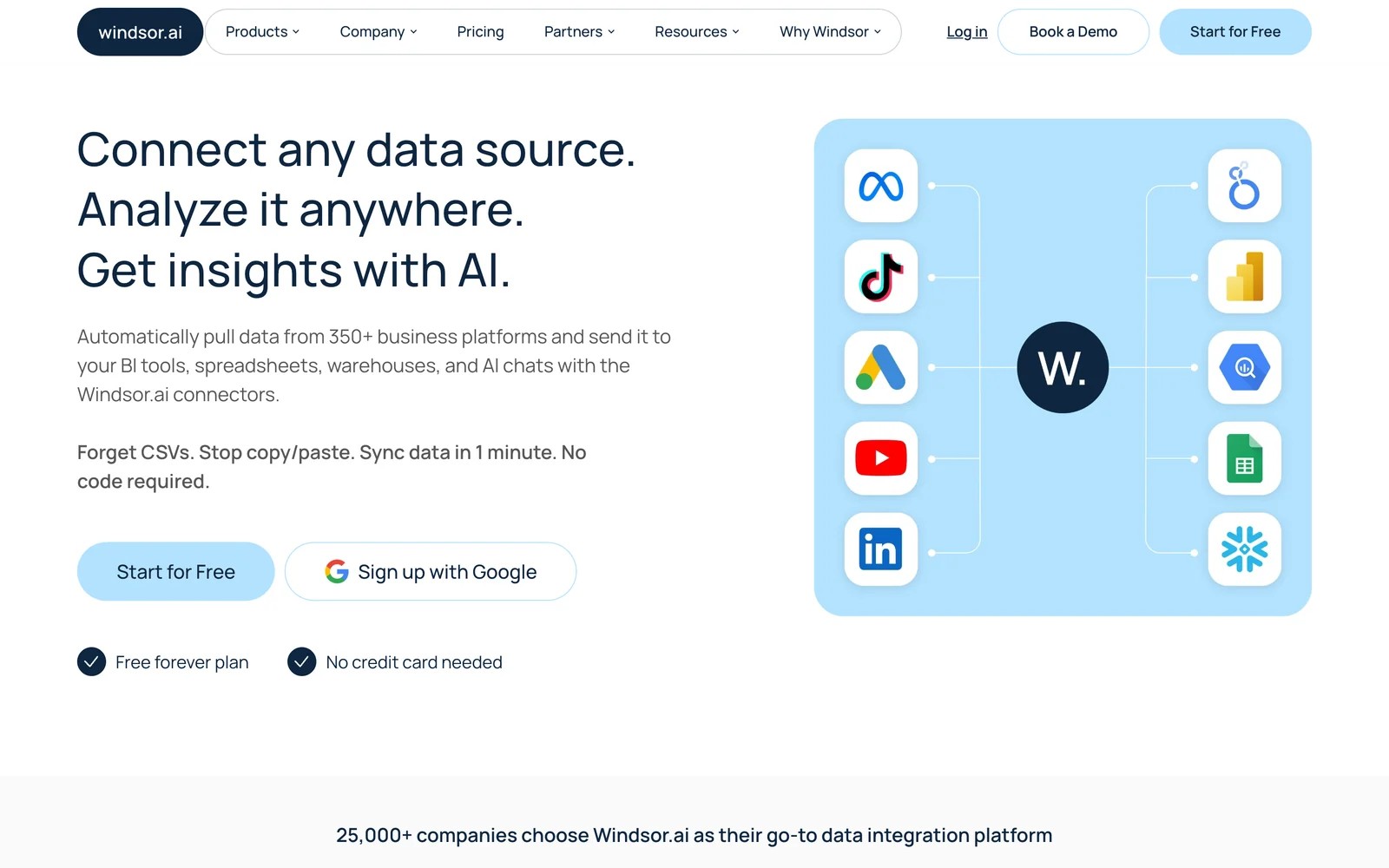
Windsor.ai connects hundreds of marketing sources to Looker Studio, BigQuery, Power BI, Sheets and more, with a free plan for one source and paid plans that start very low.
I connected HubSpot and Google Ads to Looker Studio on the free plan, and it was quick. The MCP server is a genuinely useful extra: you can ask Claude questions of the combined data without building a dashboard first.
The interface feels a step behind Funnel's, and custom transformations take time to learn. Reviewers also flag support quality and billing surprises.
For the price, though, it's the easiest way to test whether a connector setup is what you need before committing to something bigger.
Key features
- Hundreds of connectors cover ad platforms, analytics, CRMs and ecommerce, so most marketing stacks are reachable on day one.
- Data can land in Looker Studio, BigQuery, Power BI, Sheets and other destinations, matching whatever reporting tool you prefer.
- An MCP server lets AI assistants query, and act on, the connected data, which speeds up quick analysis.
- A free-forever plan for one data source lets you test the setup properly before paying anything.
Where it falls short
- Like any connector tool, it moves data but doesn't track visitors or leads, so attribution has to be modeled elsewhere.
- Advanced transformations and custom pipelines take time to learn, which narrows the gap with pricier tools.
- The interface feels dated next to Funnel, and some reviewers report frustrating support and billing experiences.
What users say
"The most helpful part of Windsor.ai is its ability to connect multiple marketing data sources quickly and reliably." (Source)
"Some configurations can take time to fully understand, especially when setting up custom data pipelines or advanced transformations." (Source)
"The interface could be modernized and polished compared to industry tools." (Source)
Pricing
- Free: one data source
- Basic: $23/mo ($19 billed yearly)
- Standard: $118/mo ($99 yearly)
- Plus and Professional: $299 and $598/mo, with a 30-day trial
4. Adverity
Best for: enterprises and large agencies that need governed, audited marketing data across many teams and markets.

Adverity is the closest like-for-like Funnel competitor at the enterprise end. It connects sources, harmonizes data, checks quality and sends it to dashboards or a warehouse, with governance features built for large organizations.
It sells through demos, and from the walkthrough and the agencies we know who run it, the strength is control: workspaces, data quality monitoring and consistent naming across markets. That matters when twenty people touch the same data.
The trade-off is weight. Fixing a single data error often means going back to the source rather than adjusting it in Adverity, and its built-in visualization has started to feel dated to long-time users.
It's a serious platform for organizations that need one. For a single brand or small agency, it's more machinery than the problem calls for.
Key features
- A large library of pre-built connectors and destinations covers most enterprise marketing stacks without custom code.
- Data quality monitoring and governance controls flag errors and keep naming consistent across teams and markets.
- Workspaces and projects keep clients, brands or regions separate while sharing the same data model.
- Built-in dashboards let teams visualize data without a separate BI tool, though most send it to their warehouse.
Where it falls short
- Pricing is quote-only with no self-serve trial, which slows down any team trying to compare options quickly.
- Correcting individual data errors usually means changing the source, which reviewers describe as slow and cumbersome.
- It stops at governed data, so attribution and revenue analysis still need modeling on top.
What users say
"I appreciate the vast number of pre-existing data sources and destinations available in Adverity." (Source)
"With Adverity, correcting individual data errors is particularly time-consuming." (Source)
"The data visualization capabilities have started to feel dated and a bit restrictive." (Source)
Pricing
- Custom quote only. Adverity doesn't publish plans or offer a self-serve trial.
5. Whatagraph
Best for: agencies that mainly used Funnel to feed client reports, and would rather skip the BI tool.
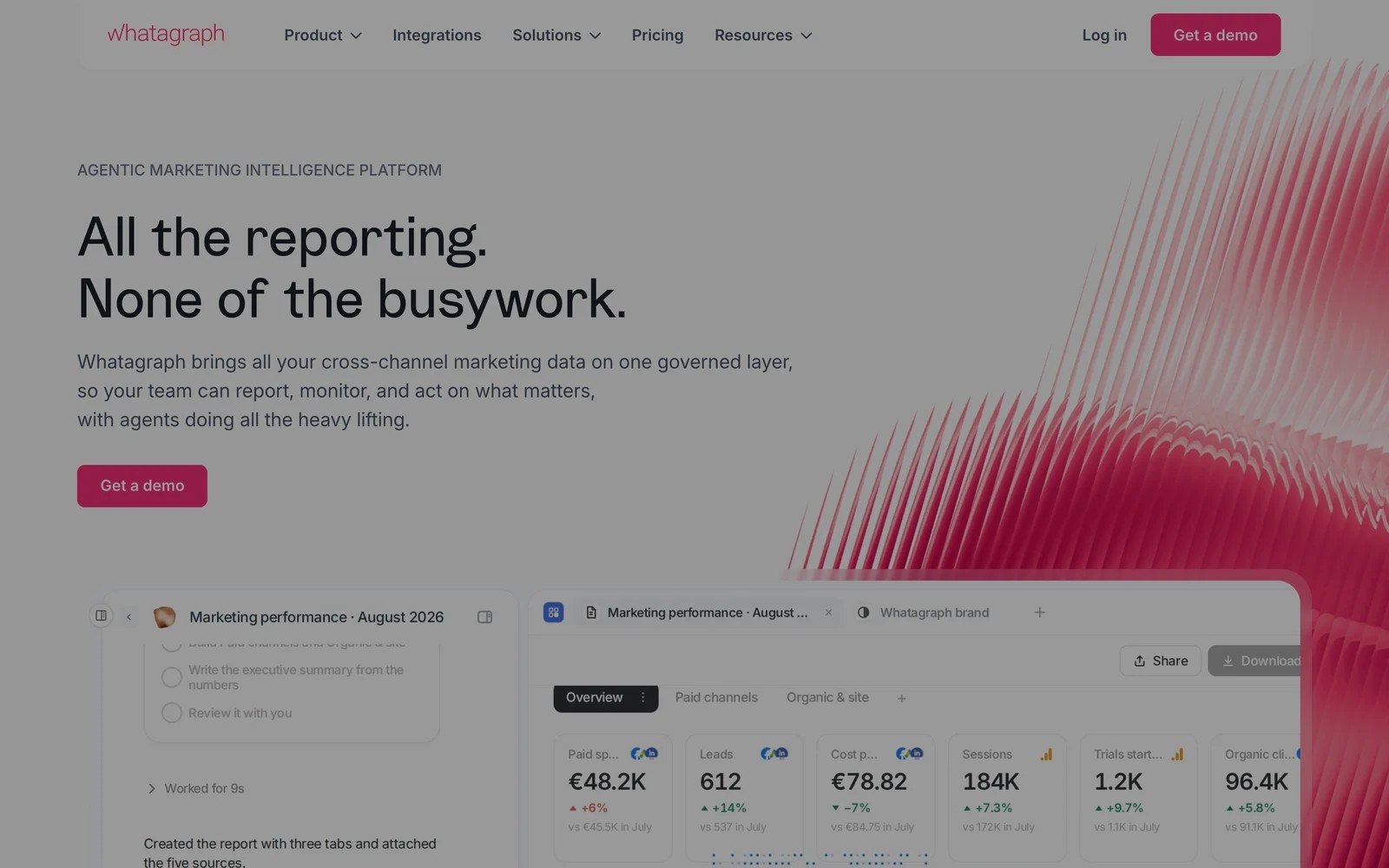
Whatagraph combines connectors with the reporting layer: drag-and-drop reports, white-label sharing, KPI alerts and AI agents that build and summarize reports. Data never has to touch a separate dashboard tool.
From the agencies we know who use it, the appeal is speed to a client-ready report. Connect the accounts, pick a template, add your logo, schedule it. That's a very different workflow from piping data into Looker Studio and designing from scratch.
The learning curve is real, though, and reviewers mention data sources disconnecting and lags when platform APIs change. The entry price also assumes an agency with a healthy client list.
Its reports show what each platform reports. It won't settle which channel deserves credit for a lead.
Key features
- Drag-and-drop reports and templates turn connected data into client-ready reports without a separate BI tool.
- White-label reports and a custom report domain keep your agency's branding front and center with clients.
- KPI overviews with alerts flag changes in performance, so problems surface before the monthly report.
- IQ agents use AI to build reports and write summaries, which cuts the time spent on routine reporting.
Where it falls short
- Pricing starts at €699 a month on an annual plan, which is steep for freelancers and small agencies.
- Reports mirror platform-reported numbers, so it can't reconcile Meta and Google both claiming the same lead.
- Reviewers mention a learning curve and data sources occasionally disconnecting, which can delay client reports.
What users say
"It's user-friendly and has good sharing features which helps when wanting to send reports both internally and externally" (Source)
"You have to learn their language and the way they build things. It is not overly intuitive." (Source)
"Data sources being randomly disconnected for no apparent reason." (Source)
Pricing
- Max: from €699/mo billed annually, starting at 50 source credits
- Prime: custom, adding BigQuery and Looker transfers and a public API
6. Fivetran
Best for: companies with a data team and a warehouse that want marketing data alongside everything else.
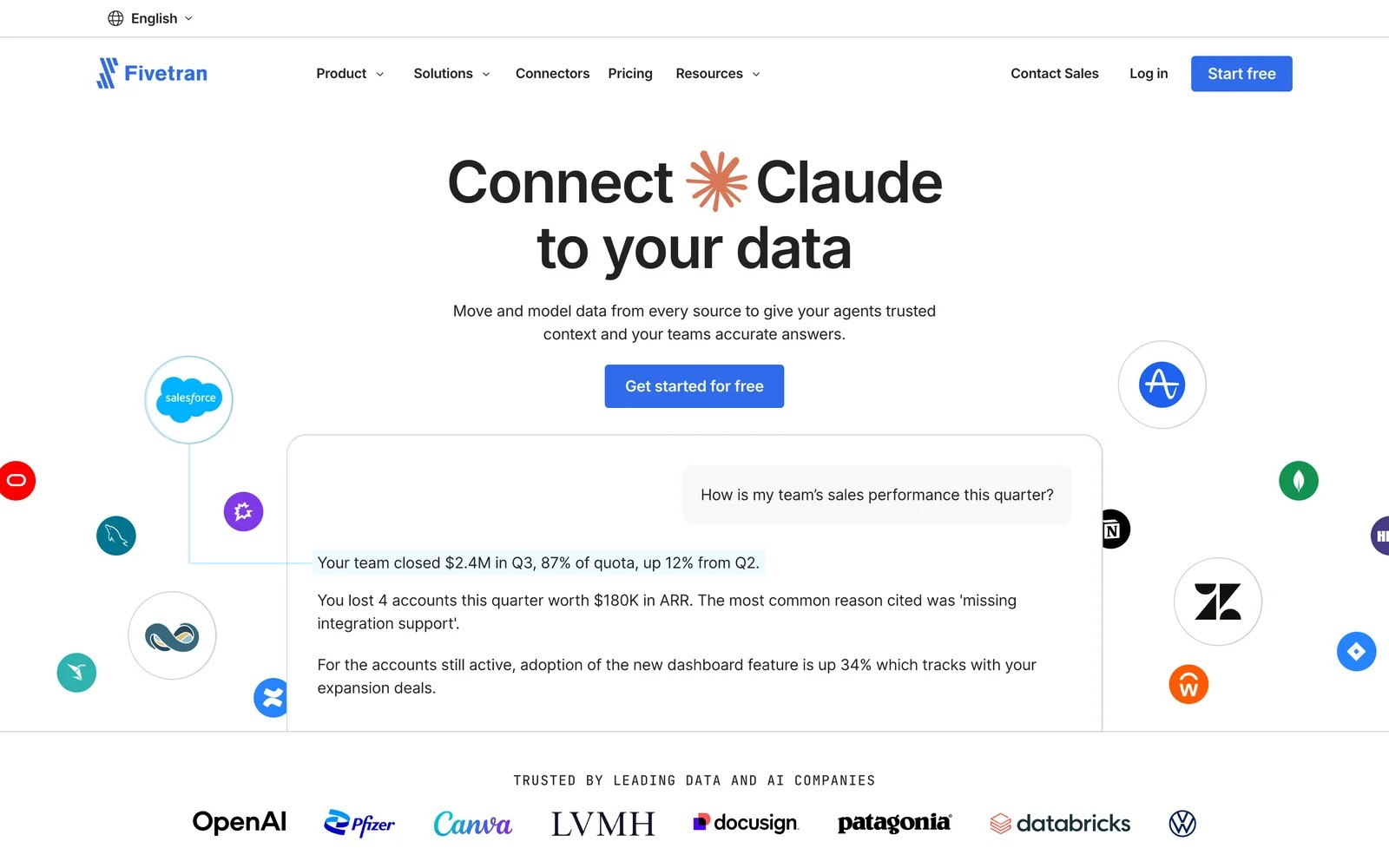
Fivetran is a general-purpose data pipeline with hundreds of managed connectors, including the ad platforms. It loads raw data into Snowflake, BigQuery, Databricks or Redshift and leaves the modeling to your team.
I tried the free tier with Google Ads and Meta into BigQuery. The connectors are dependable and handle schema changes gracefully, which is exactly what a data engineer wants.
For a marketer, it's the wrong end of the stack. You get raw tables, not reports, and the bill is based on monthly active rows, which is hard to predict and, according to several reviewers, easy to overspend.
Choose it if marketing data is one input to a broader company warehouse. Skip it if marketing is the whole point.
Key features
- Hundreds of managed connectors, including the major ad platforms, load data without building or maintaining pipelines.
- Automatic handling of schema changes and incremental updates keeps tables current as platforms change their APIs.
- Data lands in Snowflake, BigQuery, Databricks, Redshift and other warehouses, alongside the rest of the company's data.
- Transformations run on dbt-style models, so a data team can build marketing models in the same workflow as everything else.
Where it falls short
- It loads raw tables into a warehouse, so every report and attribution model has to be built by a data team.
- Usage-based pricing on monthly active rows is hard to forecast, and reviewers describe bills growing faster than expected.
- Without a warehouse and someone to model the data, there's nothing for a marketing team to look at.
What users say
"The fivetran connector library is large and the connectors generally work well." (Source)
"Pricing based on monthly active rows (MAR) can grow quickly." (Source)
"One area that could be improved is the pricing, especially as data volumes and the number of connectors grow, since the overall cost can increase significantly over time." (Source)
Pricing
- Free: up to 500,000 monthly active rows
- Standard, Enterprise and Business Critical: usage-based on monthly active rows, with no published starting price
How to choose
Work out what you actually want at the end of the pipe.
1. What's the end product?
- A dashboard you build yourself: Supermetrics or Windsor.ai.
- Governed data for many teams: Adverity.
- Client-ready reports: Whatagraph.
- Raw tables in a company warehouse: Fivetran.
- Which campaigns produced leads and revenue: SourceLoop. It suits lead-gen businesses, agencies and SaaS teams, and needs no pipeline or BI tool.
2. Who maintains it?
- A data engineer: Fivetran or Adverity.
- A marketer or agency analyst: Supermetrics, Windsor.ai, Whatagraph or SourceLoop.
3. How will the bill grow?
- Funnel and Supermetrics grow with sources and accounts, Fivetran with rows, Whatagraph with source credits. SourceLoop meters page views and never charges per conversion.
If attribution is the real goal, our comparison of marketing attribution software goes deeper on that side.
Frequently asked questions
-
What is Funnel.io used for?
Funnel is a marketing data platform. It connects hundreds of ad, analytics and sales sources, cleans and maps the data, and sends it to dashboards, spreadsheets or a data warehouse.
-
How much does Funnel.io cost?
As of November 2026, Funnel's Starter plan starts at $300 a month and Business at $600 a month, both billed annually, with Enterprise quoted. There's a 30-day free trial.
-
What's the cheapest Funnel.io alternative?
Windsor.ai has a free plan for one source and paid plans from $19 a month billed yearly. Supermetrics starts at $39 a month billed yearly.
-
Is Supermetrics better than Funnel?
Supermetrics is usually cheaper and simpler for Looker Studio and Sheets users. Funnel offers more data transformation and a broader set of destinations for larger teams.
-
Do I need a data pipeline for marketing attribution?
Not necessarily. Pipelines move platform metrics, but they don't know which lead came from which click. Attribution tools like SourceLoop collect that data directly and report revenue by campaign without a pipeline.
-
Can I send Funnel data to a warehouse?
Yes, Funnel exports to BigQuery, Snowflake and other warehouses. Fivetran and Adverity do the same, and SourceLoop can export its attribution data to Snowflake, BigQuery, S3 or GCS.

 Paid Social


