
7 Rockerbox Alternatives for MTA, MMM and Testing
Seven Rockerbox alternatives sorted by measurement method: multi-touch attribution, media mix modeling and incrementality, with user reviews.
Table of contents
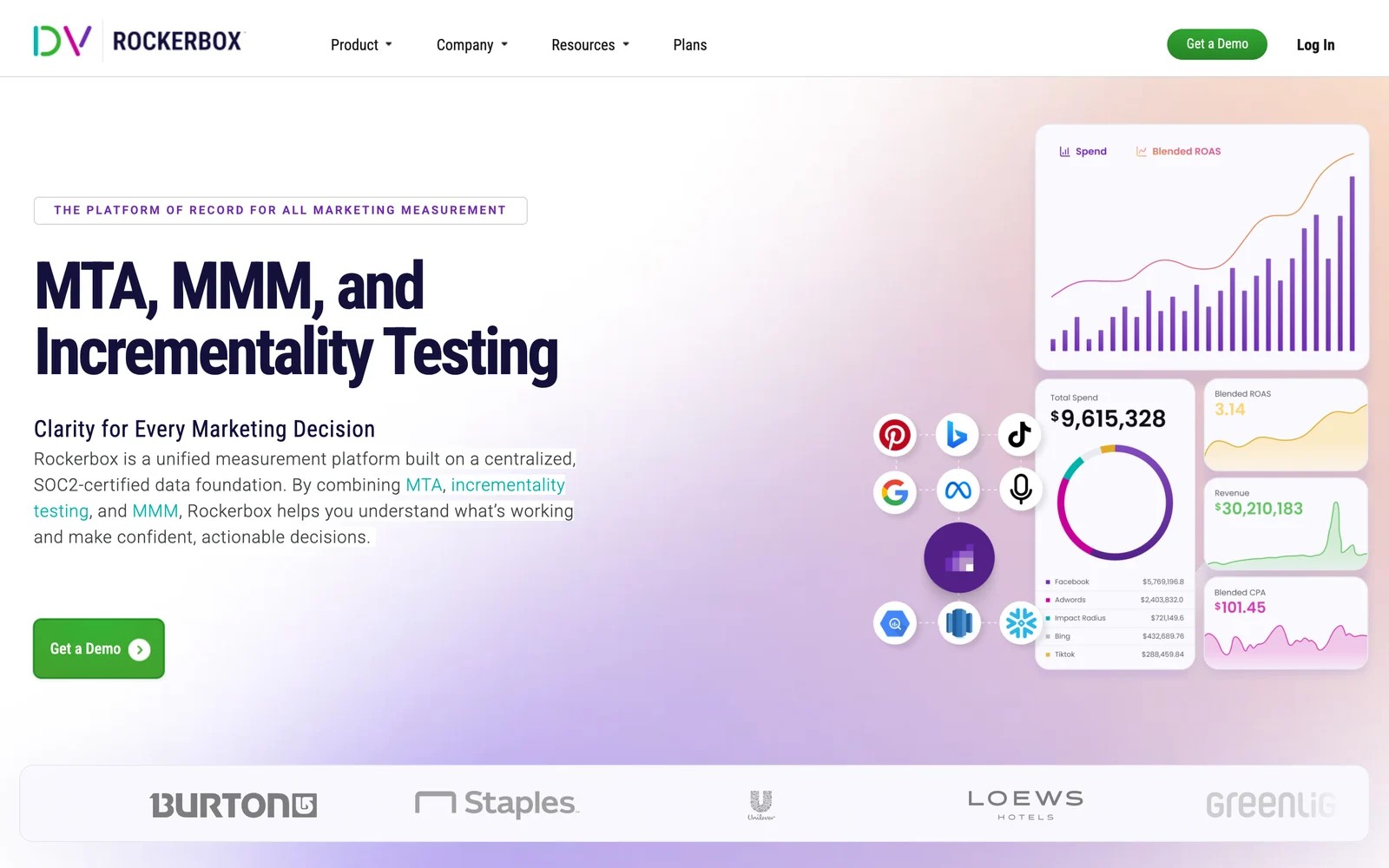
Rockerbox sells itself as one place for all three ways of measuring marketing: multi-touch attribution, media mix modeling and incrementality testing. That's a lot of methodology for one contract.
Since DoubleVerify agreed to buy Rockerbox in February 2025 for $85 million, some customers have also been asking what the roadmap means for them.
In this guide, I'll first explain what each method answers, then sort seven alternatives by the method they're strongest at.
Our approach to this list
Because Rockerbox spans three methods, we grouped alternatives by what they actually measure instead of forcing them into one ranking. We've used Triple Whale ourselves. Northbeam, Measured, Haus, Lifesight and SegmentStream are sold to larger brands through demos, so we relied on their documentation, published methodology and conversations with teams that run them.
The brands and agencies we work with range from lead-gen operators to ecommerce brands testing TV and podcasts, which is why we covered all three methods. Reviews on G2 and Capterra added the user view, though several tools have few public reviews. We asked:
- Which of the three methods does it really do well?
- How much data and spend does it need to work?
- How long until you get a usable answer?
- Can a marketer run it without a data scientist?
SourceLoop is our product. It only does attribution, and we've ranked it for the teams where that's the right method.
Last checked November 2026. Confirm current pricing with each vendor.
Three methods, three different questions
Each method answers a different question, needs different data, and moves at a different speed.
| Method | Question it answers | Data it needs | Speed | Blind spot |
|---|---|---|---|---|
| Multi-touch attribution | Which clicks and campaigns led to each conversion? | Visit-level tracking and conversions | Daily | Ads seen but not clicked, offline media |
| Media mix modeling | How much does each channel drive overall? | Two or more years of spend and sales | Weekly to monthly | Campaign and ad-level detail |
| Incrementality testing | Would these sales have happened without this channel? | Holdout groups or geo splits | Weeks per test | Only tests one thing at a time |
If your spend is mostly clickable digital ads and your conversions are leads or signups, attribution covers most decisions. If you buy TV, podcasts or retail media, you'll need modeling or tests too. Our explainer on multi-touch attribution vs marketing mix modeling goes deeper.
Rockerbox users rate its support. The friction is setup, and the platform's terminology takes learning:
"The first initial set up of Rockerbox can be very tedious it takes a full-time developer to have this done as well as continuous support on the Rockerbox side." (Source)
"The customer service at Rockerbox is top notch." (Source)
"Does not work well with view based channels, like tiktok and youtube; it started charging extra for some services" (Source)
Rockerbox alternatives compared
Here's how the 7 Rockerbox alternatives cover the three methods, as of November 2026.
| Tool | Best for | Multi-touch attribution | Media mix modeling | Incrementality tests | Pricing |
|---|---|---|---|---|---|
 SourceLoop | Lead-gen businesses, agencies, SaaS | Yes | No | No | From $49/mo |
 Northbeam | Large DTC budgets | Yes | Yes | Yes | From $1,500/mo |
 Triple Whale | Shopify brands | Yes | Partly | Partly | Priced by GMV |
 Measured | Enterprise incrementality | No | Yes | Yes | Quote |
 Haus | Geo experiments at scale | Causal attribution | Yes | Yes | Quote |
 Lifesight | Unified measurement, mid-market up | Incrementality-adjusted | Yes | Yes | Quote |
 SegmentStream | Budget allocation for big spenders | Yes | No | Yes | Quote |
The 7 best Rockerbox alternatives
The first three are attribution-led. The last four lean on modeling and experiments.
1. SourceLoop
Best for: lead generation businesses, agencies and SaaS teams whose spend is mostly clickable ads and whose conversions are leads, calls, signups or deals.
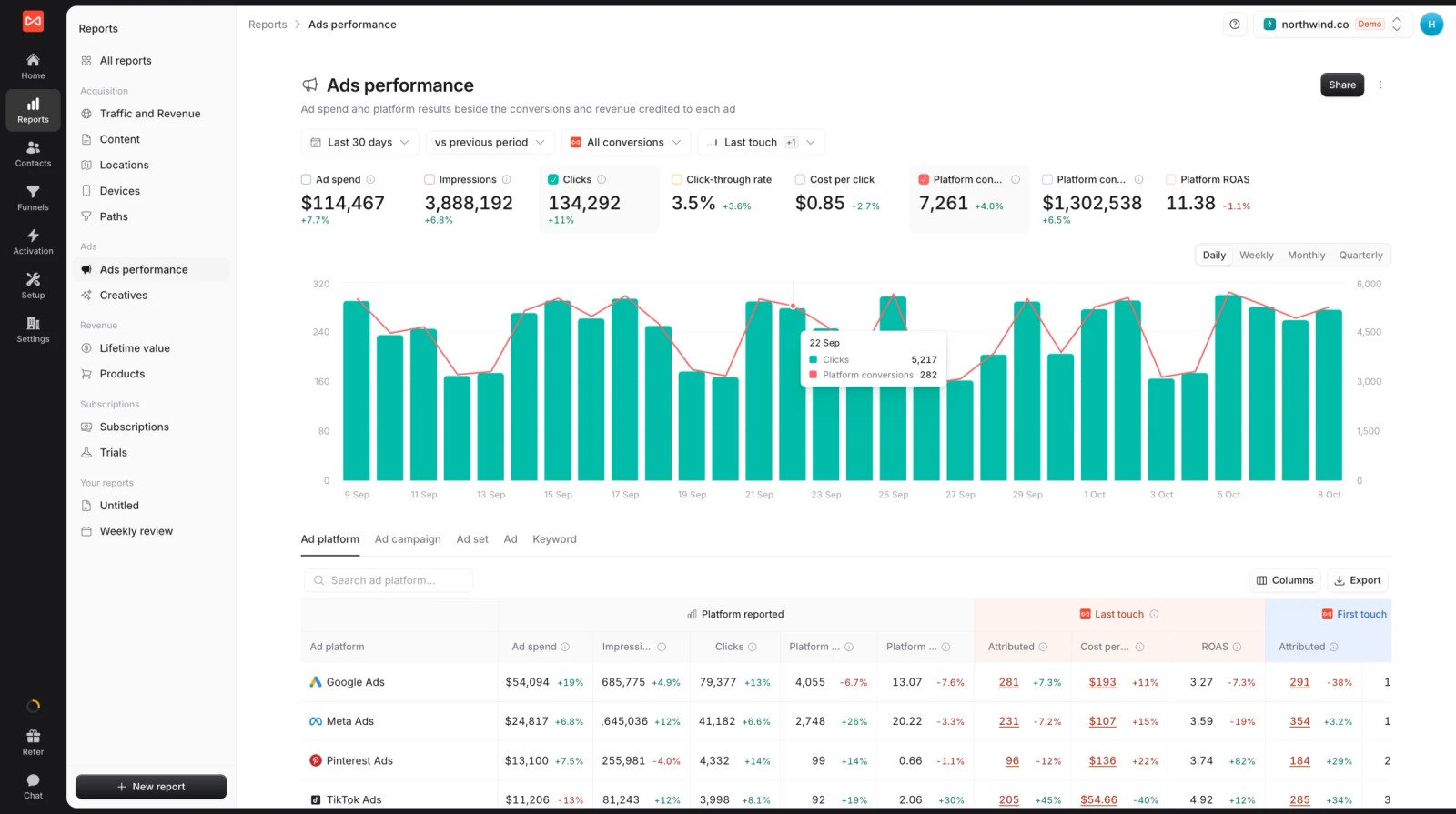
SourceLoop is a first-party marketing attribution and measurement tool. It doesn't model TV or run geo tests. It does the attribution part of Rockerbox with person-level journeys, and it reaches further down the funnel into CRM deals and subscription revenue.
For a lot of teams that bought Rockerbox for attribution, that's the piece they used daily. Here, it's self-serve, the rules are published, and it's live the same day.
Key features
- Platform claims vs credited results: spend, clicks and platform-reported conversions beside what SourceLoop credits each platform under first and last touch.
- Seven rule-based models: first and last touch, first and last non-direct, linear, U-shaped and time decay. Switch models on any report to see how credit moves between channels.
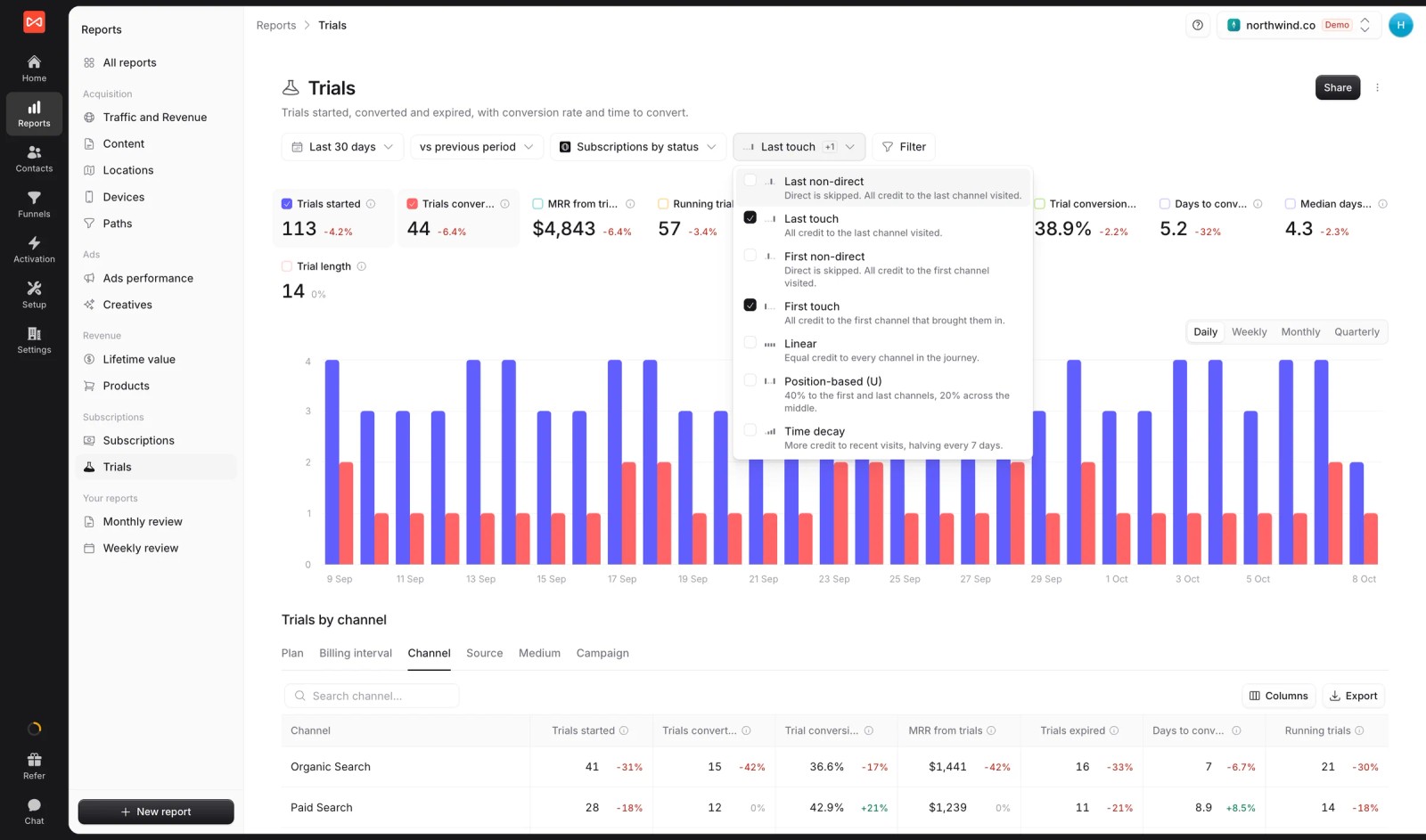
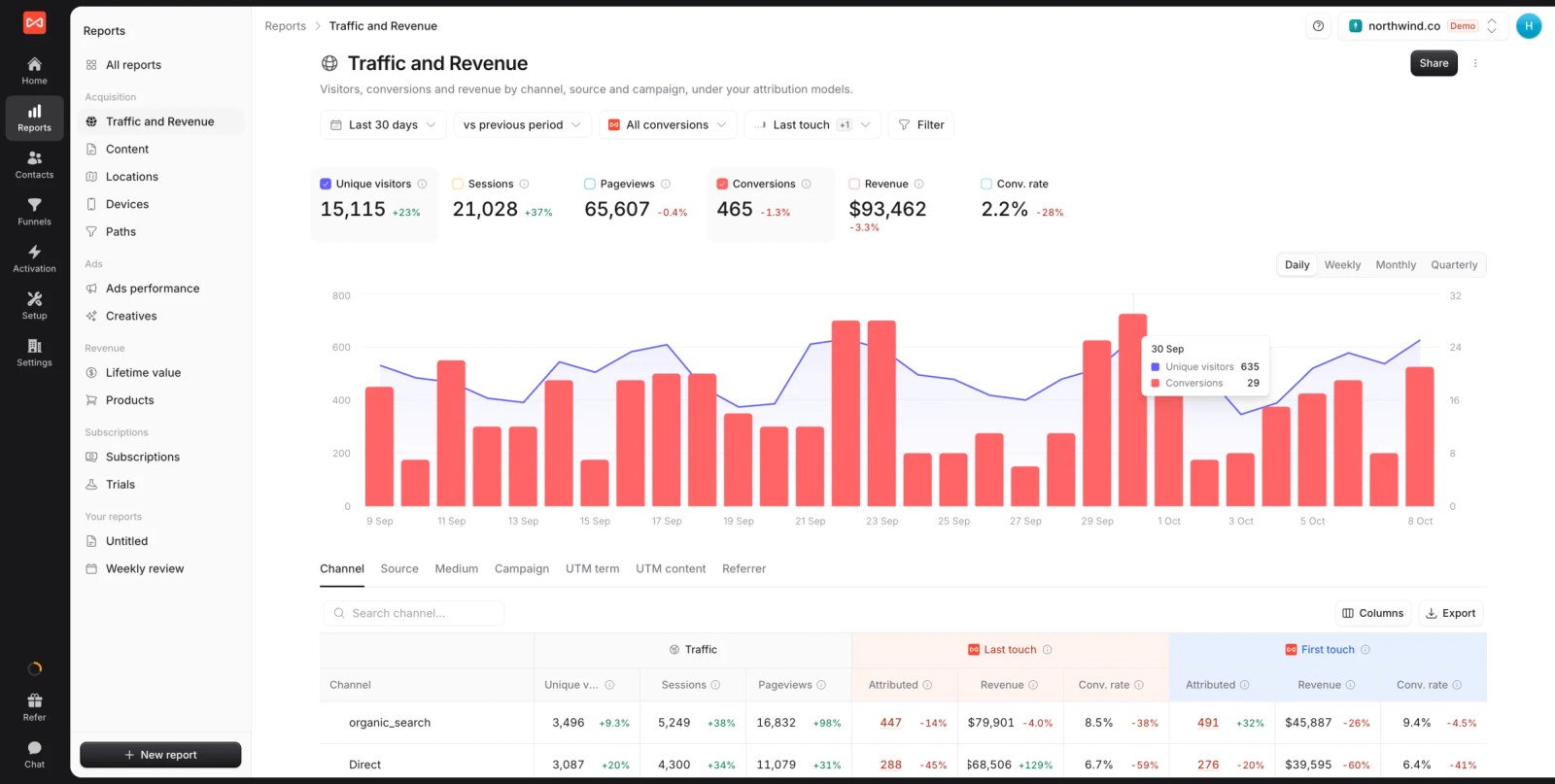
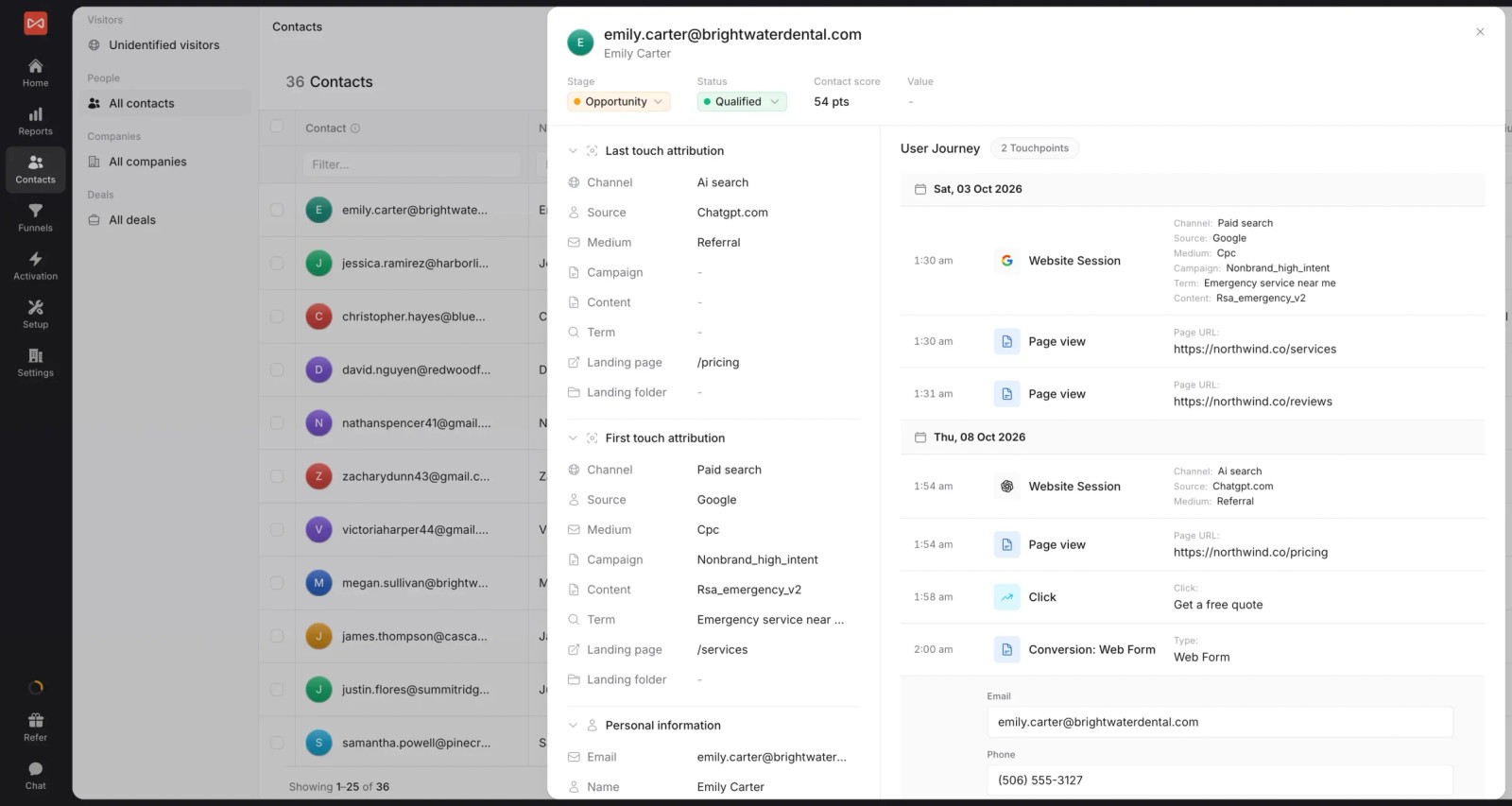
- Person-level journeys: every visit and ad click before a lead, call or sale.
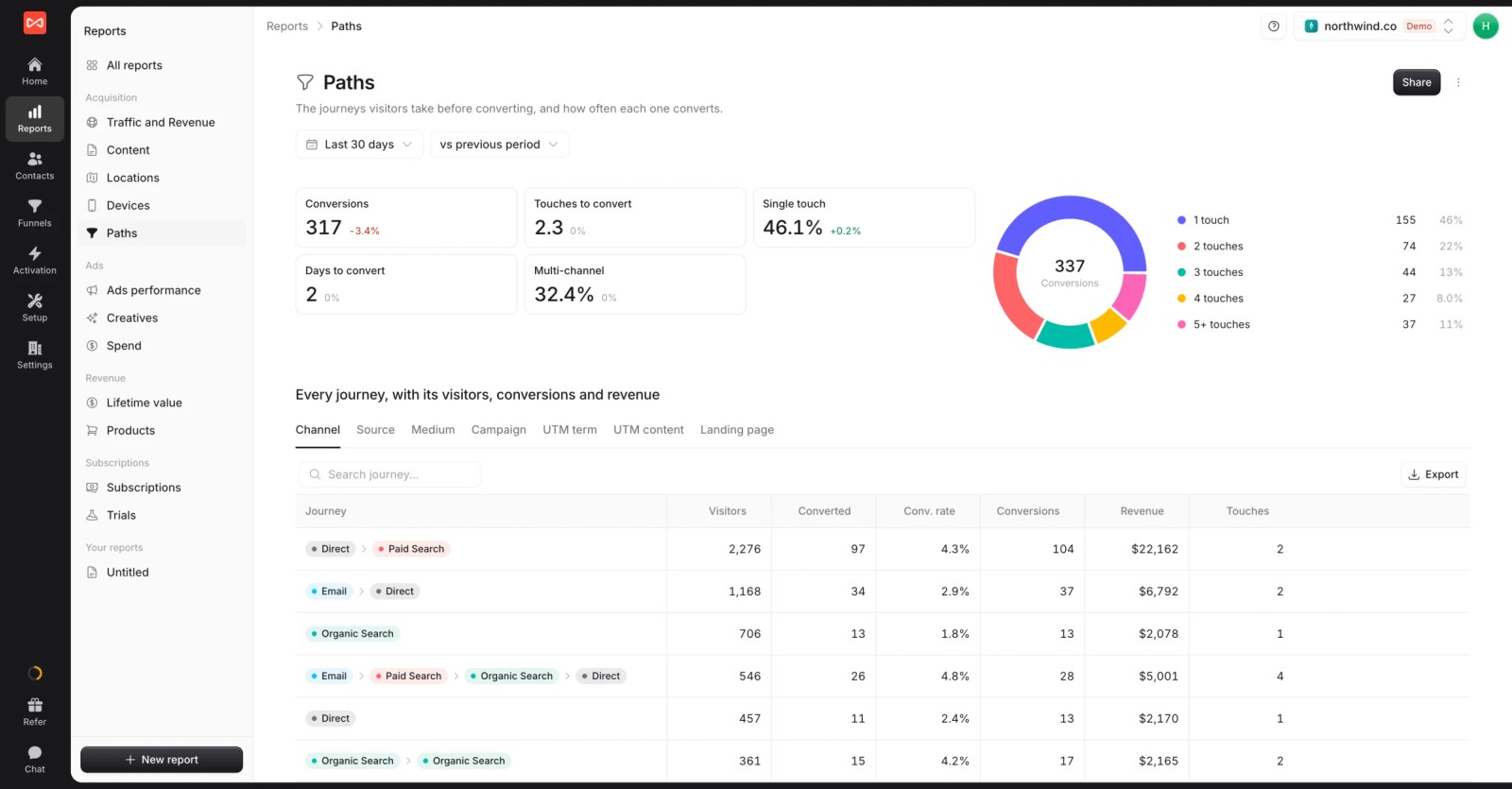
- Conversion paths: the channel sequences that lead to conversions, with touches and days to convert, so you can see which channels open journeys and which close them.
- Outcomes past the form: CRM stages and deals from HubSpot, Salesforce, Pipedrive and Jobber, payments from Stripe or Paddle, and calls from CallRail or CallTrackingMetrics.
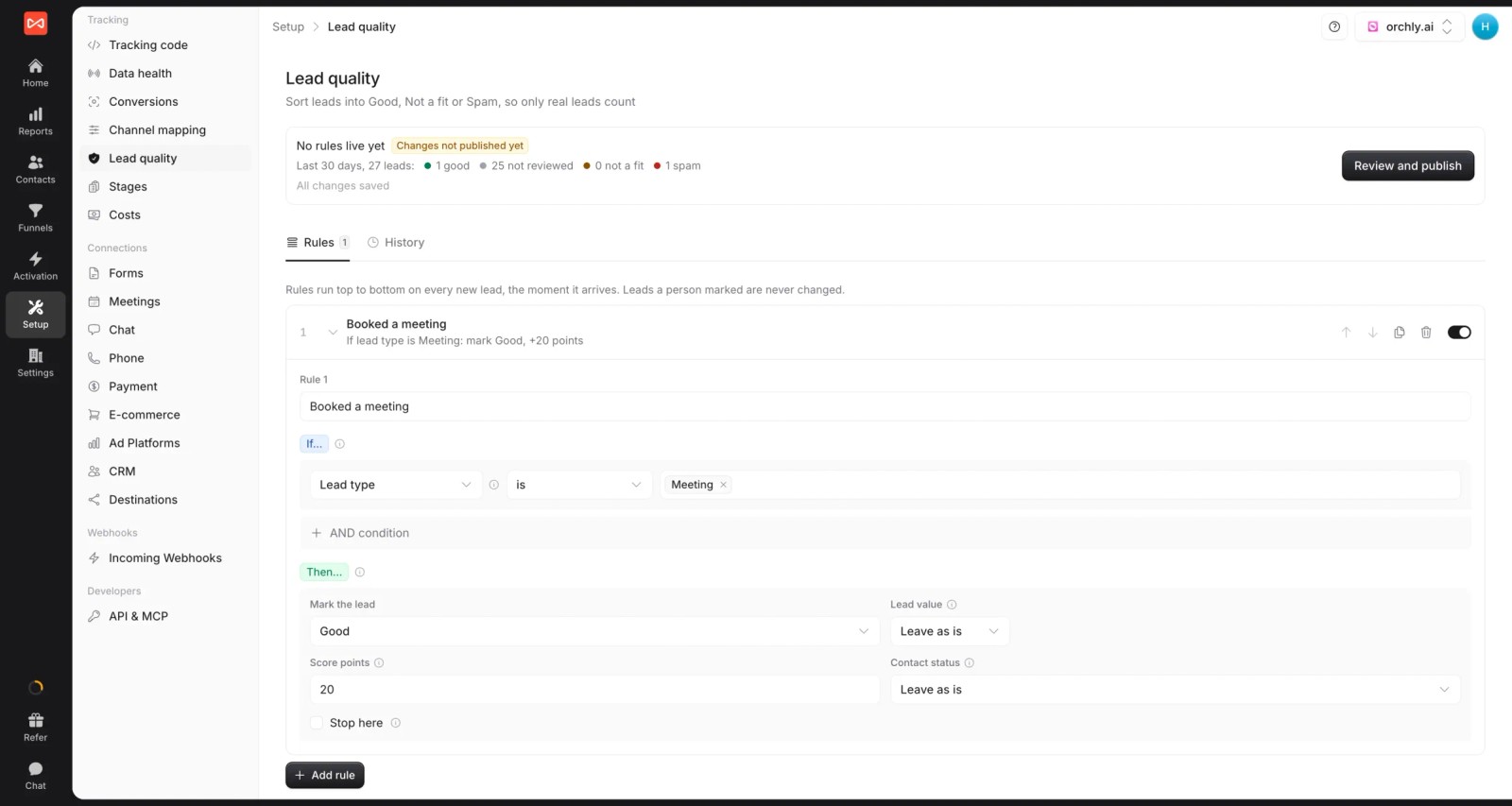
- Lead quality rules: mark leads Good, Not a fit or Spam from form answers, email domain or call length, so reports and bidding skip junk.
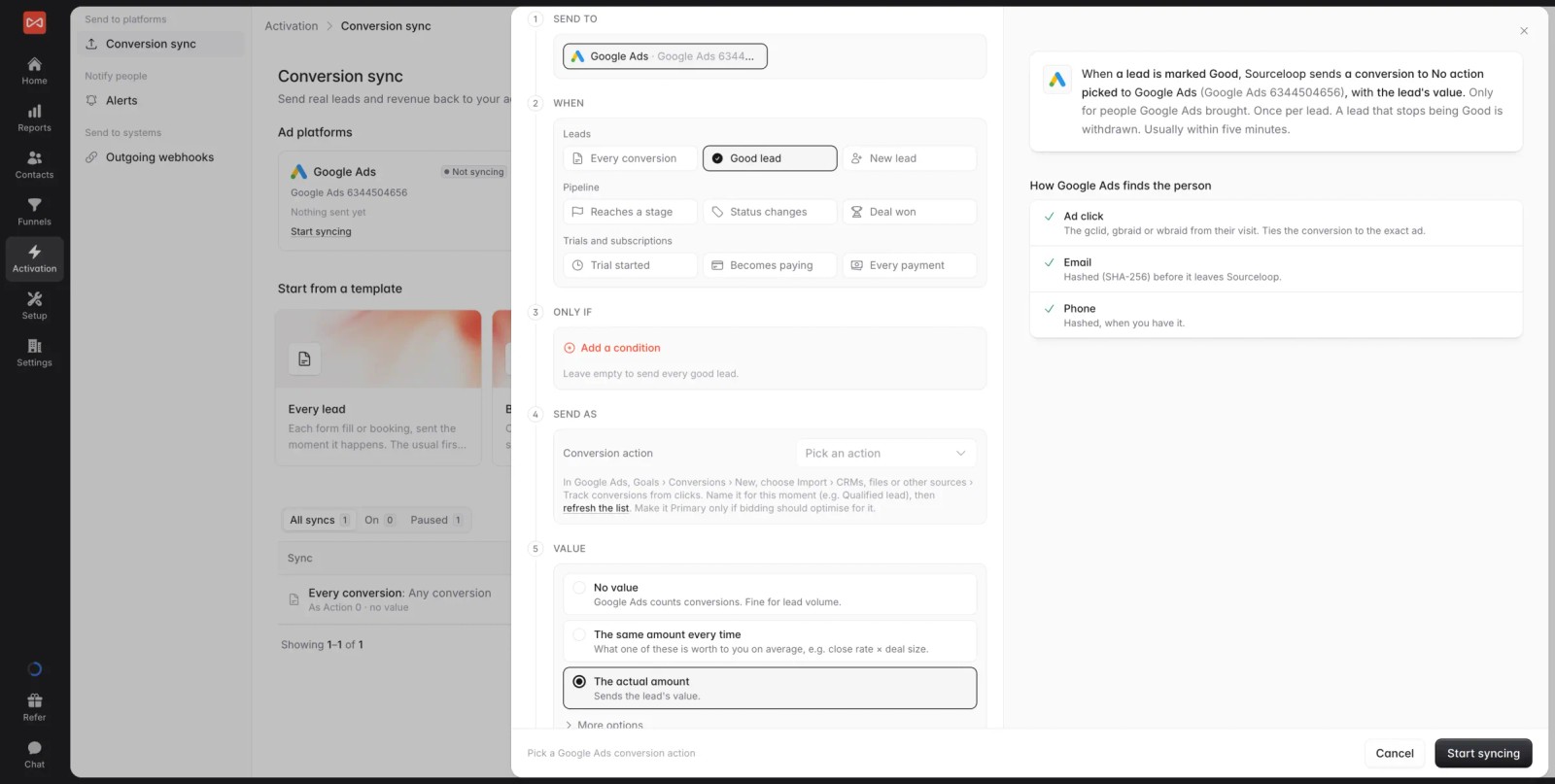
- Conversion sync: good leads, won deals and payments go to Google Ads, Meta, Microsoft Ads and ChatGPT Ads, through server-side conversion sync.
- Warehouse export: send data to Snowflake, BigQuery, S3 or GCS if you want to model it yourself.
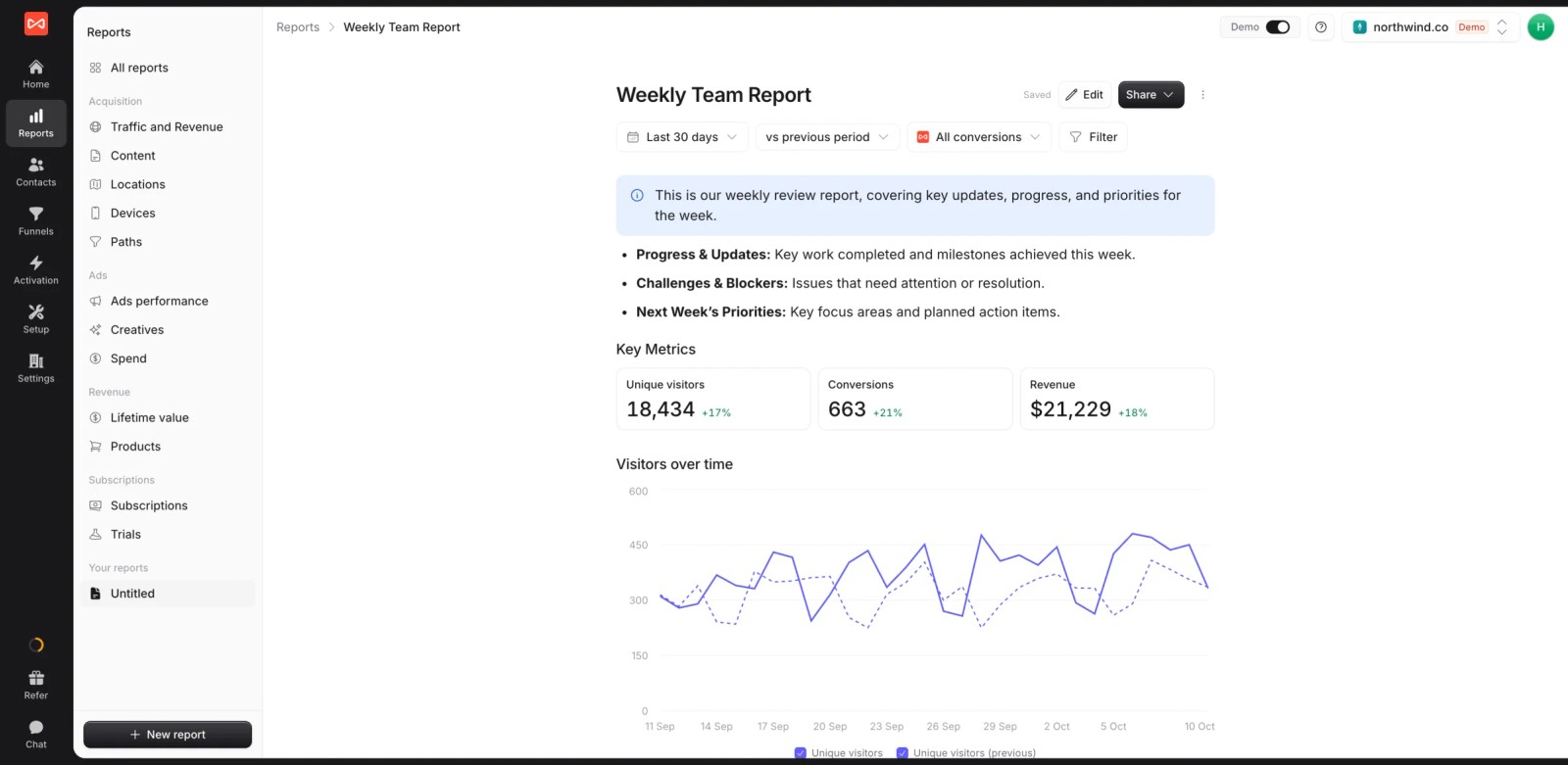
- Custom reports: combine channel numbers, MRR or pipeline into one live document, then share the link or export it, which covers most of the weekly reporting Rockerbox dashboards were used for.
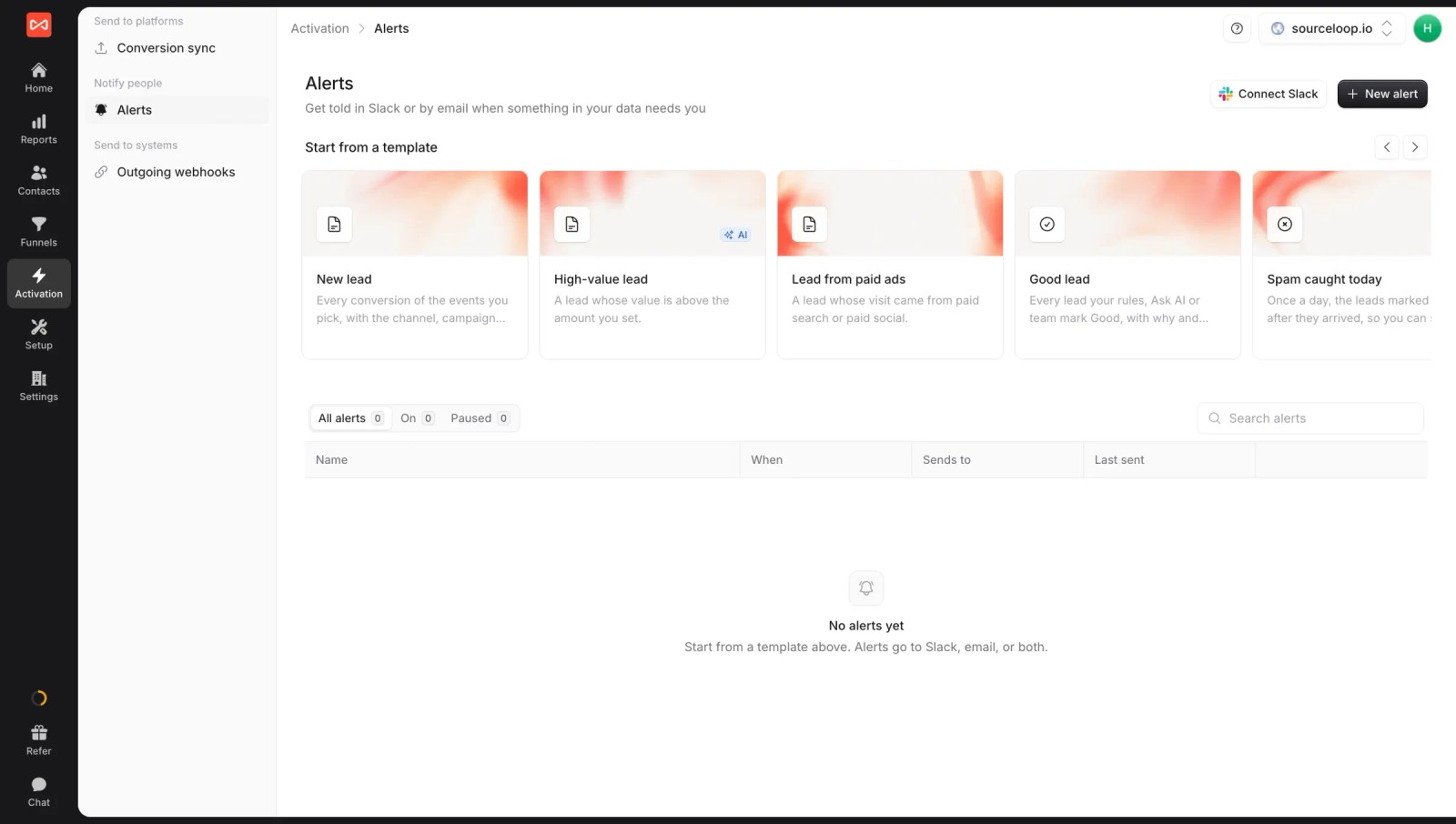
- Alerts: ready-made rules for new leads, high-value leads, paid-ad leads and spam caught, posted to Slack or email.
- White label, multiple websites and MCP: run several sites under one login with your own branding, and query the data from an AI assistant through the MCP server on Professional and up.
Where it falls short
- No media mix modeling or incrementality testing. Try our free marketing mix model calculator for a rough first read, or pair it with a dedicated MMM tool.
- No view-through credit, and it isn't built for Shopify stores.
Pricing
- Essential: $49/mo for one site and 30,000 page views, with tracking, attribution reports, lead quality rules and alerts
- Professional: $99/mo for 100,000 page views and unlimited users, adding CRM sync, conversion sync to the ad platforms, the API and MCP
- Agency: $249/mo for three sites and 1.5 million page views, adding white label reporting
- Unlimited conversions and a 7-day trial. Rockerbox is quoted.
Verdict: the right swap if attribution was the part of Rockerbox you relied on and your conversions happen in a CRM or billing system. Not a replacement for its MMM or testing.
2. Northbeam
Best for: DTC brands with large paid budgets that want all three methods from one vendor, much like Rockerbox.
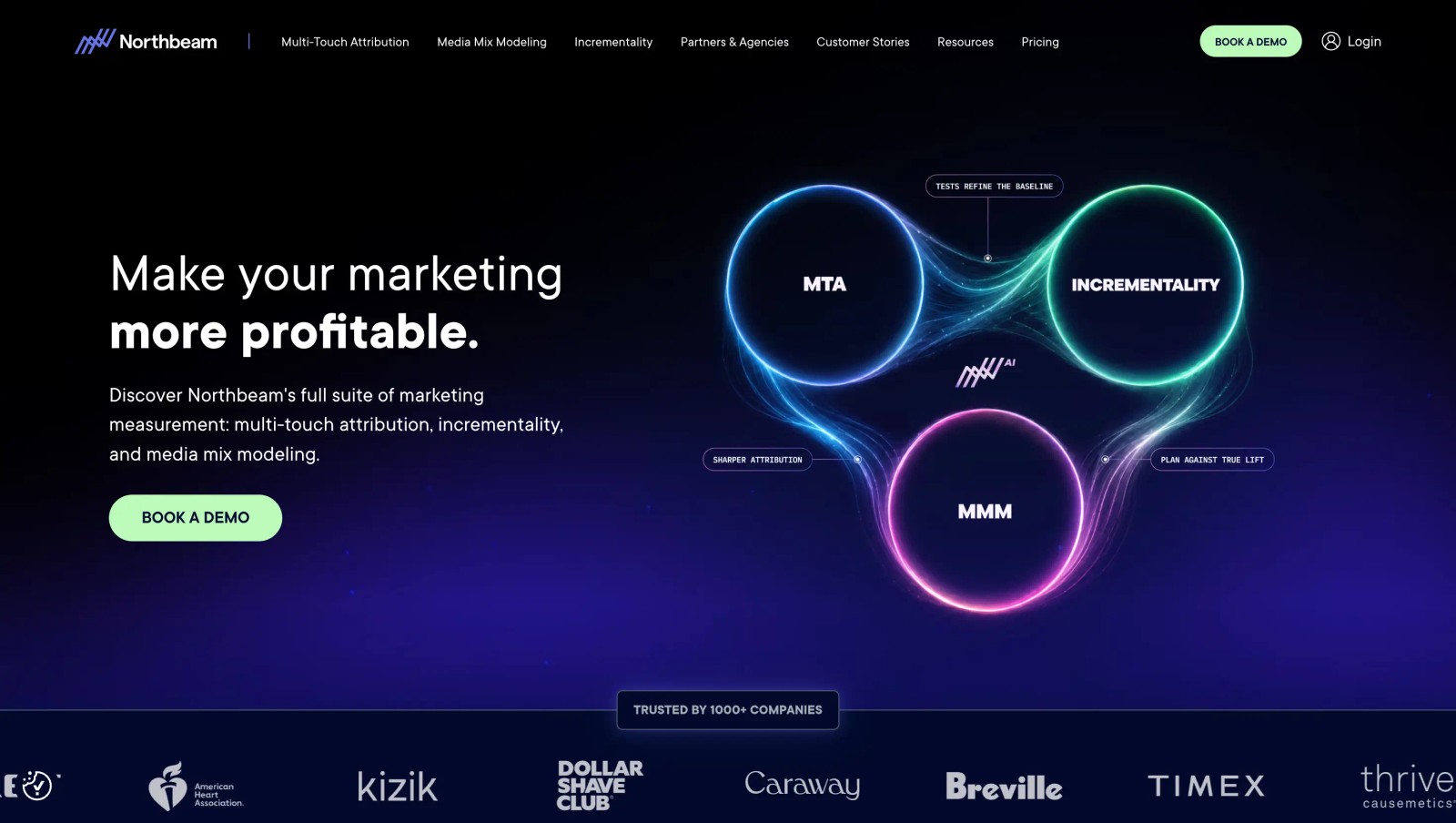
Northbeam is the closest like-for-like Rockerbox alternative for ecommerce. Its attribution counts clicks and deterministic views, and MMM Plus and incrementality testing are available on higher tiers.
Brands above its spend threshold call it their source of truth. Below it, onboarding and price are the usual complaints, and some miss a simple blended view because the data is modeled.
Teams we know who switched from Rockerbox to Northbeam say the daily attribution dashboards felt familiar quickly. The bigger adjustment was its modeled view-through credit, which shifts more value toward paid social than they were used to.
In the walkthrough I saw, the incrementality and MMM Plus modules sat behind the higher tiers, so a Rockerbox customer using all three methods should price Professional or Enterprise, not Starter. That's the comparison that matters at renewal time.
Key features
- Its multi-touch attribution counts deterministic ad views as well as clicks, which matters most for brands spending heavily on Meta and TikTok.
- MMM Plus models channel contribution alongside seasonality and promotions, so a big sale week doesn't get mistaken for a channel suddenly working.
- Incrementality testing is an option on the Professional and Enterprise plans, letting larger brands check what attribution says against controlled tests.
- Northbeam Apex sends enriched conversion data back to the ad platforms, with the aim of improving how their algorithms target and bid.
Where it falls short
- It attributes store orders, so lead generation businesses with deals in a CRM won't see their revenue reflected anywhere.
- Brands spending well below its pricing tiers will find the cost and onboarding hard to justify against lighter tools.
- There's no self-serve trial, so evaluating it means a demo and sales process before you see any of your own data.
What users say
"Northbeam is our standard for all attribution now, for paid and owned channels." (Source)
"All of the data is modeled, so there's no way to look at a \"blended\" performance report." (Source)
"It can be a bit pricier than some other solutions (not saying it's not worth it!), but for smaller companies, may be out of their price range." (Source)
Northbeam has no reviews on Capterra yet.
Pricing
- Starter: from $1,500/mo
- Professional: from $3,500/mo, with incrementality optional
- Enterprise: custom, with MMM Plus optional. See Northbeam pricing.
3. Triple Whale
Best for: Shopify brands that want daily attribution and analytics without an enterprise contract.
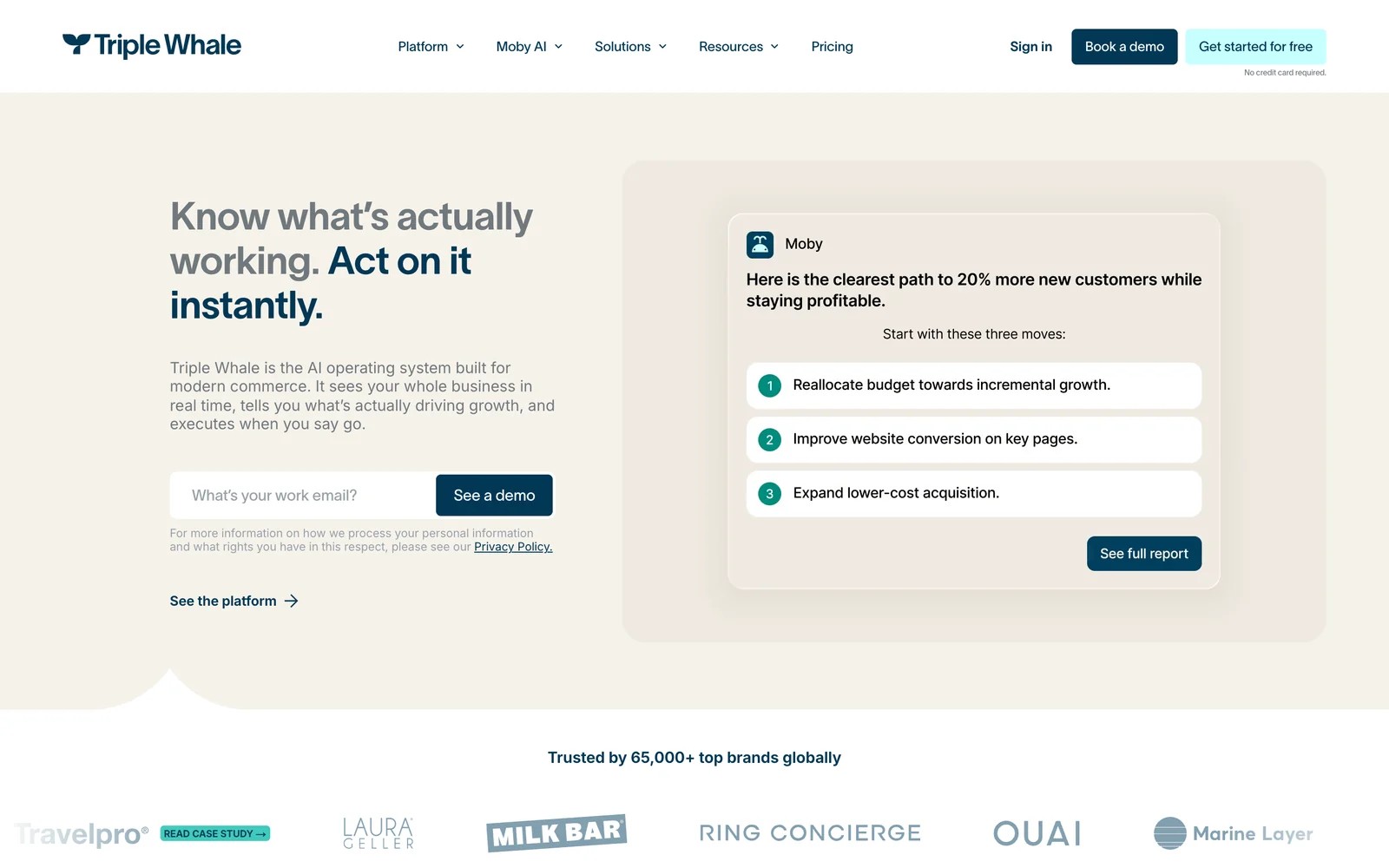
Triple Whale covers the attribution side for Shopify, with its own pixel, cohorts and AI agents, and has added modeling and lift-style features on top. It's lighter than Rockerbox and much quicker to start.
We've tested it. The dashboard is useful on day one. The pixel's numbers need explaining to stakeholders, since they rarely line up with Meta's, and that's where Rockerbox-style rigor is thinner.
When I set it up, the free plan got the pixel and a unified dashboard running before I'd spoken to anyone, which is the opposite of Rockerbox's sales-led start. Multi-touch attribution, custom dashboards and signals back to the ad platforms sit on the paid tiers, priced by GMV.
For a Rockerbox customer, the honest framing is that Triple Whale replaces the daily attribution view well and the measurement science only partly. If you relied on Rockerbox's MMM or tests for budget decisions, plan to add something for that.
Key features
- Shopify orders, ad spend and data from the Triple Pixel land in one dashboard, which most store owners find useful from the first day.
- Orders are attributed across Meta, Google, TikTok and other paid channels, covering the attribution job Rockerbox did for many ecommerce brands.
- AI agents answer questions about performance and build reports on request, saving smaller teams from digging through dashboards themselves.
- Enriched conversion data goes back to the ad platforms, giving their bidding algorithms a fuller picture of which orders came from ads.
Where it falls short
- Its modeling and testing features are lighter than Rockerbox's, so brands that relied on MMM depth may feel the gap.
- Leads and CRM deals aren't attributed, which makes it a poor fit for anything other than ecommerce stores.
- Pricing rises with store revenue, so a growing brand's bill climbs even if its usage of the tool stays the same.
What users say
"Triple Whale is our source of truth for marketing data." (Source)
"Unfortunately the Enterprise version has all the best toys and is quite pricey for SMEs." (Source)
"Also, the attribution of imported marketplace orders is not working." (Source)
Pricing
- Priced by store GMV, with a free starter tier. See Triple Whale pricing.
4. Measured
Best for: enterprise brands that want incrementality to drive budget decisions across many channels.
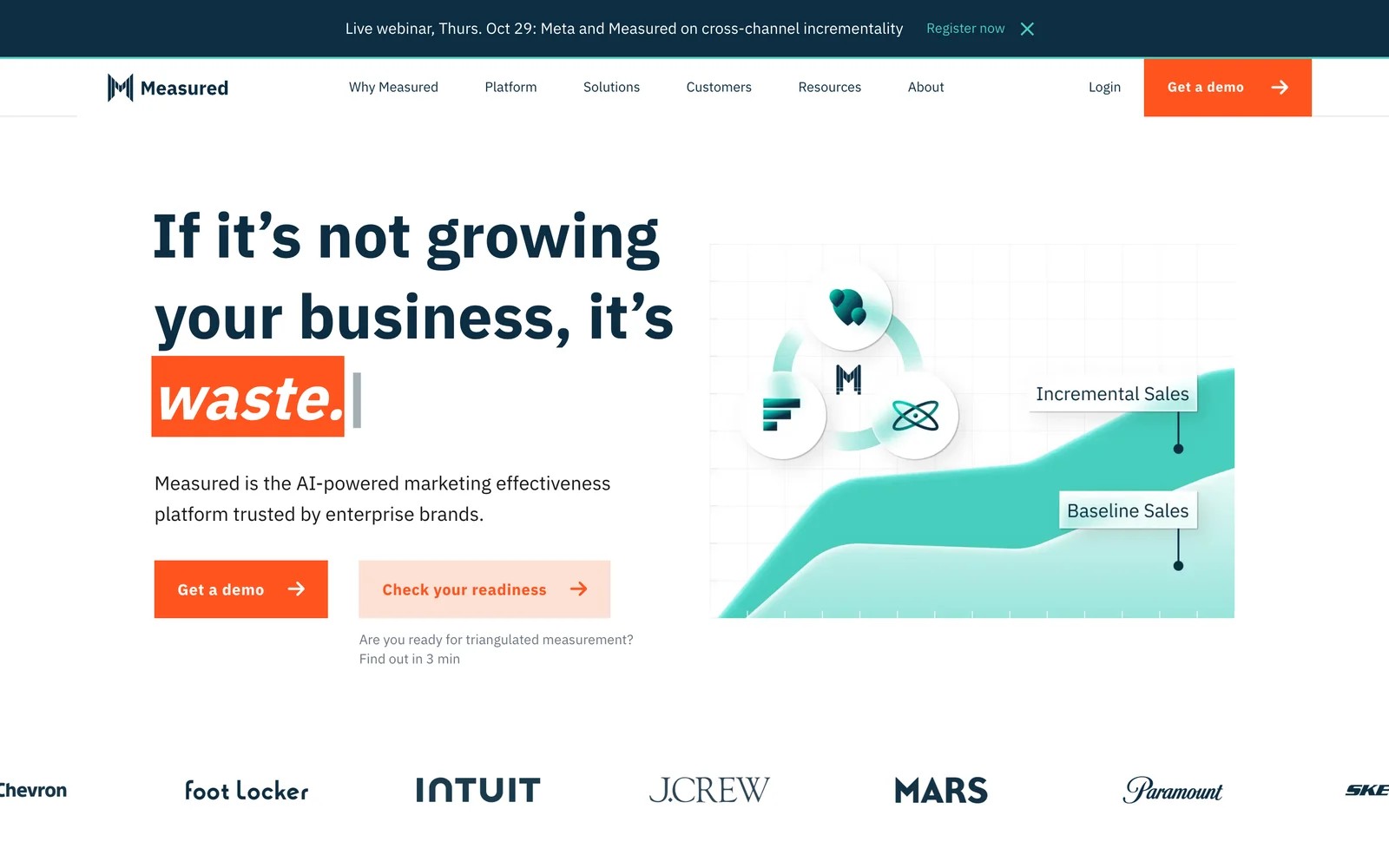
Measured is built around incrementality: it runs tests across channels and combines them with modeling to estimate what each channel truly adds. It comes with a strategy team, which is a big part of what customers pay for.
Reviewers who picked it often did so after deciding against multi-touch attribution. They praise the team and methodology. The costs are setup help, manual tests outside the major platforms, and results that can be hard to explain internally.
From what teams we know describe, Measured feels more like a partnership than a dashboard. The strategy team designs tests with you, and the first useful readouts take a few test cycles, so it rewards patience.
Key features
- Incrementality tests run across the major ad platforms, and their results feed directly into the budget recommendations the team gives you.
- A media mix model estimates each channel's contribution and is calibrated with those test results, which keeps it grounded in real experiments.
- Cross-channel reporting ties performance to finance goals as well as marketing ones, useful when the CFO is the person asking for proof.
- A dedicated strategy team helps design tests and interpret what they mean, a large part of what enterprise customers are paying for.
Where it falls short
- It doesn't provide click-level journeys or campaign-level attribution, so day-to-day optimization still needs another tool alongside it.
- Most of the value comes through its services team, which suits enterprises but leaves little room for a hands-off setup.
- Tests need large budgets to detect a lift reliably, which puts it out of reach for small and mid-sized advertisers.
What users say
"With updates in privacy laws and breakage all over the place, we decided not to go down the multi-touch attribution path." (Source)
"Most tests (outside of the standard platforms) have to be setup manually and you can only do so many at the same time." (Source)
"We have had some instances where our dashboards do not work / data was loaded incorrectly." (Source)
Pricing
- Quoted, for enterprise brands.
5. Haus
Best for: large brands that want frequent geo experiments and a causal MMM built on them.
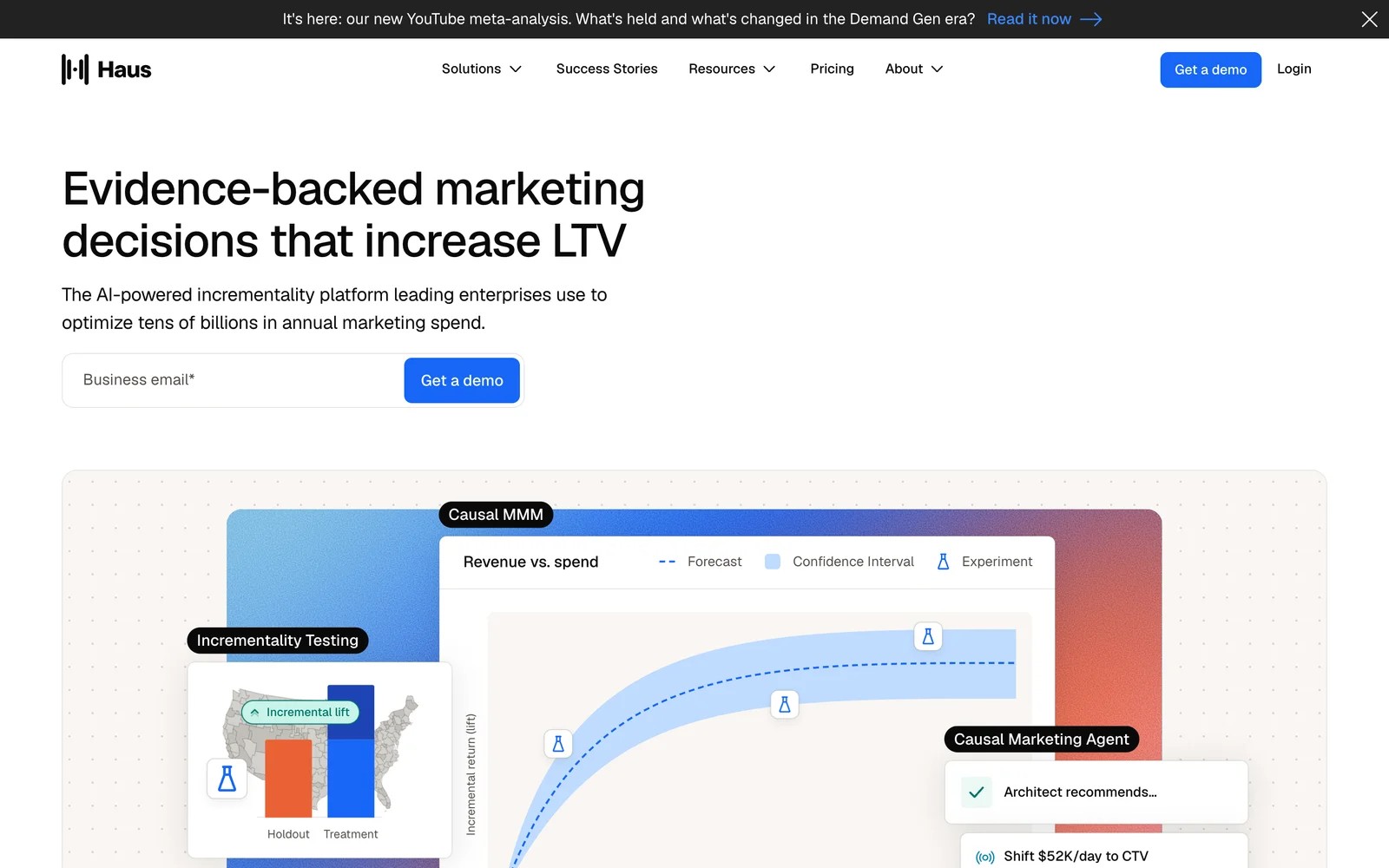
Haus runs incrementality experiments, then uses them to build a causal MMM that updates weekly, plus causal attribution down to the ad. An AI agent called Architect suggests next moves.
Its customers are big names, such as Intuit, FanDuel and Sonos, and experiments are set up with the Haus team. We couldn't find public reviews on G2 or Capterra, so we're relying on its documentation and published case studies.
Reading through its methodology, the idea I found most useful is that the MMM is anchored to real experiments, so the model isn't left to guess what a channel adds. For a brand that distrusted Rockerbox's modeled outputs, that's a meaningful difference.
The catch is the cadence. Geo experiments need enough spend and enough regions to read cleanly, so smaller brands may wait a long time between results.
Key features
- Incrementality experiments compare exposed and holdout groups across online and offline channels, showing what each one adds beyond baseline sales.
- A causal mix model, calibrated by those experiments, updates every week, so budget decisions don't wait for a quarterly modeling refresh.
- Causal attribution estimates incremental impact down to the individual ad, bringing experiment-based thinking into day-to-day creative decisions.
- The Architect agent flags risks, runs what-if scenarios and recommends next actions, aimed at teams running many tests at once.
Where it falls short
- There's no self-serve setup or trial, and experiments are configured with the Haus team, so expect a sales-led start.
- It doesn't track individual leads or customer journeys, so it can't tell you which campaign produced a specific deal.
- The product is aimed at large advertisers, and smaller budgets rarely generate enough volume for its experiments to be conclusive.
What users say
We couldn't find Haus reviews on G2 or Capterra. Ask for references from brands with a similar channel mix.
Pricing
- Quoted after a demo.
6. Lifesight
Best for: mid-market and larger brands that want MMM, incrementality and adjusted attribution in one platform.

Lifesight combines causal MMM, incrementality testing and incrementality-adjusted attribution, with AI agents for planning budgets. In scope, it's one of the closest matches to Rockerbox.
Users like the unified approach. The recurring complaints are a learning curve, pricing that isn't transparent, and slow reports on large datasets.
Reviewers say the first weeks go into understanding its causal approach and feeding it enough historical spend data. After that, having mix modeling, tests and attribution in one place is the part they value most.
In the walkthrough, budget planning was where it felt most different from Rockerbox: you can model next quarter's spend split and see the forecast before moving any money. That's useful for finance conversations, less so for daily campaign tweaks.
Key features
- A causal mix model shows how each channel contributes and where budget should move next, including offline media that clicks never capture.
- Incrementality tests calibrate the model and validate individual channels, so you can check a surprising result before acting on it.
- Attribution is adjusted using measured incrementality, which reduces the credit given to channels that mostly harvest demand you already had.
- AI agents compare budget scenarios and suggest plans within the limits you set, useful for teams juggling many channels and markets.
Where it falls short
- Prices aren't published, so you won't know whether it fits your budget until you've spoken to sales.
- It doesn't show raw, person-level journeys, which lead-gen teams need to connect a campaign to an actual customer.
- Its models need enough historical spend data to work well, so newer brands or recent channel launches may get weaker results.
What users say
"Its unified measurement approach combines MMM and causal attribution, making it a comprehensive solution." (Source)
"The learning curve is somewhat steep, and the pricing tends to be on the higher side." (Source)
"Some reports took a while to load, especially when filtering large datasets." (Source)
Lifesight has no reviews on Capterra yet.
Pricing
- Quoted. Our Lifesight alternatives guide compares it with similar tools.
7. SegmentStream
Best for: performance teams with large digital budgets that want attribution, tests and automated budget allocation.
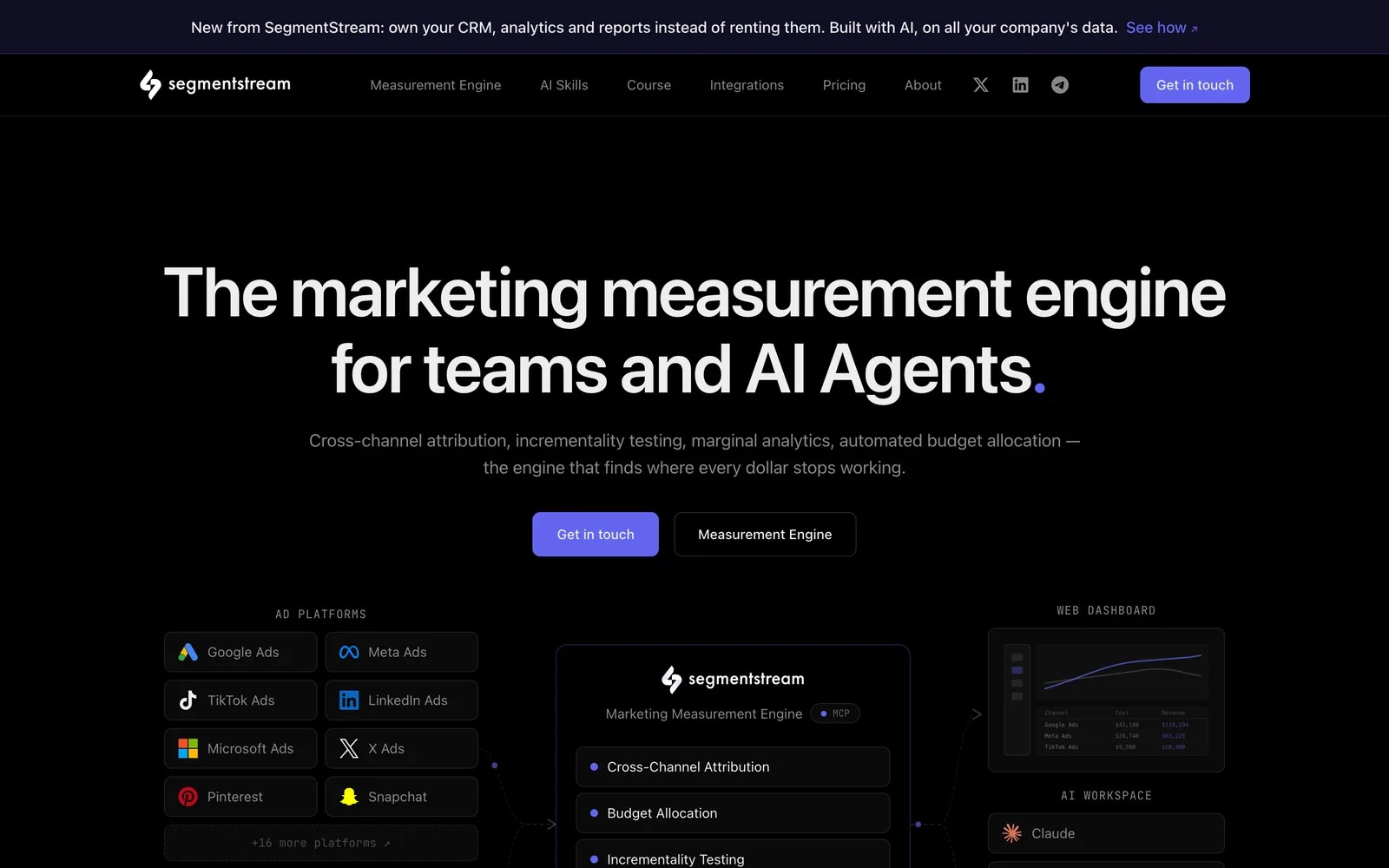
SegmentStream scores each visit's likelihood to convert, uses that for cross-channel attribution, and adds incrementality testing and automated budget allocation. It's positioned for brands spending heavily on digital media.
Reviewers find its visit-scoring approach distinctive. Its MMM for non-click media is seen as less differentiated, and some want better visuals for explaining the model internally.
In the demo, the visit-scoring view was the part worth seeing. Each session gets a predicted likelihood to convert, so channels that bring engaged visitors get credit even before a sale happens, which helps with longer consideration cycles.
Teams I know who run it say the budget allocation recommendations are where it pays off, but only at real scale. SegmentStream itself points to $100K or more a month in ad spend, so it isn't an option for most brands leaving Rockerbox on cost.
Key features
- Every site visit is scored for its likelihood to convert, and that score drives attribution, so channels that start journeys get recognized.
- Incrementality testing validates whether a channel's impact is real, giving performance teams a second check beyond the attribution model.
- Automated budget allocation recommends spend shifts down to campaign level, which suits brands managing large digital budgets across many accounts.
- An MCP server and AI skills let teams query the measurement engine from AI assistants, without exporting the data first.
Where it falls short
- Pricing and service are built for brands with large digital budgets, which rules out most small and mid-sized teams.
- CRM deals aren't attributed for lead generation, so B2B and service businesses won't see pipeline in its reports.
- Its modeling for offline media is less of a strength, so brands spending heavily on TV or print may need a separate MMM.
What users say
"SegmentStream's approach of scoring every single site visit is something I haven't seen from any other marketing measurement vendor and makes a ton of sense." (Source)
"They have an MMM for no-click media but that aspect of their solution is less differentiated vs alternatives" (Source)
"I would love to have better visualization tools for the model, making it easier to communicate internally and explain how it works." (Source)
SegmentStream has no reviews on Capterra yet.
Pricing
- Quoted, aimed at brands spending $100K+ a month on paid media, according to its pricing page.
How to choose
Choose by the question you most need answered, then by budget.
"Which campaigns produced these leads, deals or signups?"
- That's attribution. SourceLoop fits lead generation businesses, agencies and SaaS teams, and sends the results back to Google Ads, Meta and Microsoft Ads. Northbeam and Triple Whale fit ecommerce.
"How much is TV, podcast or retail media really adding?"
- That's modeling. Lifesight or Northbeam's MMM Plus, or Measured if you want a strategy team alongside.
"Is this channel incremental at all?"
- That's testing. Haus or Measured for large budgets, SegmentStream for heavy digital spend.
Budget check: the MMM and testing platforms here are quoted and aimed at large advertisers. If your monthly ad spend is in the thousands, not hundreds of thousands, attribution alone will usually answer what you need. See Rockerbox pricing for context on what you'd be replacing.
Frequently asked questions
-
What is Rockerbox?
Rockerbox is a marketing measurement platform that combines multi-touch attribution, media mix modeling and incrementality testing on a unified first-party data foundation. DoubleVerify announced it would acquire Rockerbox in February 2025.
-
How much does Rockerbox cost?
Rockerbox doesn't publish prices. Plans are quoted after a demo, based on the products you choose and your data volume.
-
What is the closest alternative to Rockerbox?
For ecommerce brands that want all three methods from one vendor, Northbeam and Lifesight are the closest. For lead generation and SaaS teams that mainly used Rockerbox for attribution, SourceLoop is a self-serve alternative from $49 a month.
-
Do I need both multi-touch attribution and MMM?
Only if a meaningful share of your spend goes to channels people can't click, like TV, radio or podcasts. For mostly digital, click-based spend, multi-touch attribution answers most day-to-day questions.
-
What's the difference between MMM and incrementality testing?
MMM uses historical spend and sales to estimate each channel's contribution. Incrementality testing runs controlled experiments, like geo holdouts, to measure whether a channel causes extra sales. Many platforms use tests to calibrate their models.
-
Which Rockerbox alternative is cheapest?
SourceLoop starts at $49 a month for attribution. Triple Whale has a free starter tier for Shopify stores. The MMM and incrementality platforms are all quoted.


 Paid Social


