
10 Best Marketing Measurement Tools: Compared in 2026
A practical comparison of 10 marketing measurement tools across MMM, incrementality, and unified measurement, who they're built for, and what you'll actually pay.
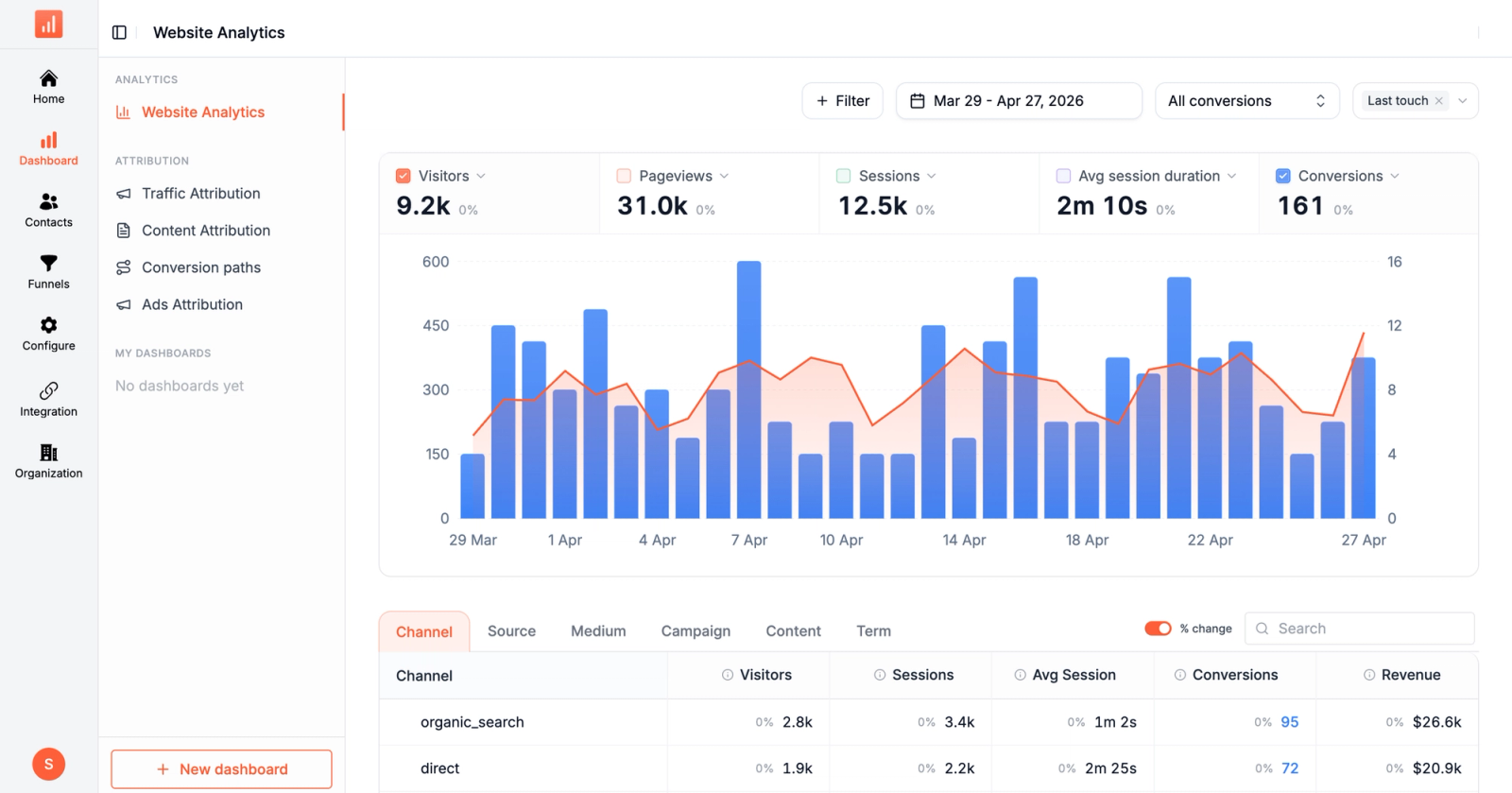
Table of contents
Marketing measurement is having a moment.
With third-party cookies fading, iOS opt-in rates stuck around 15-25%, and last-click attribution increasingly wrong, marketers are returning to the disciplines that don't depend on user-level tracking: marketing mix modeling (MMM) and incrementality testing.
The category below covers the 10 measurement tools driving that shift in 2026.
Quick Comparison of Best Marketing Measurement Software
| Tool | Methodology | Starts at |
|---|---|---|
 Sourceloop Sourceloop |
First-party data foundation + attribution | $49/mo |
 Northbeam Northbeam |
Attribution + MMM + incrementality | $1,500/mo |
 Triple Whale Compass Triple Whale Compass |
Unified MTA + MMM + incrementality | Add-on to TW plans |
 Measured Measured |
Incrementality testing + Causal MMM | $50K+/yr |
 Recast Recast |
Self-serve Bayesian MMM | $1,000+/mo |
 INCRMNTAL INCRMNTAL |
Always-on causal AI incrementality | Custom |
 Rockerbox Rockerbox |
Attribution + MMM + incrementality | Custom |
 Sellforte Sellforte |
Next-gen MMM with miROAS optimization | Custom |
 Google Meridian / Meta Robyn Google Meridian / Meta Robyn |
Open-source Bayesian MMM | Free |
 Analytic Partners Analytic Partners |
Enterprise MMM consultancy | Custom |
1. Sourceloop
Best for: Teams that need clean first-party data as the foundation for any measurement approach
Sourceloop isn't an MMM platform, and it isn't an incrementality testing tool.
It's the first-party data foundation that both methodologies depend on. MMM models are only as good as the marketing spend, conversion, and revenue data feeding them.
Incrementality tests rely on accurate conversion events captured server-side, before iOS or ad blockers strip them.
Most teams investing in measurement skip the data layer and then wonder why their MMM coefficients are noisy or their lift tests come back inconclusive.
Sourceloop is one tag, $49 a month, that captures every visitor's source, all UTMs and click IDs, server-side conversions back to Google, Meta, TikTok, and LinkedIn, and revenue events stitched from Stripe, Polar, and LemonSqueezy webhooks.
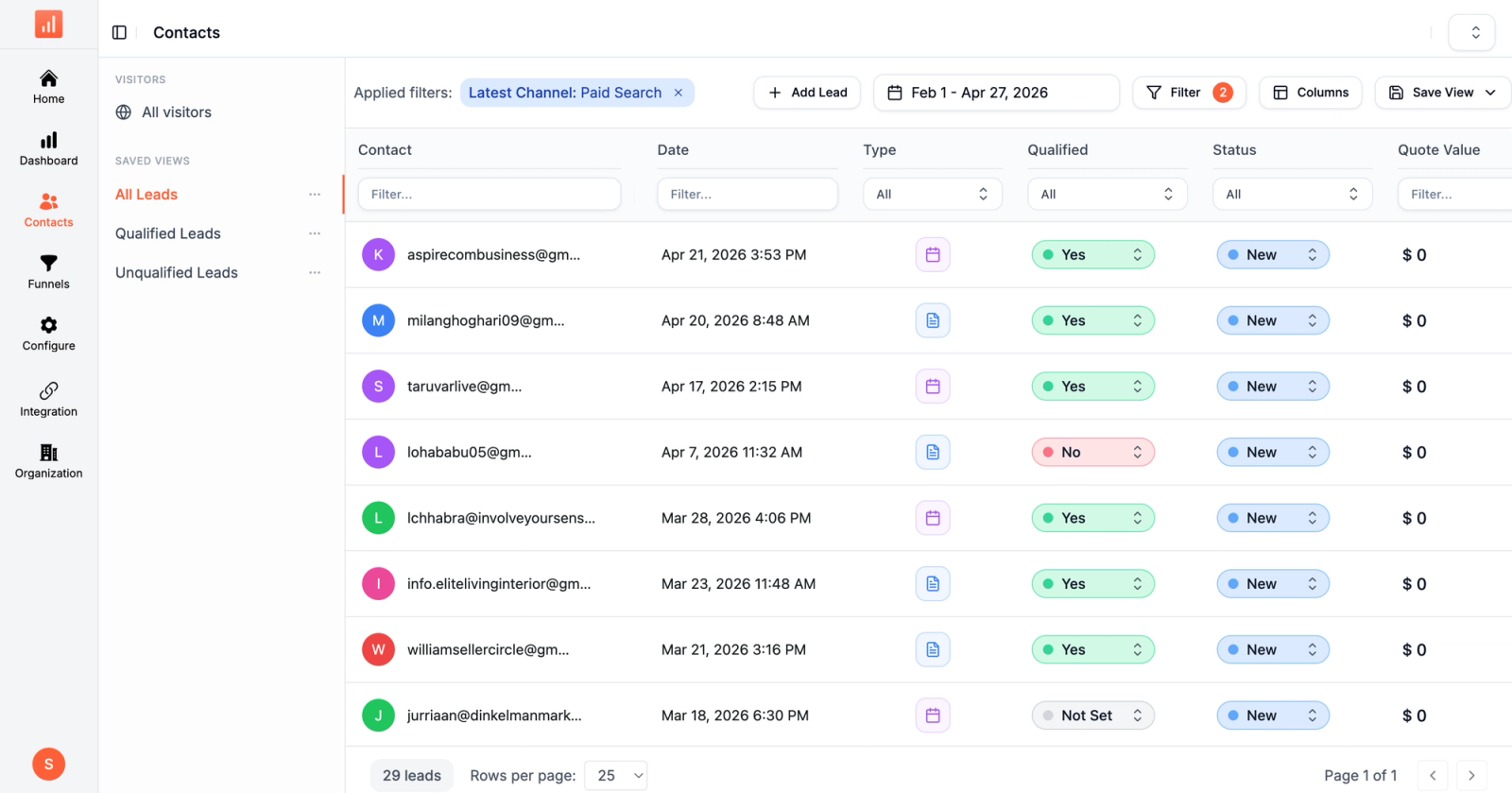
That data feeds clean into any MMM tool (Recast, Meridian, Sellforte) or incrementality platform (Measured, INCRMNTAL) on top.
Why Sourceloop matters as a measurement foundation
1. Server-side Conversions API to every major platform
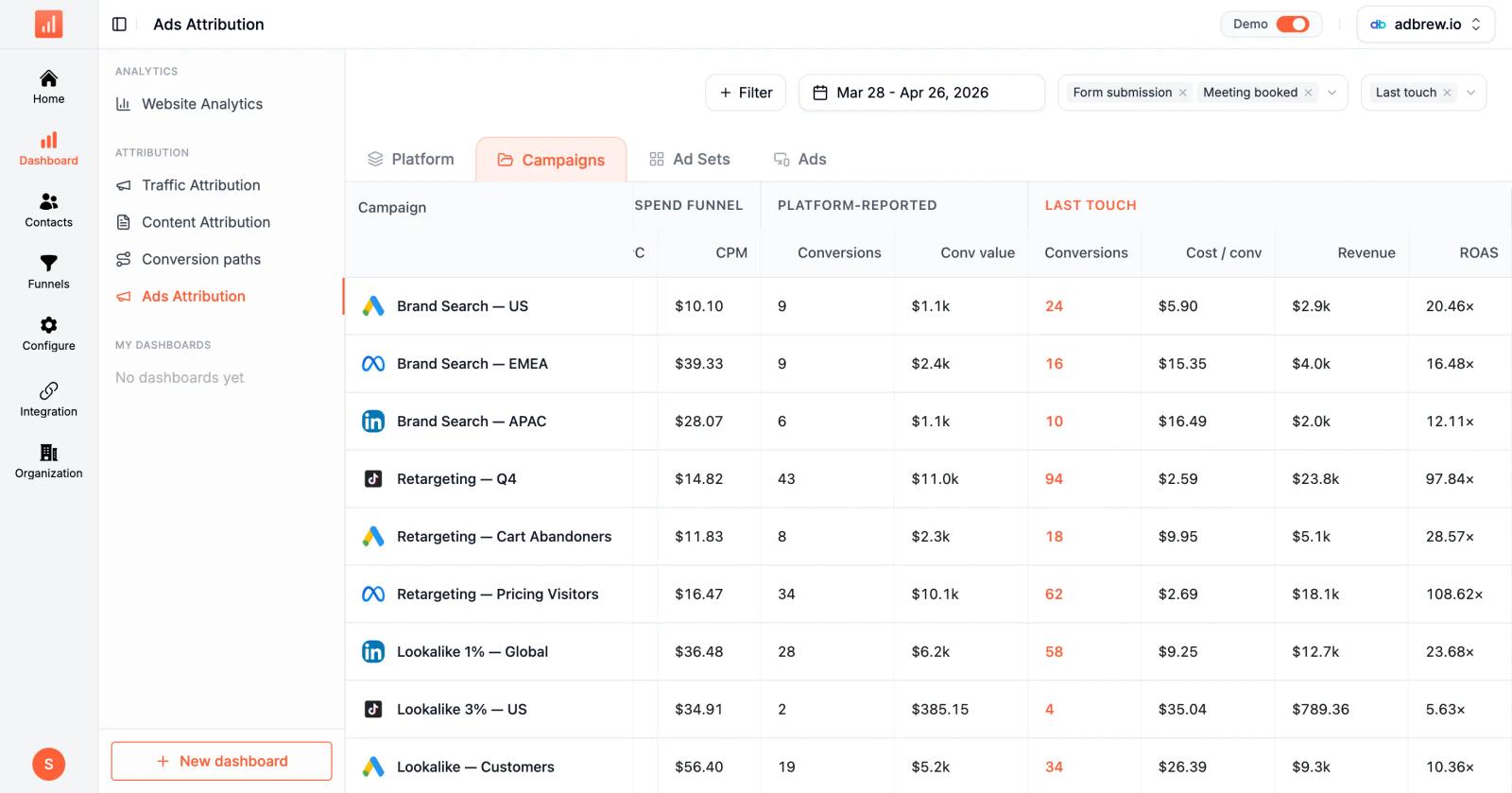
Server-side CAPI to Google, Meta, TikTok, and LinkedIn means the conversion signal that feeds back to ad platforms (and into your own measurement layer) doesn't get lost to iOS opt-outs or ad blockers.
This recovers the 15-30% of conversion data that browser pixels miss, which is the difference between an MMM that converges on a real answer and one that produces noise.
2. Captures all UTMs plus 9 click ID parameters automatically
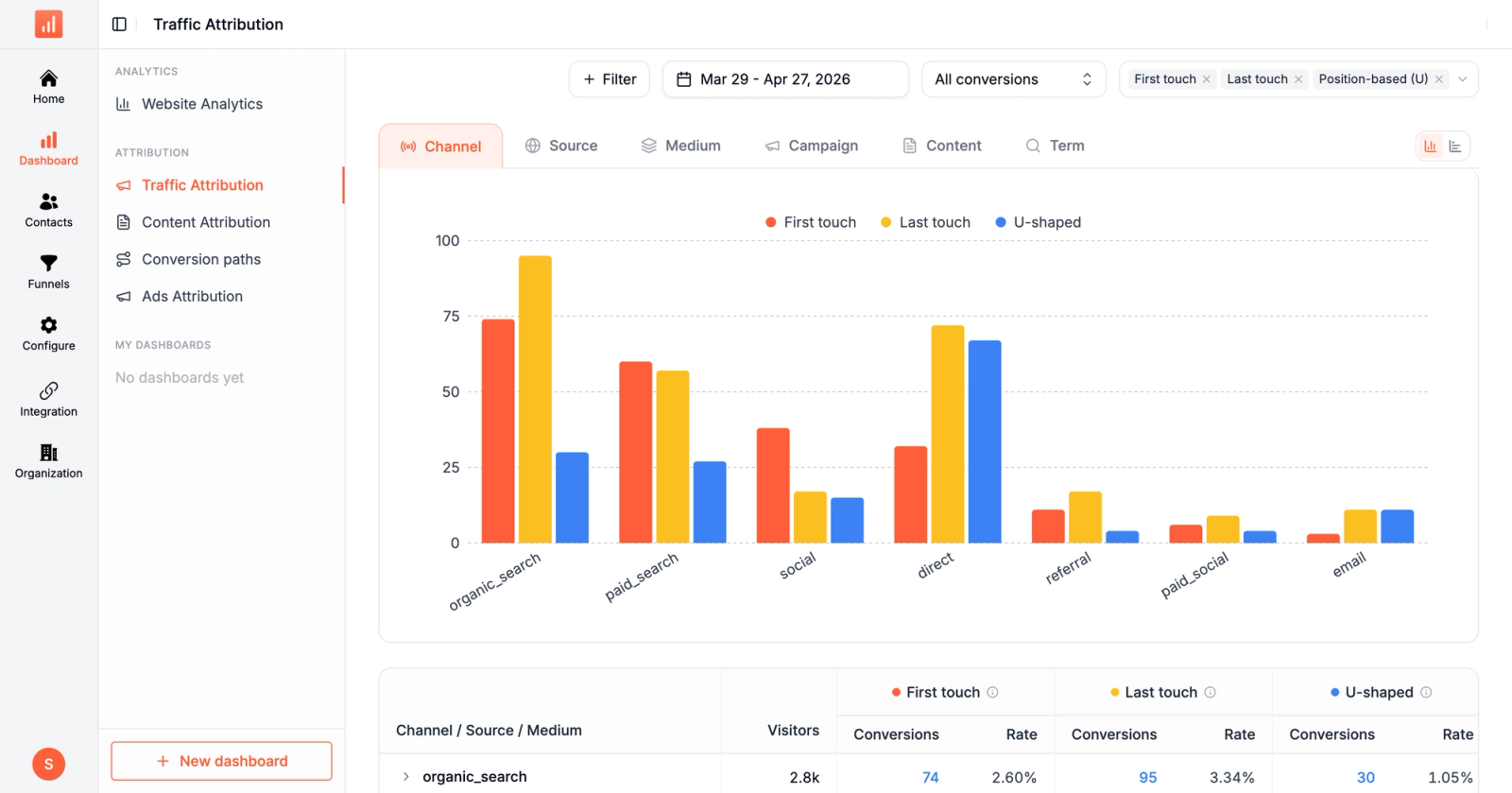
Standard UTMs plus gclid, fbclid, msclkid, ttclid, li_fat_id, gbraid, wbraid, dclid, and twclid. Click IDs matter because Google and Meta auto-tagging often overrides UTMs, and missing them is the most common reason paid traffic shows up as "direct" in measurement inputs.
3. Stripe, Polar, LemonSqueezy webhook stitching for revenue

Every purchase webhook gets matched back to the visitor who originally clicked the ad, even when checkout happens days later on a different device.
This closes the gap between "ad click" and "actual revenue" that most measurement tools never close, because they only see what their pixel sees.
4. 365-day data retention on every plan
MMM typically needs 12-24 months of clean historical data to produce reliable coefficients.
GA4 defaults to 14 months for most properties, and most attribution competitors gate longer retention behind enterprise tiers. Sourceloop gives 365 days flat across all plans, which is the minimum table stakes for serious measurement work.
7. Public API and outgoing webhooks
Push the captured first-party data into BigQuery, Snowflake, or directly into Recast, Meridian, or Robyn. Sourceloop doesn't replace your measurement platform, it feeds it the clean inputs it needs.
Pros:
- Server-side CAPI to Google, Meta, TikTok, LinkedIn included
- Captures all UTMs and 9 click IDs automatically
- Cookieless-resilient for accurate measurement inputs
- Stripe, Polar, LemonSqueezy webhook revenue stitching
- AI Referrals as a dedicated channel for measurement models
- 365-day retention meets MMM minimum requirements
- Public API pushes clean data to MMM and incrementality tools
Cons:
- Not an MMM or incrementality platform on its own
- Newer to market than Northbeam or Measured
Pricing: Starts at $49/mo with all attribution models, server-side CAPI, all native ad integrations, and 365-day retention included. Professional unlocks unlimited websites. Business adds white-label. Enterprise adds the DPA.
2. Northbeam
Best for: DTC brands at $1M+ ARR that want attribution, MMM, and incrementality in one platform

Northbeam ships first-party multi-touch attribution, deterministic view-through measurement, weekly-retraining MMM+, and the Apex integration that feeds Northbeam data back into Meta and other ad platforms. Northbeam tracks over $25 billion in ad spend across 800+ companies, and in their own study, Apex users saw an average 34% improvement in conversion rates.
Northbeam is the most technically sophisticated unified measurement platform for DTC, but it requires a 2-4 week calibration period before reliable data flows. Below $20-50K/month in spend, the platform doesn't pencil out.
Pros:
- Combines attribution, MMM, and incrementality in one platform
- Apex CAPI integration drives measurable lift
- Weekly-retraining MMM+ for offline channels
Cons:
- Steep price floor, not viable below $20-50K/month in spend
- Calibration period of 2-4 weeks before reliable data
- Onboarding has gotten thinner for sub-$1K/month accounts
Pricing: Starter from $1,500/month for brands spending under $250K/month. Professional at $2,500/month. Enterprise custom.
3. Triple Whale Compass
Best for: Shopify DTC brands that want unified MTA, MMM, and incrementality without leaving Triple Whale
Triple Whale Compass is Triple Whale's unified measurement add-on that brings multi-touch attribution, marketing mix modeling, and incrementality testing into a single decision-ready view.
The angle is that the three methodologies inform each other: incrementality tests calibrate MMM, MMM calibrates MTA, and AI agents flag conflicts between them.
Compass is built for scaling, multi-channel ecommerce brands with complex funnels and heavy view-through activity. It's a paid add-on to existing Triple Whale plans, so you're already committing to the broader Triple Whale stack ($179/month minimum).
For Shopify DTC brands already on Triple Whale, this is the natural upgrade. For non-Shopify or brands using a different attribution layer, it's a harder sell.
Pros:
- Only unified system that combines MTA + MMM + incrementality + AI agents
- Marketing data scientist support included with Compass
- Integrated with Triple Pixel attribution data
Cons:
- Requires existing Triple Whale subscription as base
- Shopify-first, less mature for non-Shopify ecommerce
- Pricing not publicly disclosed for Compass add-on
Pricing: Compass is a paid add-on to Triple Whale Starter ($179/month) or higher plans. Pricing on request.
4. Measured
Best for: Mid-market to enterprise brands that want rigorous, automated incrementality testing
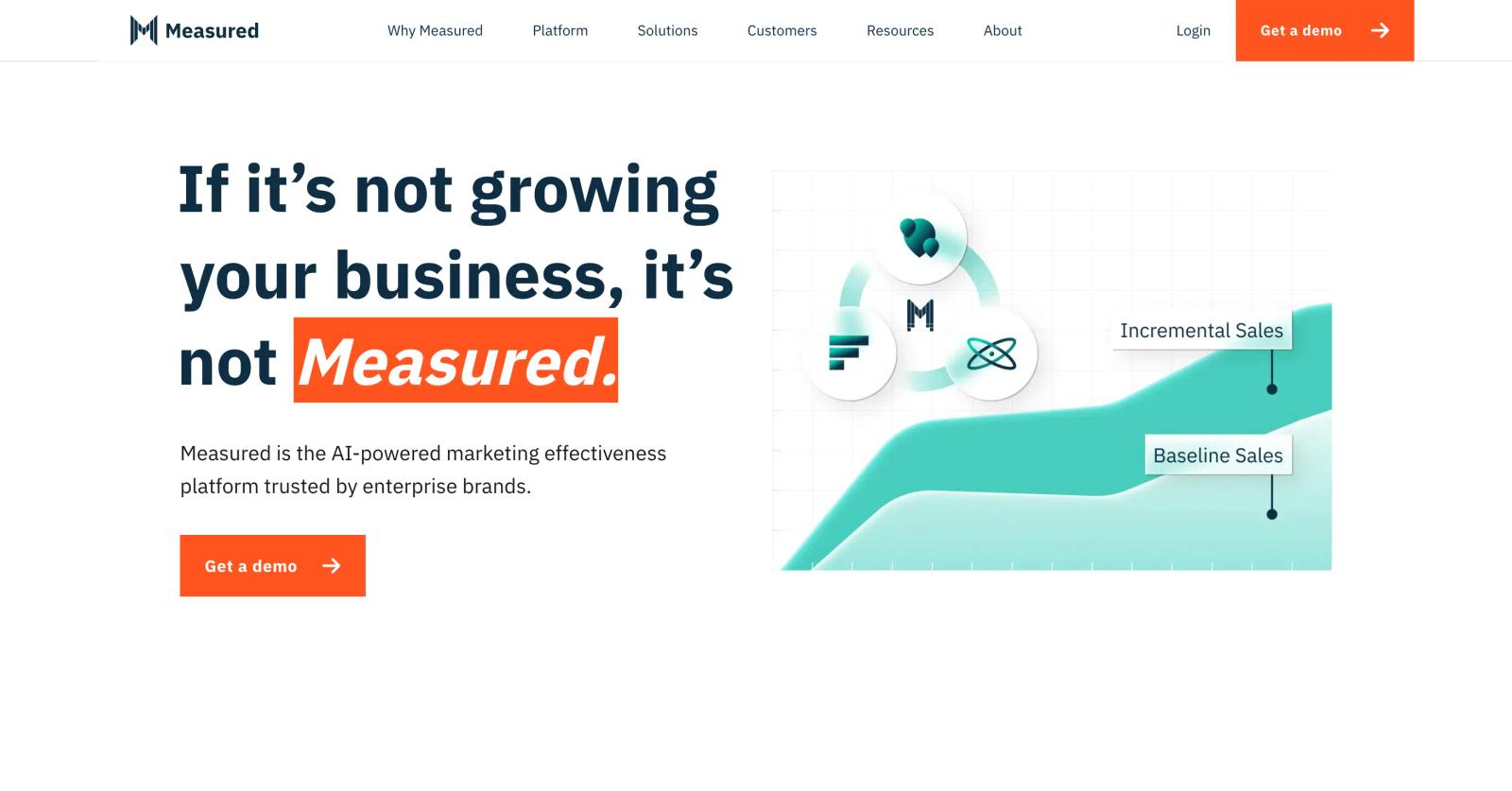
Measured is widely recognized as the industry leader in incrementality-based measurement. The platform automates geo-testing, multi-tactic experiments, and integrates Causal MMM with in-market lift results.
Measured serves hundreds of enterprise brands and is known for scientific rigor, fast onboarding (2-4 weeks), and executive-ready reporting.
The trade-off is enterprise pricing. Measured typically starts around $50,000/year and scales sharply with channel coverage. For brands spending less than $1M/year on paid media, the cost is rarely justified.
Measured shines for brands running TV, OOH, podcast, and digital simultaneously where cross-channel measurement matters more than within-channel optimization.
Pros:
- Industry leader for automated incrementality testing
- Strong cross-channel coverage (digital, TV, podcast, OOH, walled gardens)
- Causal MMM calibrated with in-market lift data
Cons:
- Enterprise pricing, $50K+/year typical
- Not viable for brands spending under $1M/year on paid media
- 2-4 week onboarding before usable insights
Pricing: Custom enterprise pricing. Annual cost typically starts around $50,000/year, scaling with channel coverage and ad spend.
5. Recast
Best for: Growth-stage and mid-market brands that want self-serve MMM without hiring a data science team
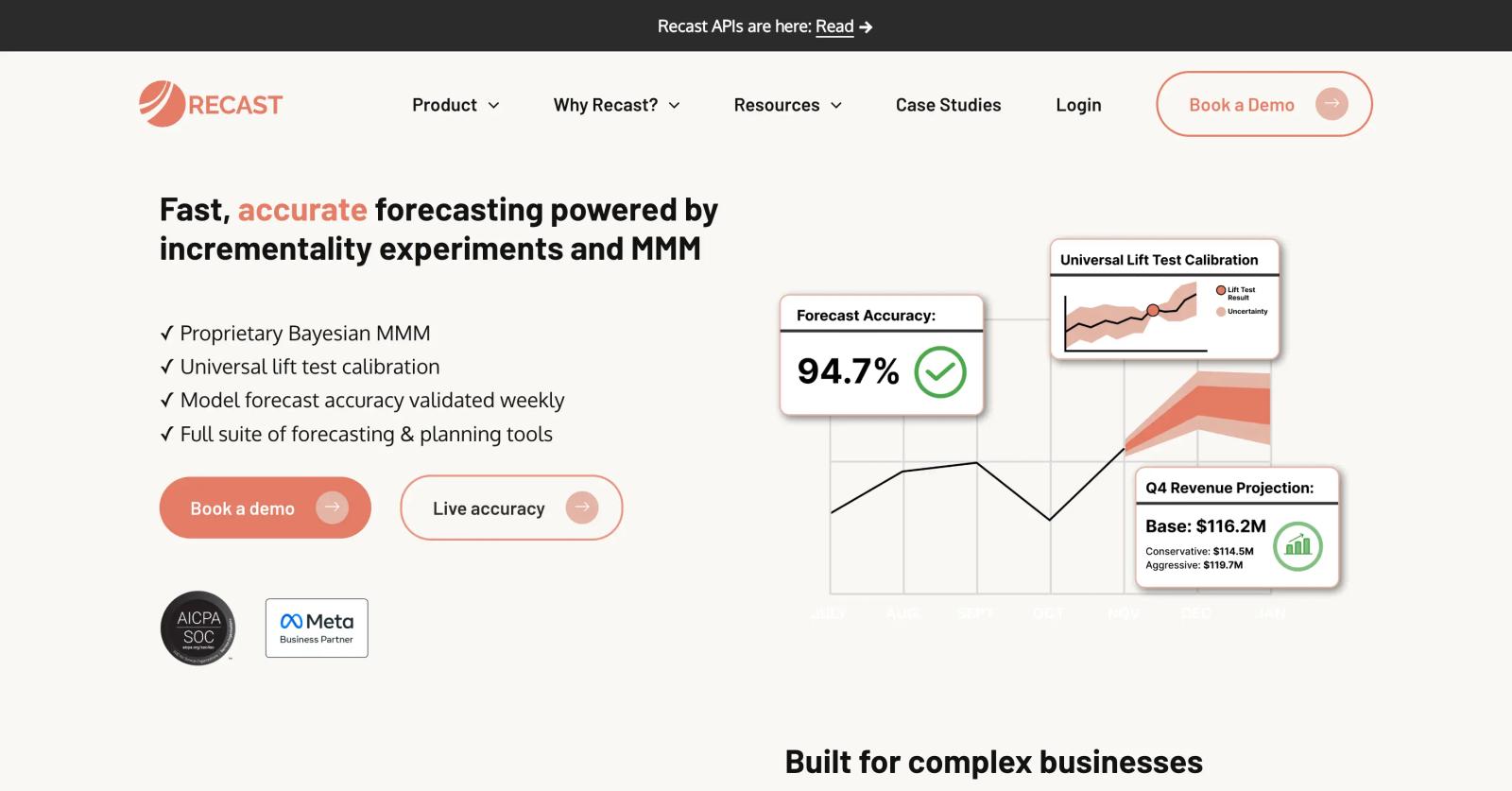
Recast democratizes marketing mix modeling. The platform uses Bayesian methodology to deliver weekly-updating MMM that growth-stage brands can run without a dedicated data scientist.
Where traditional MMM consultancies require months of historical data and produce static quarterly reports, Recast updates models continuously and lets you see results in weeks, not quarters.
Recast is a strong fit for ecommerce and DTC brands in the $5M-$50M revenue range that need MMM but can't afford Analytic Partners or Sellforte. The platform doesn't include incrementality testing as a core feature, so most users pair it with INCRMNTAL or geo-lift tests they run manually.
Pros:
- Self-serve MMM, no data science team required
- Bayesian methodology updates weekly
- Strong fit for $5M-$50M revenue brands
Cons:
- Doesn't include built-in incrementality testing
- Pricing scales with channel and spend volume
- Less suitable for offline-heavy or B2B-heavy brands
Pricing: Custom pricing typically starting around $1,000/month, scaling with revenue and data complexity.
6. INCRMNTAL
Best for: Brands that want always-on incrementality measurement without running discrete experiments
INCRMNTAL takes a different approach to incrementality than Measured. Instead of designing discrete experiments with holdout groups, INCRMNTAL uses causal AI on aggregated data to run continuous incrementality measurement across every channel.
The platform requires no SDK integration, no user-level tracking, and no experiment design.
For privacy-first brands or those operating in heavily regulated industries, INCRMNTAL's aggregated-data approach is the right fit. For teams that want explicit experimental rigor (true holdout groups, geo-lift designs), Measured is the better choice.
Pros:
- Always-on incrementality without discrete experiments
- Privacy-first, no user-level tracking required
- Fastest onboarding among incrementality platforms
Cons:
- Less methodologically rigorous than experiment-based testing
- No public pricing
- Smaller customer base than Measured or Northbeam
Pricing: Custom enterprise pricing. Demo required.
7. Rockerbox
Best for: DTC and ecommerce brands wanting attribution validated by incrementality tests
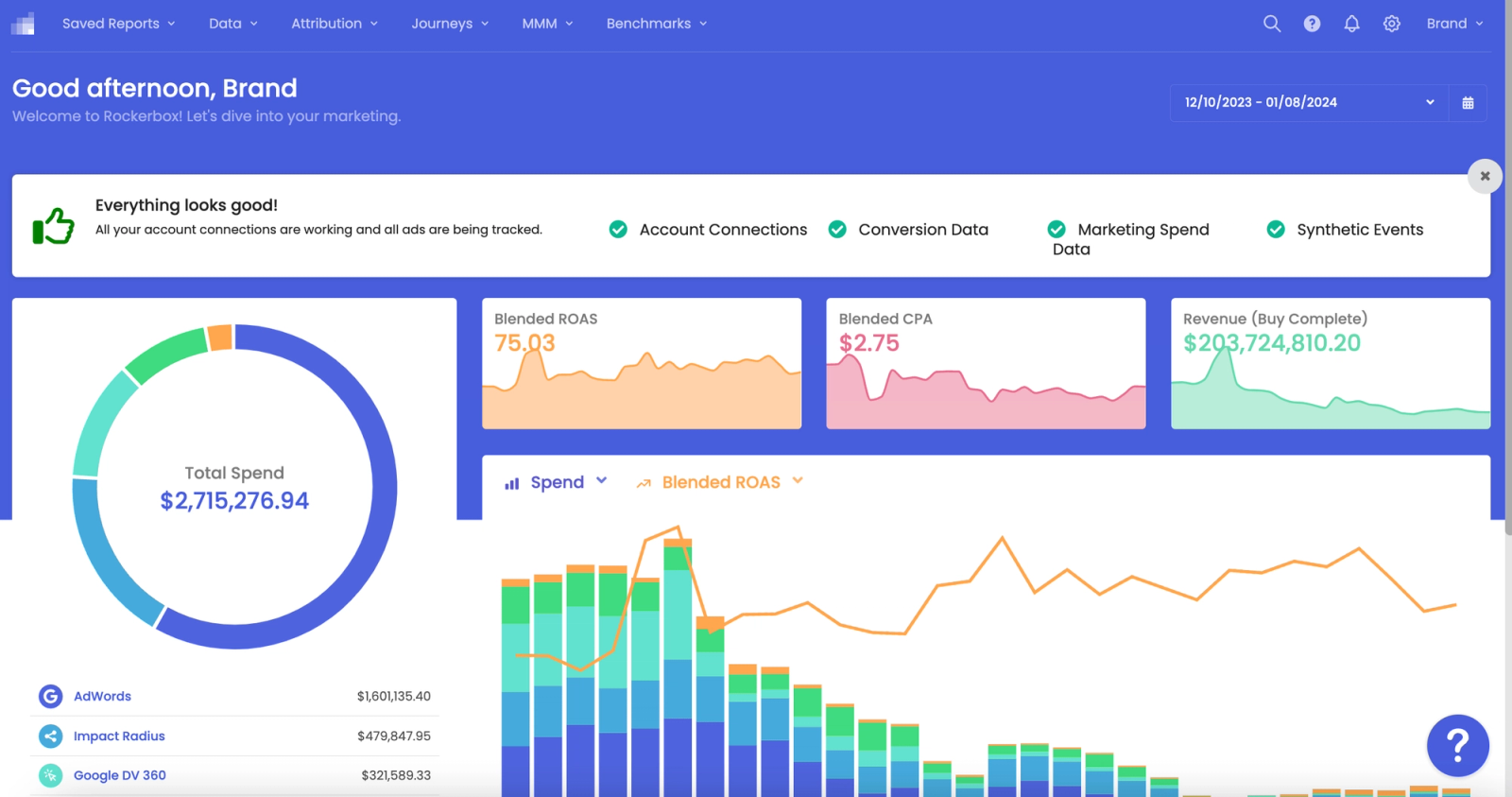
Rockerbox is a unified marketing measurement platform combining multi-touch attribution, marketing mix modeling, and incrementality testing for direct-to-consumer brands.
The platform integrates deeply with Shopify and other ecommerce platforms, pulling revenue data at the transaction level.
What makes Rockerbox interesting is how it validates attribution with incrementality.
You can compare which attribution model best reflects reality by comparing its predictions against actual lift from holdout experiments. For DTC brands tired of MTA models that disagree with what holdout tests prove, this validation loop is the differentiator.
Pros:
- Unified MTA + MMM + incrementality in one platform
- Strong ecommerce and Shopify integration
- Validates attribution models against incrementality data
Cons:
- Pricing not publicly listed
- Less brand recognition than Northbeam or Triple Whale
- Implementation takes 4-6 weeks
Pricing: Custom pricing based on revenue and channel coverage.
8. Sellforte
Best for: Mid-market and enterprise ecommerce brands that want MMM with campaign-level optimization
Sellforte is a next-gen MMM platform built specifically for ecommerce, DTC, and retail. Where most MMM tools provide channel-level recommendations ("spend more on Meta, less on TikTok"), Sellforte provides Marginal Incremental ROAS (miROAS) optimization down to individual campaigns and ad sets.
Sellforte is built for mid-sized and large ecoms that have outgrown channel-level reporting and need granular spend optimization. The platform measures offline media, models all sales channels (ecommerce, retail, Amazon, marketplace), and includes promotional and experiment-based modeling.
Pros:
- Campaign and ad-set level miROAS optimization
- Strong ecommerce-specific MMM features
- Models offline media, retail, Amazon, marketplaces
Cons:
- Enterprise pricing, custom quotes only
- Implementation requires data engineering investment
- Less suited for B2B or service businesses
Pricing: Custom enterprise pricing, no public tiers.
9. Google Meridian / Meta Robyn (Open-Source MMM)
Best for: Teams with data science resources that want MMM without enterprise pricing
Google Meridian and Meta Robyn are open-source Bayesian MMM frameworks released by Google and Meta respectively. Both are free, both are statistically rigorous, and both have rapidly grown in adoption since their releases. Meridian integrates naturally with Google Analytics and Google Ads data. Robyn is more channel-agnostic but requires more setup.
The catch is that open-source MMM still requires a data scientist to operate. You're not getting a managed product.
You're getting a framework. For organizations that have analytics engineers but can't justify $50K+/year for managed MMM, Meridian and Robyn have replaced the case for paying consultancies for entry-level MMM work.
Pros:
- Free and open-source
- Statistically rigorous Bayesian methodology
- Backed by Google and Meta with active development
Cons:
- Requires data science resources to operate
- No managed support, you're on your own for issues
- Setup and maintenance is real work, not a shortcut
Pricing: Free. Implementation cost depends on internal data science capacity.
How to choose
For most teams, marketing measurement is a layered system, not a single tool. Here's how to think about the layers.
Start with the data foundation. MMM and incrementality both need clean first-party data feeding them.
If your conversion data is fragmented across iOS opt-outs, ad blockers, and stripped UTMs, every measurement model on top of it will be noisy. Sourceloop covers this layer at $49/month: server-side CAPI, click ID stitching, webhook revenue, AI Referrals, all on one script. For DTC and SaaS teams, this is the cheapest way to make sure your measurement inputs are accurate before you spend on MMM or incrementality tools.
Then add the measurement layer matched to your stage. Below $1M ARR, free MMM (Meridian, Robyn) plus manual geo-lift tests is genuinely viable if you have a data scientist. Between $1M-$50M ARR, Recast for self-serve MMM and INCRMNTAL or Measured for incrementality cover the bases.
Above $50M ARR, Northbeam, Triple Whale Compass, Rockerbox, or Sellforte (for ecommerce) bring unified MTA + MMM + incrementality into one platform. Above $1B revenue, Analytic Partners or Nielsen-style consultancies are the enterprise choice.
Frequently asked questions
-
What is marketing measurement software?
Marketing measurement software quantifies the causal impact of marketing activity on business outcomes (revenue, leads, signups). The category covers three distinct methodologies: multi-touch attribution (MTA), marketing mix modeling (MMM), and incrementality testing. Modern measurement increasingly combines all three because each has blind spots the others fill.
-
What's the difference between MMM, attribution, and incrementality?
Attribution (MTA) tracks individual user journeys and assigns credit across touchpoints using rules like last-click or position-based. MMM uses statistical regression on aggregated, historical data to estimate channel-level impact, including offline media. Incrementality testing uses controlled experiments (holdouts, geo-lift) to measure the causal lift a campaign produced versus what would have happened anyway. Each answers a different question.
-
Why is MMM coming back?
Third-party cookies, iOS 14, and ad blockers have broken user-level attribution. MMM doesn't need user-level data, only aggregated spend and outcome data, which makes it durable in a privacy-first world. According to a 2025 EMARKETER and TransUnion survey, 46.9% of US marketers plan to invest more in MMM in 2026, and 27.6% rate it the most reliable measurement methodology.
-
How is incrementality different from A/B testing?
A/B testing compares two variations within a single channel (e.g., two ad creatives). Incrementality testing measures the causal lift of an entire marketing activity by comparing exposed audiences to a holdout that didn't see the campaign. A/B tests optimize within a channel. Incrementality tests prove whether the channel itself is producing real lift or just claiming credit for organic conversions.
-
How much should I budget for marketing measurement?
Below $1M ARR, the open-source path (Google Meridian, Meta Robyn) plus a $49/month first-party data tool is genuinely viable if you have analytics resources. Between $1M-$50M ARR, $1,000-$5,000/month gets you Recast, INCRMNTAL, or Northbeam Starter. Above $50M ARR, $50K+/year for Measured, Analytic Partners, or Northbeam Enterprise is justified by the budget at stake. Above $500M revenue, expect six figures annually for enterprise consultancies.
-
Can I run MMM without hiring a data scientist?
Yes, but the tool you pick matters. Recast and Sellforte are self-serve platforms designed for marketing teams without dedicated data science. Google Meridian and Meta Robyn are open-source but require analytics engineering capacity. Analytic Partners and Nielsen are managed services that include data science as part of the engagement. For most growth-stage teams, Recast is the right entry point.
-
How long does it take to get usable measurement data?
For attribution and first-party data tools (Sourceloop, Northbeam attribution), data is usable within days. For incrementality (Measured, INCRMNTAL), expect 2-4 weeks for the first reliable test results. For MMM, plan for 2-4 weeks of model setup plus 12-24 months of historical data, ideally calibrated against incrementality tests. Open-source MMM (Meridian, Robyn) can take longer if your data engineering isn't already in place.
-
What measurement approach is best for cookieless future?
MMM and incrementality are both fully durable in a cookieless world because neither relies on user-level tracking. Attribution (MTA) needs first-party data infrastructure (server-side tracking, click ID capture, webhook stitching) to remain viable. The most resilient measurement stack combines clean first-party data (Sourceloop, Segment) at the input layer, MMM for budget allocation, and incrementality for causal validation.




 Paid Social


